Dying athlete or wounded Roman soldier
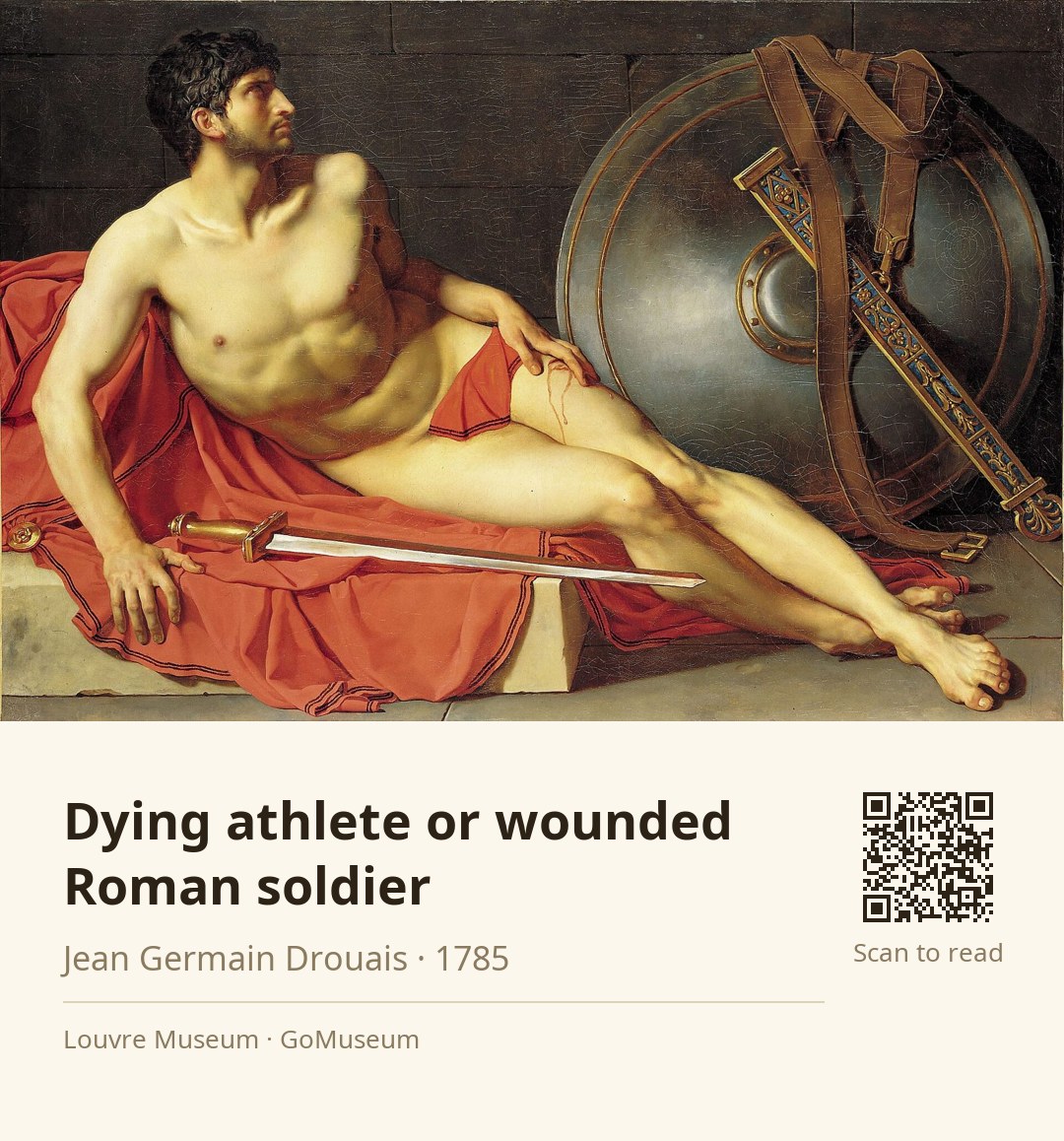
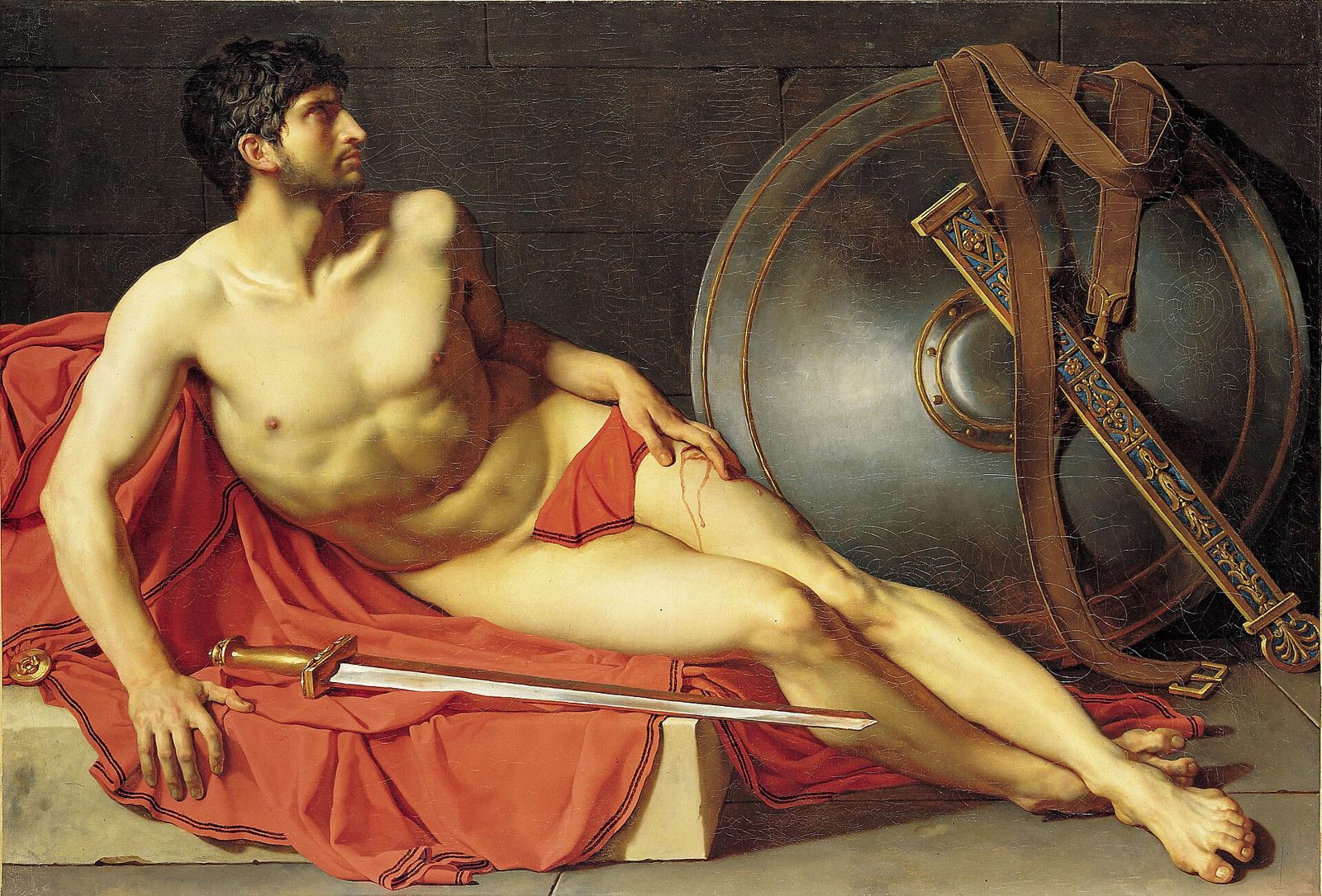
🎧 This work has audio narration — listen in the appThe muscular figure of a wounded Roman soldier lies reclined on a stone surface, draped in a striking red cloth that emphasizes his powerful physique. His gaze is directed upward, while his right arm clutches a sword with a golden hilt, hinting at a heroic past now marred by injury. The large shield and intricately decorated scabbard in the background further evoke the grandeur of ancient warfare, grounding the scene in a rich historical context.
This portrayal of a nude male figure reflects the Neoclassical style that Drouais embraced, merging elements of history painting with the beauty of the human form. The warm palette of skin tones, deep reds, and metallic grays not only highlights the figure's anatomy but also enhances the emotional weight of his plight. Created during Drouais's time in Rome, this work captures the tension between strength and vulnerability, a theme prevalent in the art of the late 18th century.
Jean Germain Drouais, a promising artist who died young at just 24, painted this piece in 1785, shortly after winning the prestigious Prix de Rome. His time in Italy profoundly influenced his artistic development, allowing him to draw inspiration from the remnants of ancient art and the works of masters like Raphael.
Jean Germain Drouais was a French historical painter born in Paris on November 25, 1763, into a family of artists. His father and grandfather were established portrait painters, providing him with early artistic guidance. Drouais studied under Nicolas Guy Brenet before joining Jacques-Louis David's studio, where he embraced the classical style and dedicated himself to his craft with fervor.
In 1784, Drouais won the prestigious Prix de Rome with his painting "The Woman of Canaan at the Feet of Christ," which earned him a scholarship to study in Rome. His time there deepened his appreciation for ancient art and the works of Raphael, influencing his own creations. His notable works, including "Marius at Minturnae," garnered acclaim for their compositional strength and emotional depth, even impressing Goethe.
Tragically, Drouais's promising career was cut short when he died of smallpox at the age of 25 in Rome. His legacy was honored by fellow students who erected a monument in his memory at Santa Maria in Via Lata. Drouais is remembered as a significant figure in the neoclassical movement, whose potential was tragically unfulfilled but whose works continue to resonate in art history.
In 1785, Jean Germain Drouais completed this striking oil painting, initially titled 'The Dying Athlete' before it became known as 'The Wounded Roman Soldier.' Commissioned during his time in Rome after winning the prestigious Prix de Rome, this piece was sent back to the French Royal Academy in Paris, where it garnered attention for its bold representation of the human form. Drouais, who tragically passed away at just 24, had his work displayed in the Louvre, ensuring its place in art history.
Drouais employed a masterful technique in this painting, using oil on canvas to create a vivid portrayal of the human body. The brushwork is both precise and expressive, allowing for a detailed rendering of the soldier's musculature and the textures of the drapery. The warm palette, dominated by skin tones and deep reds, enhances the emotional resonance of the scene, drawing the viewer into the soldier's plight. The composition is dynamic, with the figure's slight turn and upward gaze creating a sense of movement and tension. The careful placement of the sword and shield in the background not only adds depth but also reinforces the narrative of heroism and vulnerability, making the viewer ponder the story behind this wounded warrior.
The famous writer Goethe praised Drouais's work, particularly noting the strong impression made by his painting 'Marius at Minturnae'.
Drouais was an early student of Jacques-Louis David, who recognized his talent and helped shape his artistic development.