 Image: G.Garitan
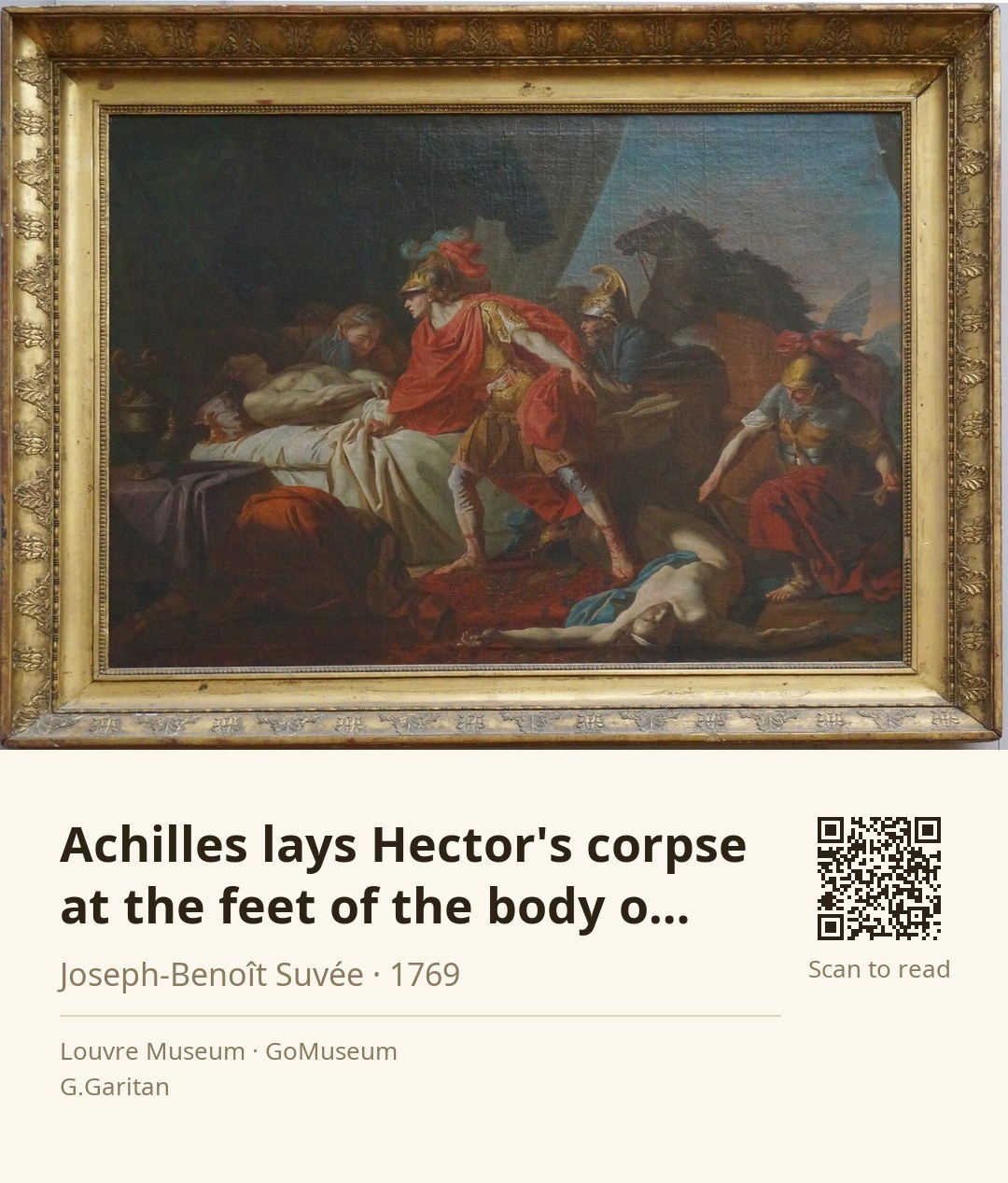
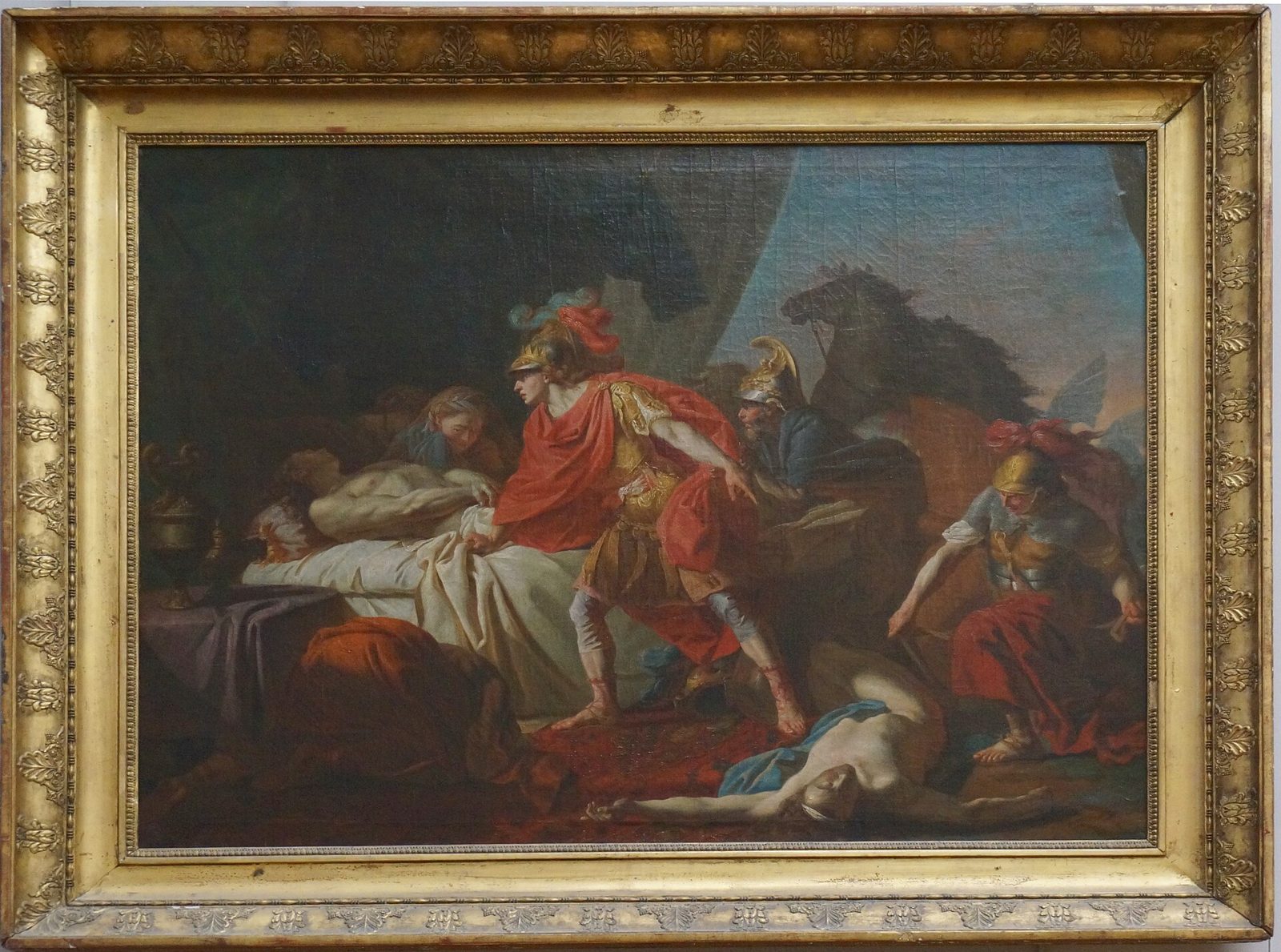
Achilles lays Hector's corpse at the feet of the body of Patroclus
🎧 This work has audio narration — listen in the appLook closely at this dramatic scene by Joseph-Benoît Suvée. Can you feel the tension in the air? Notice the way the light catches the textures of their armor and the somber expressions on their faces.
These details matter because they capture a moment of profound grief and rage, embodying the themes of honor and loss that resonate throughout the "Iliad." Suvée's choice to depict this poignant act speaks to the deep emotional currents of friendship and vengeance that define Achilles' character.
Created in 1769, this painting reflects the neoclassical style that Suvée mastered, influenced by his time in France and Italy. He was a contemporary of Jacques-Louis David, and you can see the dramatic flair that characterizes both artists.
As you stand here, think about the weight of this moment. What does it mean to you to witness such raw emotion? How does it change your understanding of heroism and sacrifice?
Joseph-Benoît Suvée was a Flemish painter born on January 3, 1743, in Bruges, whose career was deeply intertwined with the French neoclassical movement. After studying under Matthias de Visch, he moved to Paris at 19 to apprentice with Jean-Jacques Bachelier. His talent earned him the Prix de Rome in 1771, leading to a six-year stay in Rome, where he extended the typical duration for pensioners of the French Academy. Upon returning to Paris, he became an academician and opened an art school for young women, nurturing talents like Constance Mayer.
Suvée's rivalry with Jacques-Louis David marked his career, fueling a lasting animosity. In 1792, he was appointed director of the French Academy in Rome, but his tenure was delayed due to imprisonment. He eventually took up the post in 1801, where he continued to influence the art scene until his sudden death on February 9, 1807. His notable works include "Achilles depositing the body of Hector" and "Cornelia, mother of the Gracchi," both housed in the Louvre. Suvée's legacy is preserved through his students, who contributed to the evolution of art in the late 18th and early 19th centuries.
In 1769, Joseph-Benoît Suvée created 'Achilles lays Hector's corpse at the feet of the body of Patroclus,' a striking piece that reflects his deep engagement with neo-classical themes. Suvée, a Flemish painter who had moved to France, was influenced by the artistic currents of his time, and this work showcases his talent and ambition. The painting was commissioned during a period when Suvée was establishing himself in the Parisian art scene, competing with contemporaries like Jacques-Louis David. It was exhibited at the Louvre, where it remains today, and has been part of a rich provenance, reflecting the artist's journey from Bruges to Rome and back to Paris.
As you look closely at Suvée's technique, you'll notice the masterful brushwork that brings a sense of movement and emotion to the scene. The way he layers paint creates a rich texture, especially in the armor of Achilles and Hector. The light in the painting is carefully manipulated; it highlights the contours of their faces and the intricate details of their clothing, drawing your eye to the emotional expressions that convey grief and rage. The composition is structured with a triangular arrangement, guiding your gaze from Achilles to Hector and then to Patroclus, creating a dynamic interplay between the figures. The scale of the painting enhances its dramatic impact, making the viewer feel the weight of the moment. Suvée's choice of a muted color palette, punctuated by the deep reds and earthy tones, evokes a somber atmosphere that resonates with the themes of loss and honor.
Suvée's work is significant not just for its technical prowess but also for how it reflects the broader neoclassical movement, which sought to revive the ideals of ancient Greece and Rome. His portrayal of intense emotional moments influenced later artists who explored similar themes of heroism and tragedy. The dramatic representation of Achilles and Hector's story has echoed through art history, inspiring countless interpretations of classical narratives. This painting stands as a testament to the enduring power of storytelling in art, shaping how future generations would approach themes of honor, sacrifice, and the human condition.
One surprising tidbit about Suvée is that he opened an art school for young women at the Louvre, a progressive move for his time. One of his notable students was Constance Mayer, who would go on to have her own successful career, furthering Suvée's legacy as a mentor.
Suvée opened an art school for young women at the Louvre, which was quite progressive for his time, allowing women to pursue artistic education in a male-dominated field.
Suvée had a long-standing rivalry with David, which not only fueled his ambition but also led to a persistent animosity that marked both their careers in the neoclassical art scene.
Suvée was imprisoned for a time in the Prison Saint-Lazare, which delayed his ability to take up the post of director at the Academy until 1801.