Seaport by Moonlight
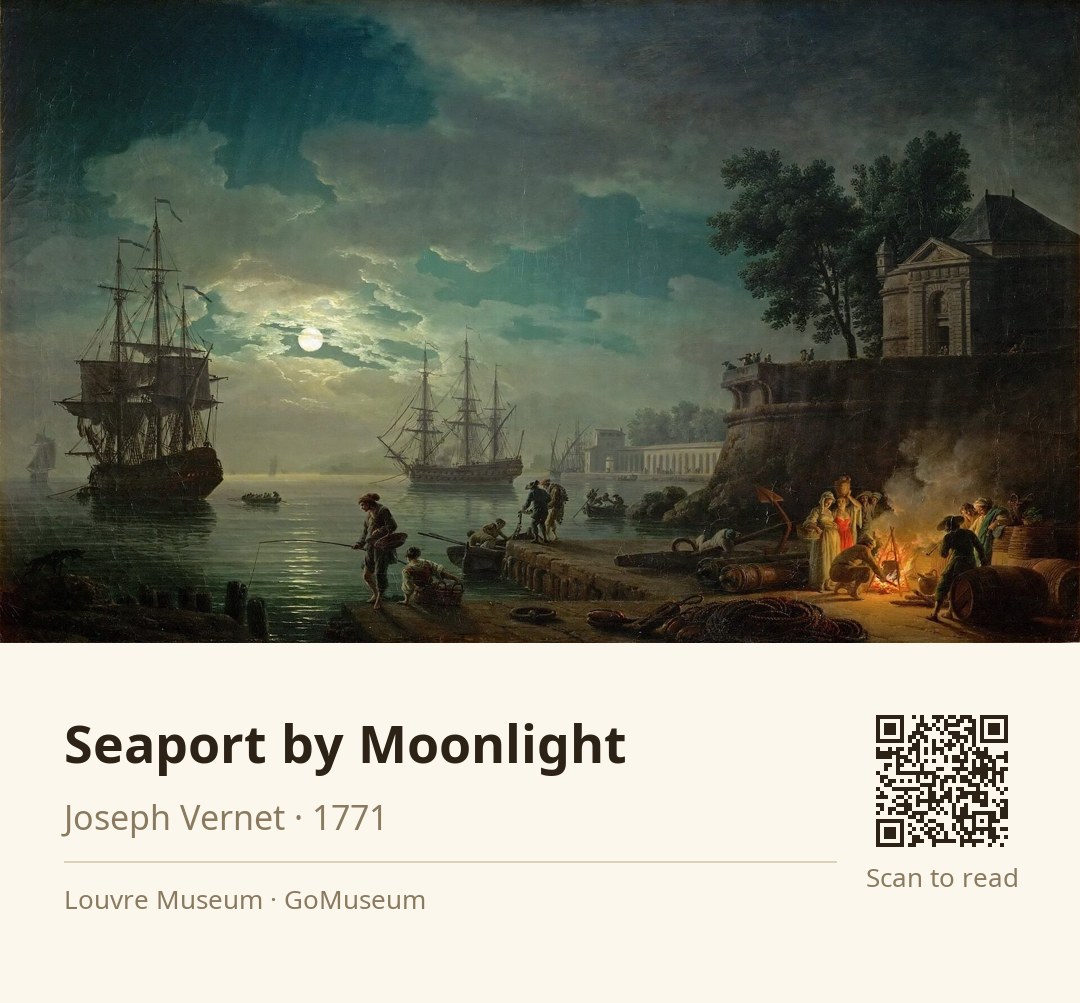
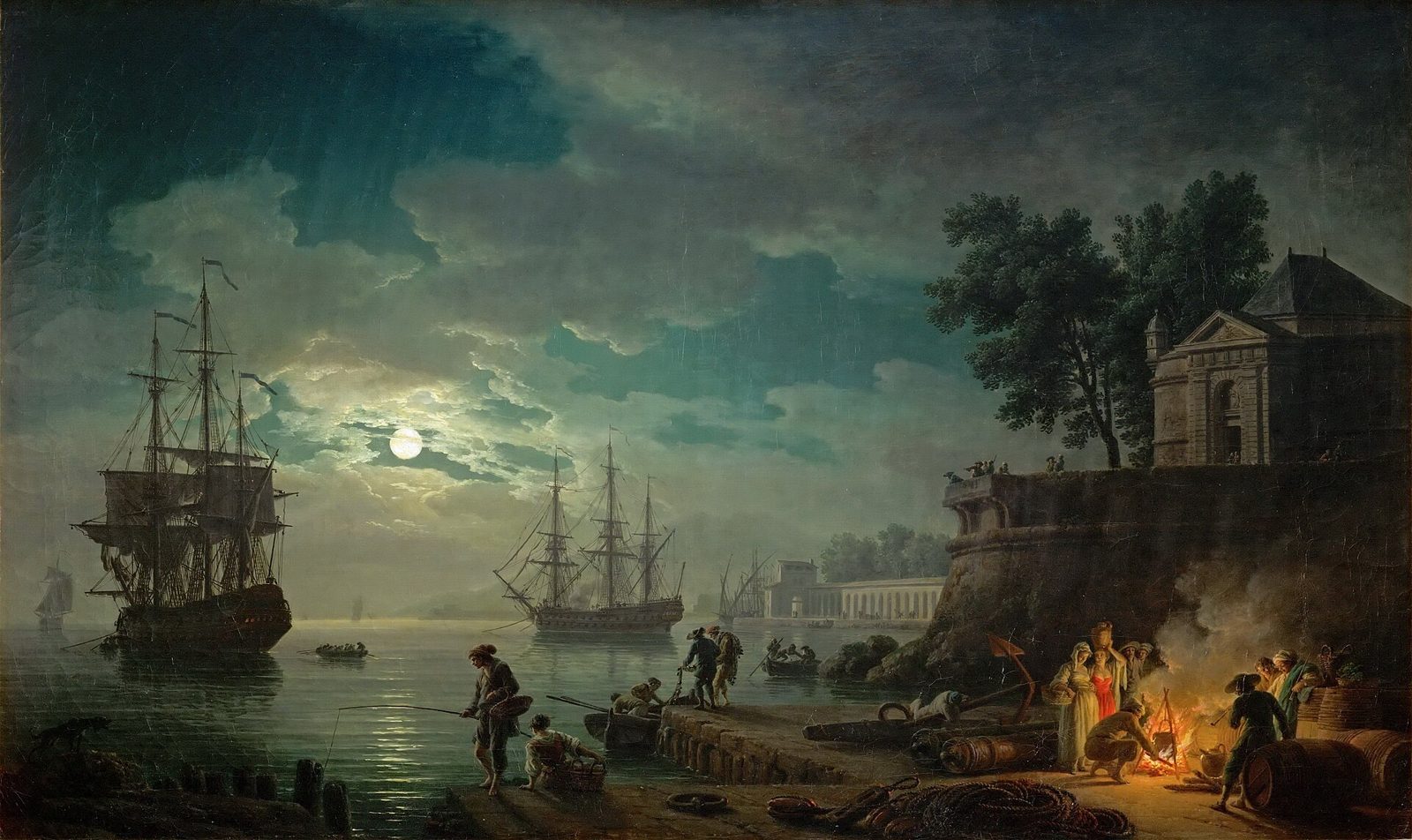
🎧 This work has audio narration — listen in the appThe full moon casts a silvery glow over the bustling harbor in Joseph Vernet's "Seaport by Moonlight." In the foreground, figures huddle around a flickering fire, their faces illuminated, while a man casts his line into the water from a dock, embodying the serene yet lively atmosphere of the scene. Nearby, coiled ropes and barrels hint at the daily activities of port life, grounding the painting in a specific moment of maritime culture.
Vernet captures the essence of night at the seaport, where the interplay of light and shadow creates a tranquil yet dynamic environment. The majestic sailing ships anchored in the middle distance, their silhouettes stark against the moonlit sky, evoke a sense of grandeur and adventure. A grand building, partially obscured by trees, adds depth to the composition, suggesting a narrative of commerce and community that thrives under the moonlight. The palette of deep blues and warm tones from the fire enhances the emotional resonance of the scene, inviting viewers to feel the calmness of the night.
Commissioned by Madame du Barry, the mistress of Louis XV, this painting is part of a series representing different times of day, with this piece specifically depicting the night. Displayed at the Salon of 1773, it reflects Vernet's mastery of atmospheric effects and his ability to weave human activity into the natural landscape.
Claude-Joseph Vernet was a prominent French painter born in Avignon on August 14, 1714. He began his artistic journey at a young age, assisting his father, a decorative painter, before moving to Rome at fourteen to study under notable artists. His time in Italy profoundly influenced his style, particularly in seascape painting, where he skillfully integrated human figures into natural settings. Vernet became renowned for his atmospheric depictions of seaports and marine life, capturing the essence of France's maritime culture.
His career flourished as he gained recognition among English aristocrats during their Grand Tours. In 1753, he returned to Paris, where he received royal commissions, notably a series of paintings of French ports that solidified his legacy. Vernet's works are characterized by their harmonious compositions and attention to light, reminiscent of Claude Lorrain. He continued to exhibit until his death on December 3, 1789, leaving behind a significant impact on marine painting. His influence extended to his family, with both his son and grandson becoming accomplished artists. Today, Vernet is celebrated as one of the foremost marine painters of his time, with his works housed in prestigious collections across Europe.
Commissioned in 1771 by Madame du Barry, the mistress of Louis XV, 'Seaport by Moonlight' is one of a series of four paintings depicting different times of day. This particular piece was displayed at the Salon of 1773 in Paris, where it garnered attention for its atmospheric qualities and vibrant depiction of maritime life. The painting was originally intended for the Château de Madame du Barry, reflecting the opulence and cultural ambitions of the French court. After the French Revolution, it was confiscated by the state and eventually found its way into the collection of the Louvre, where it remains today. The painting's provenance traces back to its royal commission, showcasing how art was intertwined with the power dynamics of the time.
Vernet's technique in 'Seaport by Moonlight' showcases his mastery of oil painting, particularly in how he handles light and color. The deep blues of the night sky contrast beautifully with the warm, flickering glow of the fire, creating a captivating atmosphere. His brushwork is both delicate and deliberate, allowing for a soft blending of colors that evokes the serene yet lively essence of the harbor. The composition is dynamic, with figures engaging in various activities that draw the viewer's eye across the canvas. The scale of the painting, measuring nearly 98 by 164 centimeters, allows for an immersive experience, inviting you into the scene. Vernet's ability to weave human figures seamlessly into the landscape speaks to his understanding of how people interact with their environment, making the painting not just a depiction of a place, but a narrative of life at sea.
Interestingly, Vernet's popularity extended beyond France; he became a favorite among English aristocrats during their Grand Tours of Europe. His works were sought after not just for their artistic merit, but also for their ability to evoke the beauty and drama of the sea, making them prized possessions in noble collections. This international appeal helped cement his status as one of the leading marine painters of the 18th century.
The painting's popularity led to it being widely reproduced in engravings, which helped to further disseminate Vernet's work and style.