Madame Molé-Reymond with Muff
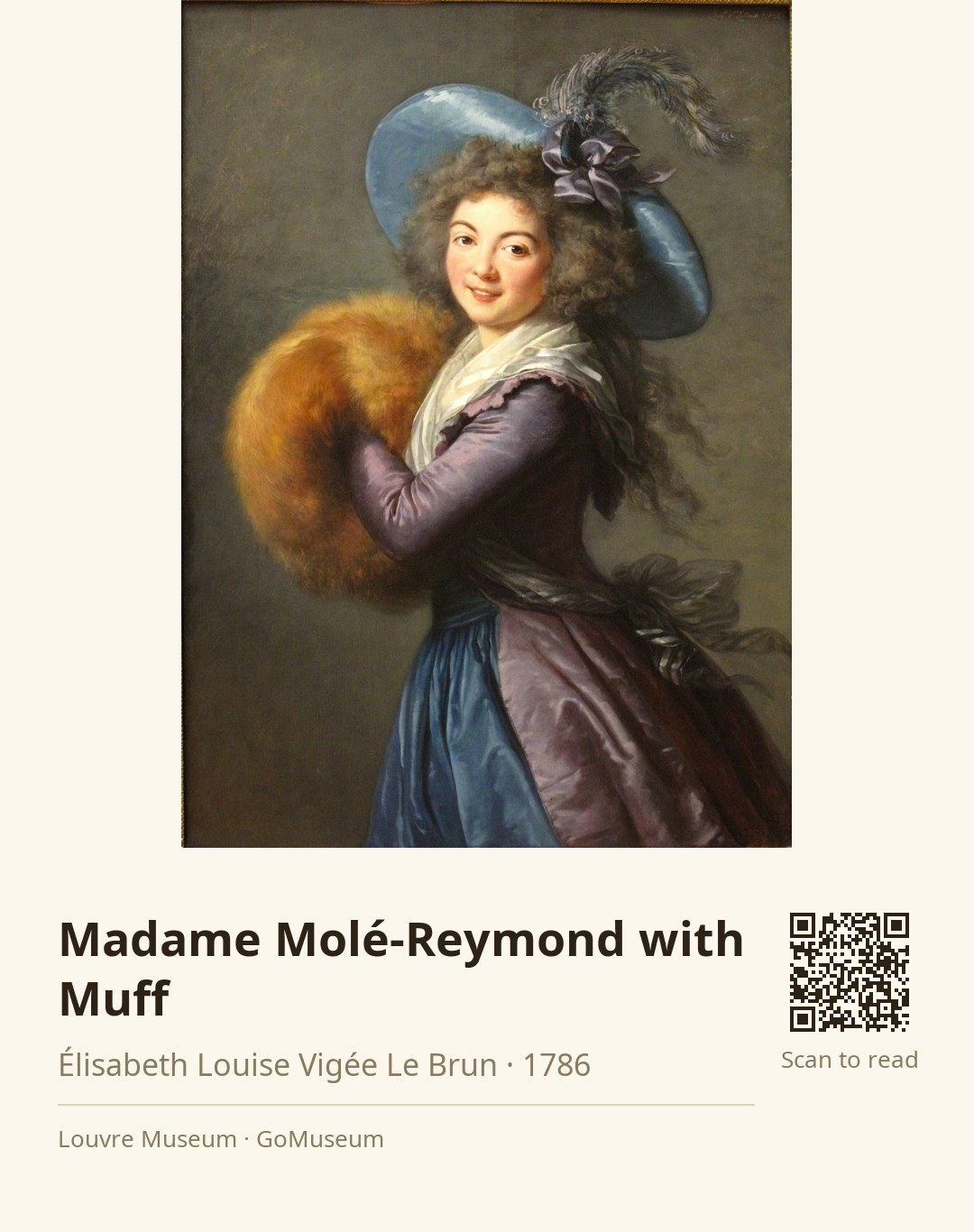
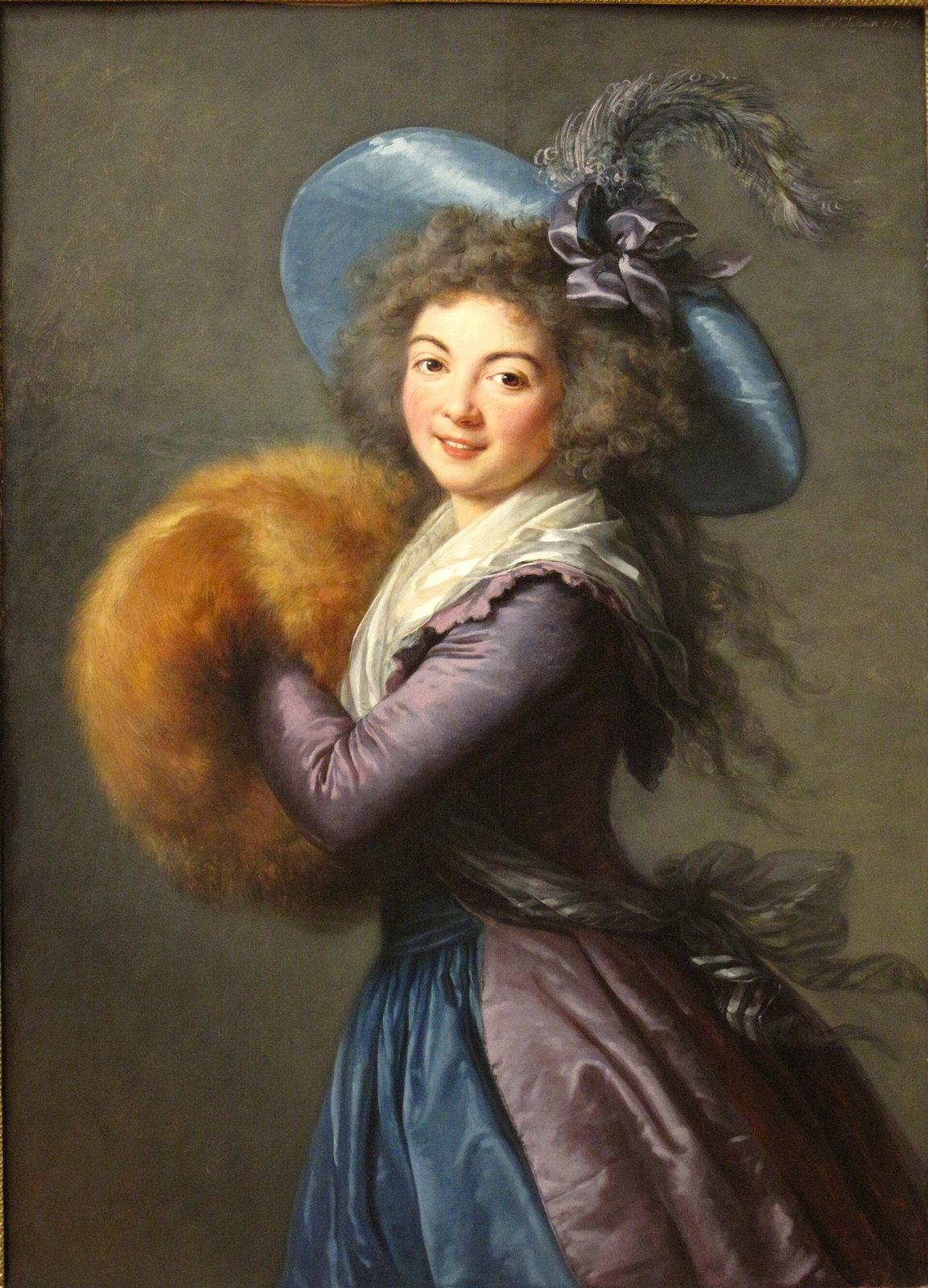
🎧 This work has audio narration — listen in the appThe young woman in this portrait, Madame Molé-Reymond, captures your attention with her direct gaze and gentle smile, inviting you into her world. Dressed in a stunning purple gown with a blue skirt, she holds a fluffy fur muff, which contrasts beautifully against the muted gray background. The large light blue hat, adorned with a purple ribbon and feathers, adds a touch of elegance and whimsy to her appearance.
Vigée Le Brun’s choice of colors and textures not only highlights the subject's grace but also reflects the fashion of the late 18th century, showcasing the artist's skill in portraying fabric and fur with remarkable precision. The smooth brushwork brings the details of her attire to life, emphasizing the luxuriousness of her clothing and the softness of the muff. This portrait is not merely a representation of a fashionable woman; it encapsulates the spirit of an era where portraiture served as a means of social expression and personal identity.
Created in 1786, this work was exhibited at the Salon des artistes français in Paris the following year. It remains a testament to Vigée Le Brun's mastery in capturing the essence of her subjects, solidifying her reputation as one of the leading portraitists of her time.
Élisabeth Louise Vigée Le Brun, born on April 16, 1755, in Paris, emerged as one of the foremost portrait painters of her time. The daughter of a portraitist, she displayed artistic talent from a young age, receiving encouragement from her father and later studying under prominent artists. Her career flourished as she became the official portraitist for Marie Antoinette, gaining recognition among European aristocrats and artists alike.
Vigée Le Brun's style, a blend of Rococo and Neoclassicism, was marked by a sensitivity to color and composition, often draping her subjects in elegant fabrics. Over her lifetime, she produced around 660 portraits and 200 landscapes, with her works housed in major museums worldwide. Despite the upheavals of the French Revolution, her royalist sentiments and artistic prowess allowed her to navigate the shifting tides of art and society.
Her memoirs, published in her later years, provide insight into her life and the challenges she faced as a female artist in a male-dominated field. Celebrated by contemporaries like Joshua Reynolds, she remains a pivotal figure in art history, symbolizing the transition from the ornate Rococo to the more restrained Neoclassical style. Vigée Le Brun passed away on March 30, 1842, leaving behind a legacy that continues to inspire.
In 1786, Élisabeth Louise Vigée Le Brun completed 'Madame Molé-Reymond with Muff,' a striking portrait of the actress Élisabeth-Félicité Molé-Reymond. This work was commissioned during a time when Vigée Le Brun was gaining prominence as one of the leading portraitists in France, having already established a reputation through her connections with the royal court, particularly with Marie Antoinette. The painting was exhibited at the Salon des artistes français in Paris in 1787, where it likely received considerable attention. After the artist's death, the painting became part of the collection of Mlle Maurice Reymond, the daughter of the sitter, and has been housed in the Louvre since 1865.
A curious tidbit about 'Madame Molé-Reymond with Muff' is its appearance in the world of popular culture. The painting is featured in the comic book 'The Adventures of Tintin: The Treasure of Rackham the Red,' where Captain Haddock moves it aside to access hidden treasure.
The painting is featured in the comic book 'The Adventures of Tintin: The Treasure of Rackham the Red,' where Captain Haddock moves it aside to access hidden treasure.