Venus Asks Vulcan to Cast Arms for her Son Aeneas
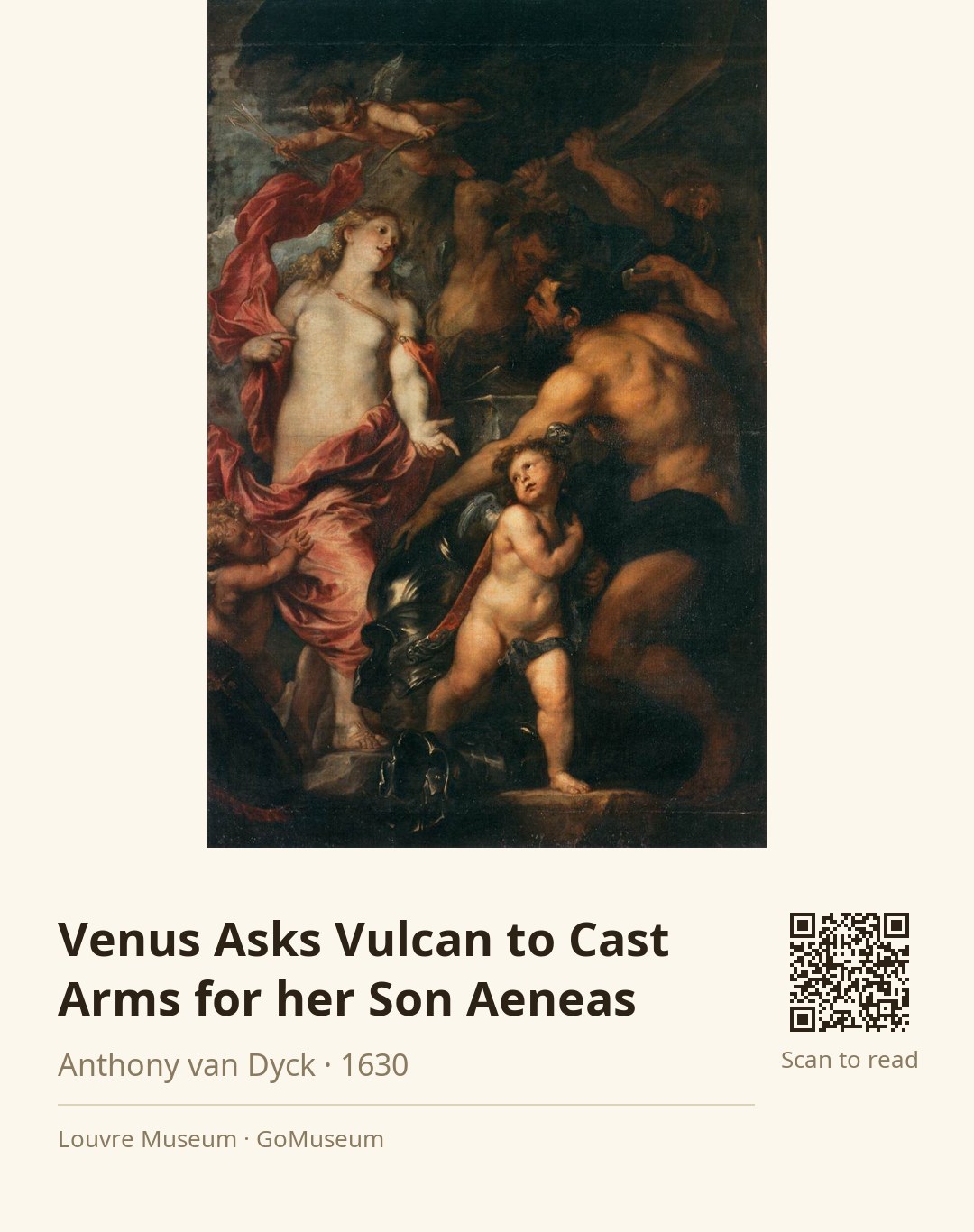
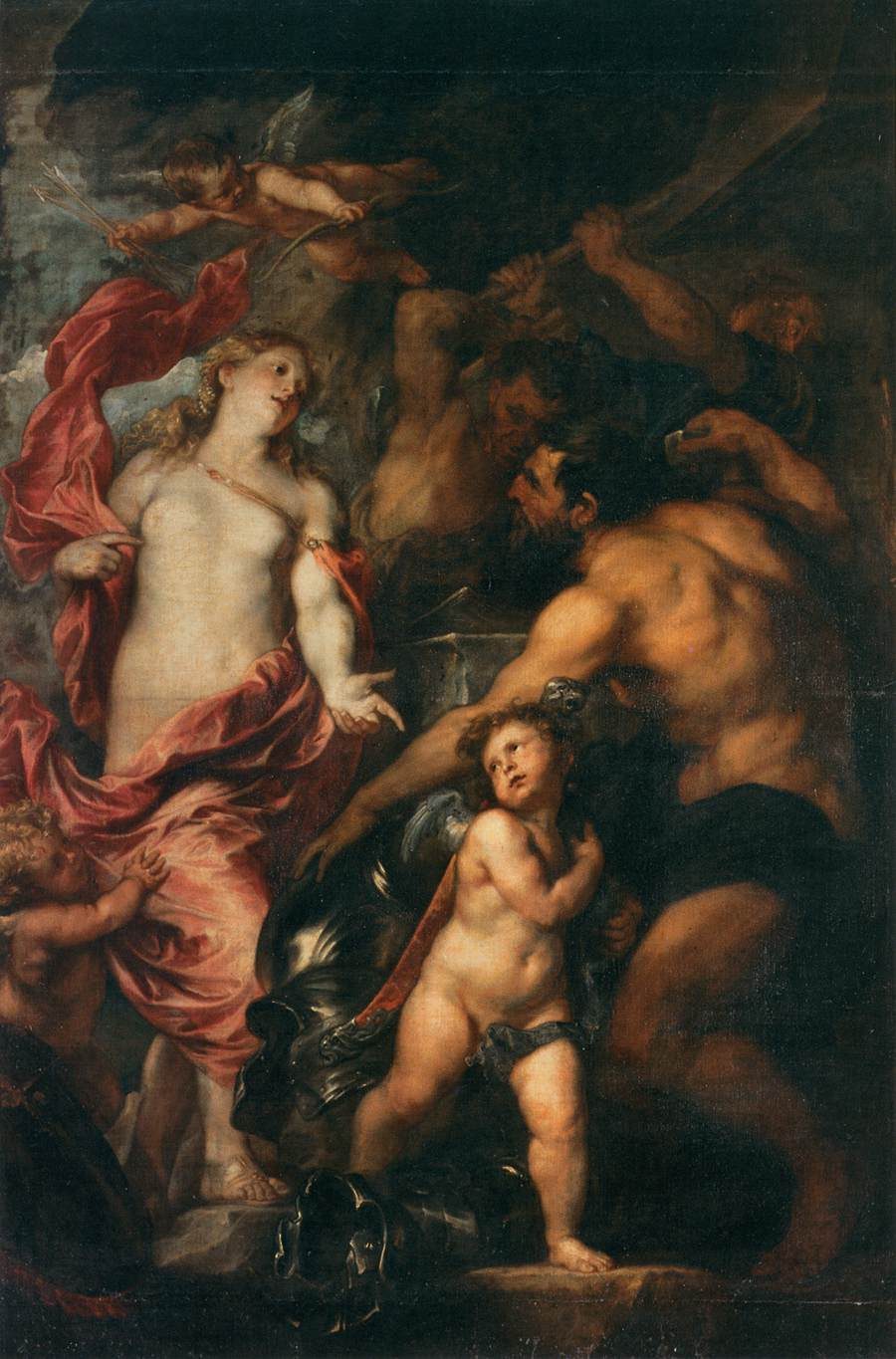
🎧 This work has audio narration — listen in the appTake a moment to really soak in the drama of this painting, "Venus Asks Vulcan to Cast Arms for her Son Aeneas." Look closely at Venus, her expression a mix of determination and tenderness as she implores Vulcan, the god of fire and forge. Notice how her flowing robes contrast with the rugged, industrial setting of Vulcan's workshop, filled with tools and glowing embers.
These details matter because they highlight the clash between divine beauty and earthly labor. Venus, representing love and desire, is seeking protection for her son Aeneas, a hero destined for greatness. This scene from Virgil's Aeneid captures a pivotal moment where love drives action, showing how even gods must navigate the complexities of motherhood and duty.
Van Dyck painted this in 1630, during a time when he was establishing himself as a leading artist in Europe, blending mythological themes with a personal touch. His style was influenced by the greats before him, but here, he brings a fresh emotional depth to the narrative.
As you stand before this work, think about the sacrifices made for love and the lengths one might go to protect their family. What would you ask of the gods if you were in Venus's shoes?
Sir Anthony van Dyck, born on March 22, 1599, in Antwerp, was a pivotal Flemish Baroque artist renowned for his portraits. As the seventh child of a wealthy silk merchant, his artistic talent emerged early, leading him to study under Hendrick van Balen and later become an assistant to the celebrated Peter Paul Rubens. By 1617, he was a master in the Guild of Saint Luke, establishing his independent workshop shortly thereafter.
Van Dyck's career flourished as he traveled to Italy, where he absorbed the styles of Titian and Veronese, and produced his acclaimed Iconography series. His return to England in 1632 as court painter to Charles I marked a significant turning point, as he became the leading portraitist of the English aristocracy, capturing the elegance and stature of his subjects with a relaxed sophistication that would influence portraiture for generations.
His innovative techniques in watercolor and etching, alongside his ability to blend mythological and biblical themes into his work, solidified his legacy. Van Dyck's impact on English art persisted long after his death on December 9, 1641, evident in the enduring popularity of the Van Dyke beard and his burial in St. Paul's Cathedral, a testament to his esteemed position in art history.
This painting, 'Venus Asks Vulcan to Cast Arms for her Son Aeneas,' was created by Anthony van Dyck between 1630 and 1632. It now resides in the Louvre Museum in Paris. The scene depicted is drawn from Virgil's Aeneid, specifically Book VIII, where Venus appeals to Vulcan to forge weapons for her son Aeneas. Interestingly, this work was not listed in the 1683 inventory of Louis XIV's collection, suggesting it may have been acquired before the 1709 inventory was compiled. By that time, the painting had been altered, with extensions added at the top and bottom, likely in the late 17th century. It first appeared in public at the Louvre when it opened in 1793, marking its journey from private collection to a celebrated piece in a major museum.
As you gaze at this painting, take note of Van Dyck's masterful brushwork. The way he layers paint creates a rich texture that draws you into the scene. The light in the workshop is almost palpable, with glowing embers illuminating Venus's delicate features, contrasting beautifully with the rugged tools surrounding her. Notice how the composition is structured; Venus is centrally positioned, her flowing robes creating a dynamic movement that leads your eye toward Vulcan. The color palette is striking, with warm reds and golds that evoke both the warmth of the forge and the divine beauty of Venus. This careful manipulation of light and color not only enhances the emotional weight of the scene but also highlights the tension between the divine and the earthly.
One intriguing aspect of this painting is its transformation over time; it was altered in the late 17th century, with additions made to its top and bottom. This kind of modification was not uncommon for artworks of the era, as tastes and contexts changed, leading to adjustments that could enhance the piece's appeal or fit its new display environment.