Portrait of the Children of Ayscoghe Boucherett
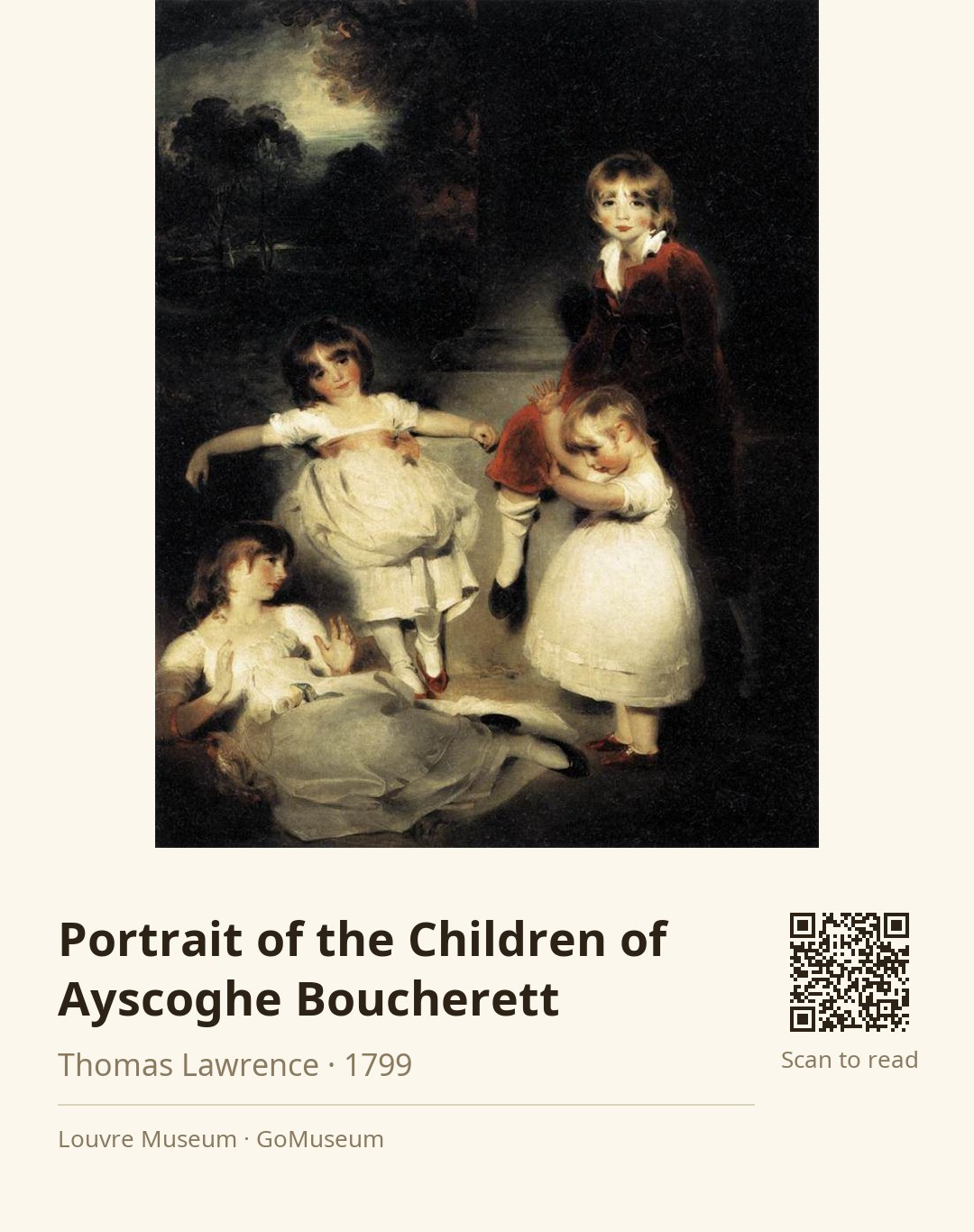
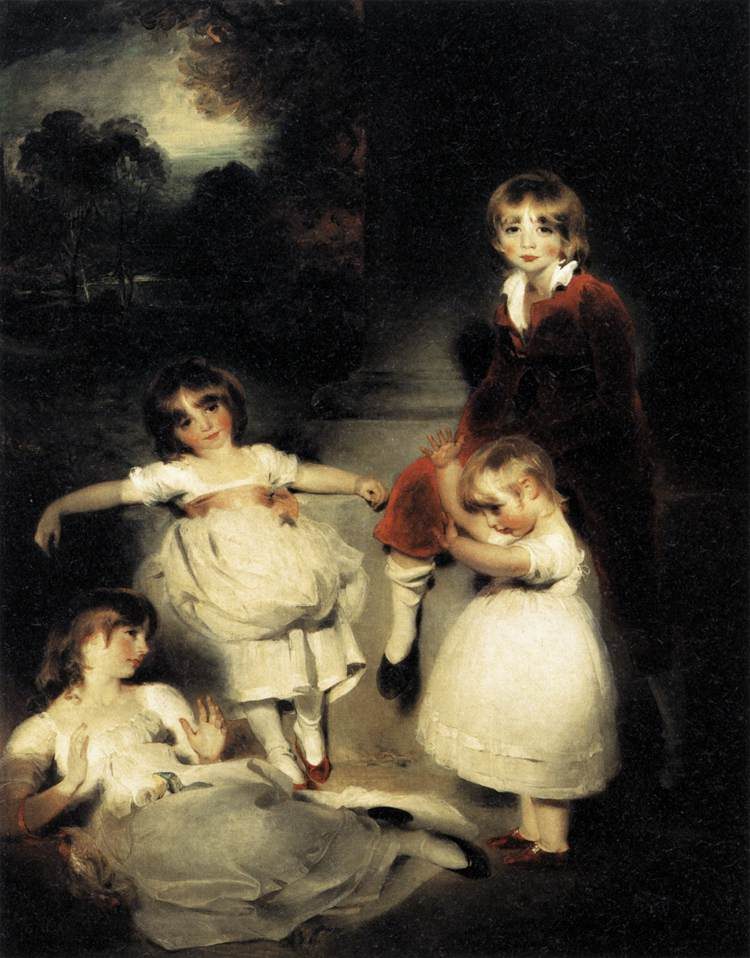
🎧 This work has audio narration — listen in the appThe four children in "Portrait of the Children of Ayscoghe Boucherett" seem to come alive in their dimly lit world. The child on the left, draped in a delicate white dress with a pink sash, reclines gracefully on the ground, while the two in the center, also clad in white, engage in a playful interaction, capturing a moment of youthful innocence. The child on the right stands out in a striking red outfit, his contemplative expression hinting at a deeper thoughtfulness amidst the playfulness surrounding him.
This contrast between the dark background and the children's bright clothing not only highlights their figures but also evokes a sense of intimacy and warmth in a potentially somber setting. The smooth brushwork reveals their delicate features, allowing viewers to connect with their emotions. Lawrence’s ability to capture the essence of childhood is evident here, as he skillfully balances the playful and the serious, creating a narrative that resonates with viewers.
Thomas Lawrence, recognized as one of the foremost portraitists of the Regency era, painted this work in 1799. His career was marked by a remarkable ability to convey both likeness and character, making him a sought-after artist among the elite of his time.
Thomas Lawrence was an English painter born on April 13, 1769, in Bristol. A child prodigy, he began drawing at a young age and supported his family with pastel portraits by the age of ten. After moving to London at eighteen, he quickly gained recognition, receiving his first royal commission in 1789 for a portrait of Queen Charlotte. Self-taught, Lawrence became known for his exceptional ability to capture likenesses and his masterful handling of paint.
He rose to prominence as the leading portraitist of the Regency era, becoming an associate of the Royal Academy in 1791 and its president in 1820. His career flourished under the patronage of the Prince Regent, who commissioned him to paint notable figures for the Waterloo Chamber at Windsor Castle. Despite his success, Lawrence's personal life was tumultuous, marked by unfulfilled love affairs and persistent financial struggles.
He remained a fashionable portrait painter until his death on January 7, 1830, at the age of 60. Although his reputation diminished during the Victorian era, it has since been partially restored, securing his place in art history as a significant figure in Romantic portraiture.
Commissioned in 1799, 'Portrait of the Children of Ayscoghe Boucherett' was painted by Thomas Lawrence, a leading figure in the Regency art scene. This particular piece was first exhibited at the Royal Academy in London in 1808, where it garnered attention for its intimate portrayal of childhood. The painting's provenance traces back through notable owners, including Mrs. Arthur James and Lady Carew Pole, before it became part of the Louvre's collection. Its journey reflects the shifting tastes of art collectors and the enduring appeal of Lawrence's work, which captured both likeness and character in a way that resonated deeply with the elite of his time. The painting's reception was warm, with critics praising Lawrence's ability to convey emotion and narrative through his subjects, solidifying his reputation as a master portraitist.
Lawrence's technique in this painting is a testament to his skillful brushwork and understanding of color. The smooth application of oil paint creates a lifelike quality in the children's delicate features, allowing their expressions to convey a range of emotions—from playful joy to contemplative seriousness. The dark background serves not just as a backdrop but as a strategic choice that enhances the brightness of the children's white and red clothing, drawing the viewer's eye directly to them. The composition is carefully balanced, with the seated children forming a triangular arrangement that guides the viewer's gaze across the canvas. Lawrence's ability to blend realism with a touch of romanticism is evident here, as he captures a fleeting moment of childhood innocence while also hinting at deeper narratives beneath the surface.
Interestingly, Lawrence was a child prodigy who began supporting his family through his art at just ten years old. His early portraits were done in pastels, and he quickly gained a reputation in Bath, where he painted the likes of the Duchess of Devonshire. This early success laid the groundwork for his later prominence as one of the most fashionable portrait painters in Europe, showcasing how talent can emerge from humble beginnings.
At the age of ten, Thomas Lawrence started supporting his family by creating pastel portraits, showcasing his exceptional talent from a young age.
Thomas Lawrence had tumultuous love affairs, particularly with Sally and Maria Siddons, which have been explored in various books.
Before becoming part of the Louvre's collection, the painting was owned by notable figures such as Mrs. Arthur James and Lady Carew Pole.