Christine Boyer
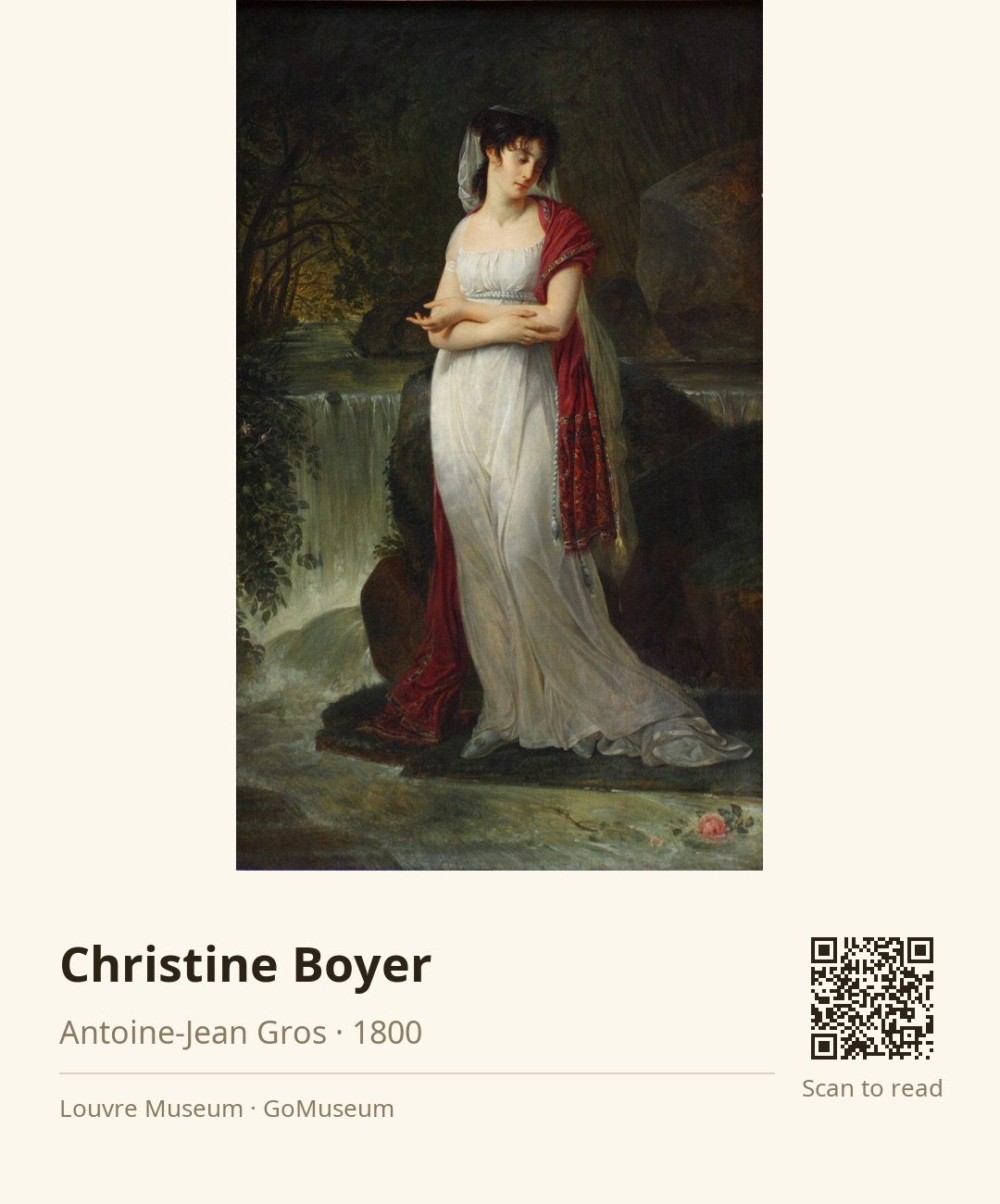
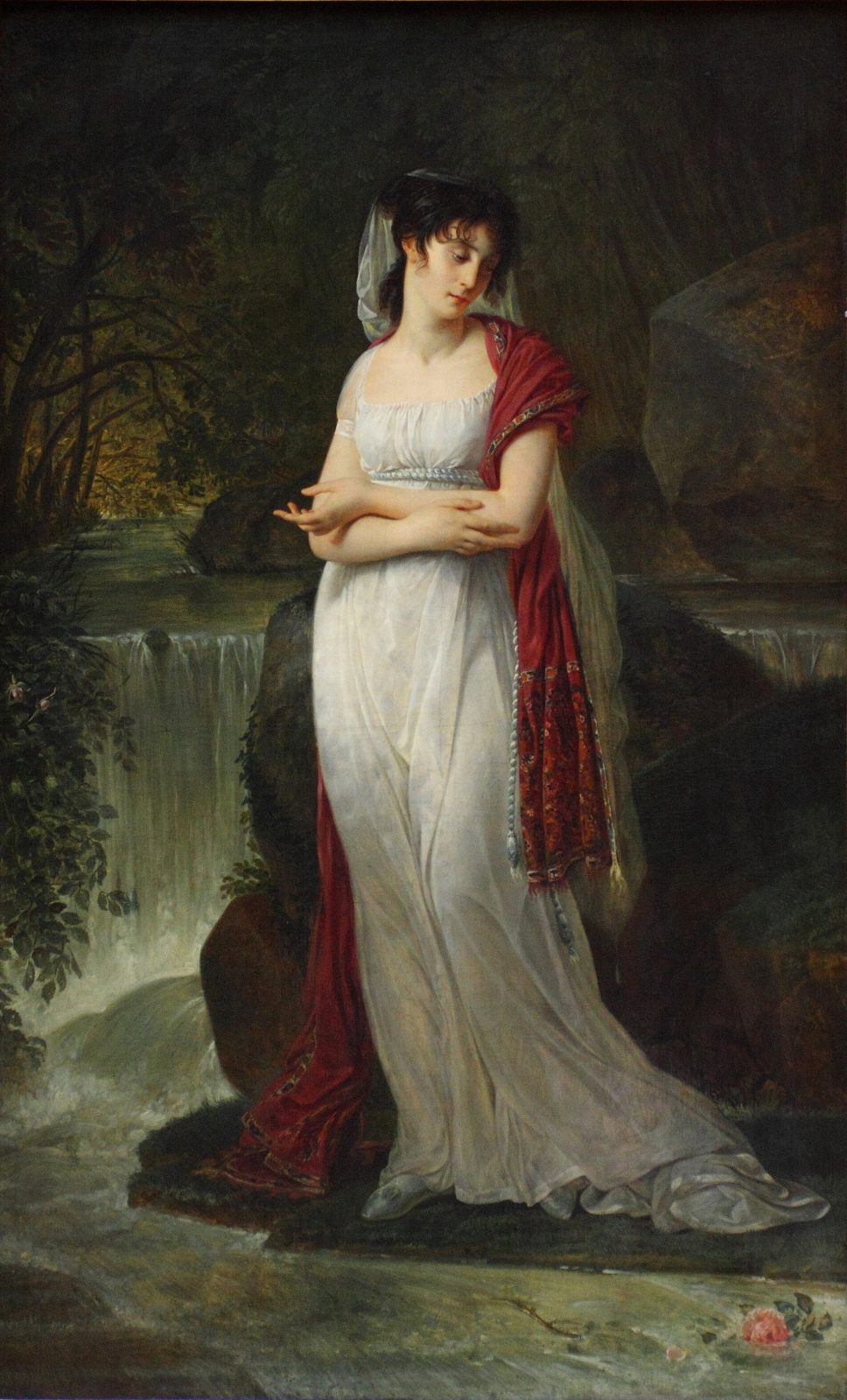
🎧 This work has audio narration — listen in the appChristine Boyer stands gracefully by a cascading waterfall, her flowing white gown and vibrant red shawl contrasting beautifully with the lush greenery surrounding her. The soft brushwork captures the delicate textures of her attire and the natural elements, while her contemplative gaze downward invites a moment of introspection.
This portrayal of Boyer, a woman of the late 18th century, reflects not only her elegance but also the romantic ideals of the time, where nature and femininity intertwine. The serene setting enhances her presence, suggesting a connection between the subject and the tranquil landscape, a hallmark of Gros's style. The choice of a waterfall as a backdrop symbolizes both beauty and the passage of time, reinforcing the notion of fleeting moments in life.
Antoine-Jean Gros, who created this piece in 1800, was known for his historical subjects and portraits, having gained prominence through his association with Napoleon Bonaparte. His work often blended neoclassical and romantic elements, and "Christine Boyer" exemplifies his ability to capture the essence of his subjects within evocative settings. Gros's artistic journey began under the tutelage of Jacques-Louis David, and he became a significant figure in the early 19th-century French art scene.
Antoine-Jean Gros was a prominent French painter born on March 16, 1771, in Paris. He was a student of Jacques-Louis David, and his early life was marked by artistic promise, nurtured by a family of painters. Gros gained fame during the French Revolution, particularly for his portrait of Napoleon Bonaparte at the Battle of Arcole, which led to a close relationship with the emperor. His works often depicted historical events, blending neoclassicism with emerging romanticism, showcasing both grandeur and emotional depth.
After spending time in Genoa, where he painted portraits, Gros returned to Paris and became a celebrated artist. His notable works include "Bonaparte Visiting the Plague Victims of Jaffa," which served to counter negative propaganda against Napoleon. Despite his success, Gros struggled with the changing artistic landscape, feeling overshadowed by the rise of Romanticism. His later years were marked by personal turmoil, culminating in his tragic suicide in 1835. Gros's legacy lies in his ability to capture the complexities of his subjects, securing his place in art history as a bridge between neoclassicism and romanticism.
Gros's technique in 'Christine Boyer' showcases his mastery of oil paint, with smooth brushwork that brings out the delicate textures of the fabric and the surrounding foliage. The colors are carefully chosen; the earthy greens and browns of the landscape contrast with the striking white of Boyer's gown and the vibrant red of her shawl. This choice not only highlights her figure but also creates a visual harmony with the natural setting. The composition centers on Boyer, with the cascading waterfall and rocks framing her, drawing the viewer's eye directly to her contemplative expression. The scale of the painting, quite large at 214 by 134 centimeters, enhances its presence, making it a striking focal point in any room.
An intriguing anecdote about Gros is that he was once a child prodigy, learning to draw at the tender age of six from his father, a miniature painter. This early start in art led him to study under the renowned Jacques-Louis David, where he quickly made a name for himself. Interestingly, Gros was also known for his brusque demeanor, yet he formed a close friendship with Élisabeth Vigée Le Brun, who recognized his artistic talent from a young age. Their bond was a rare glimpse into the softer side of a man often perceived as socially reclusive.
Gros showed remarkable artistic talent from a very young age, learning to draw at just six years old from his father, who was a miniature painter.
Despite being socially reclusive and brusque, Gros developed a close friendship with Élisabeth Vigée Le Brun, who had seen his artistic potential since childhood.
Gros gained significant recognition and the patronage of Napoleon after painting a portrait of him during the Battle of Arcole in 1796.