 Image: Sailko
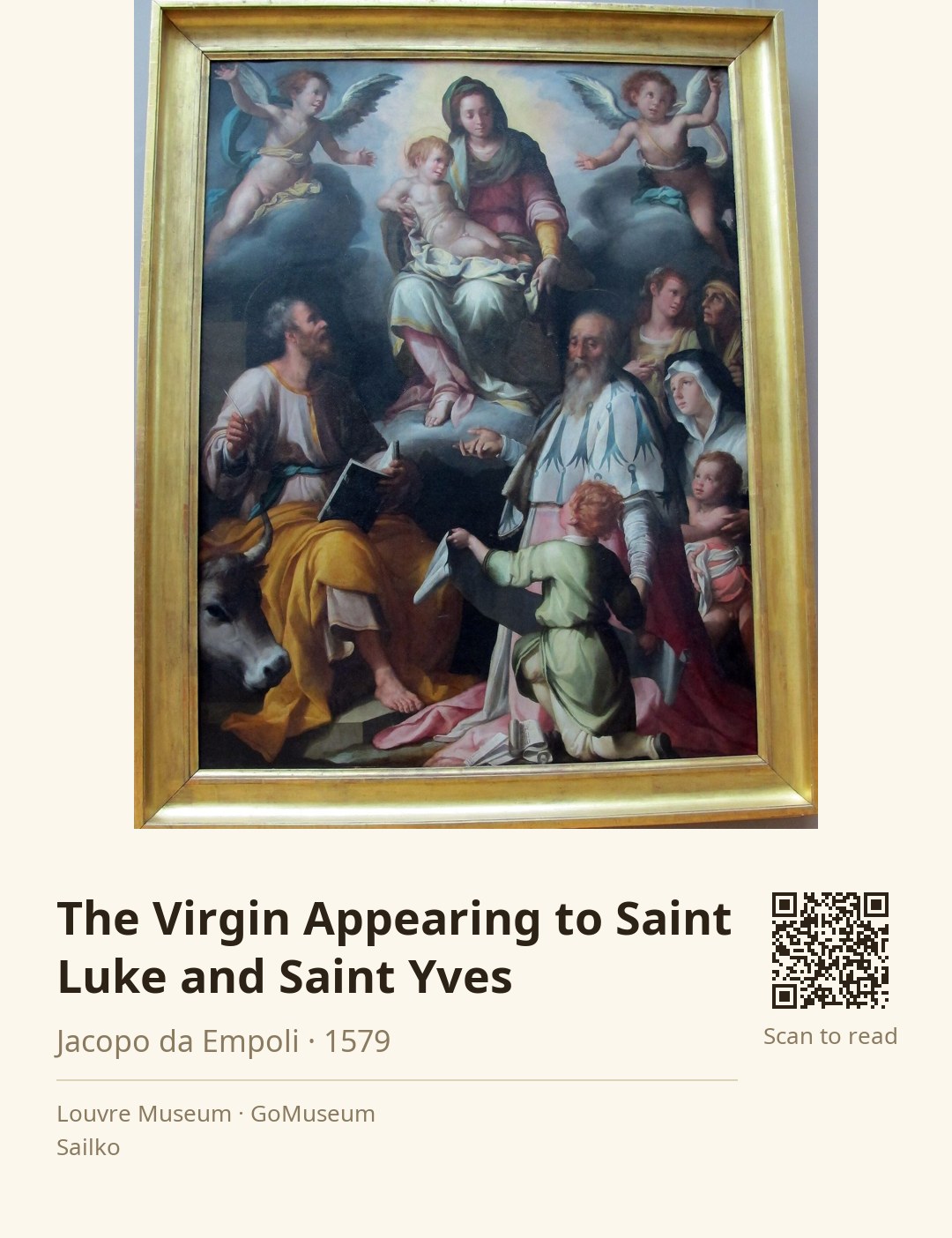
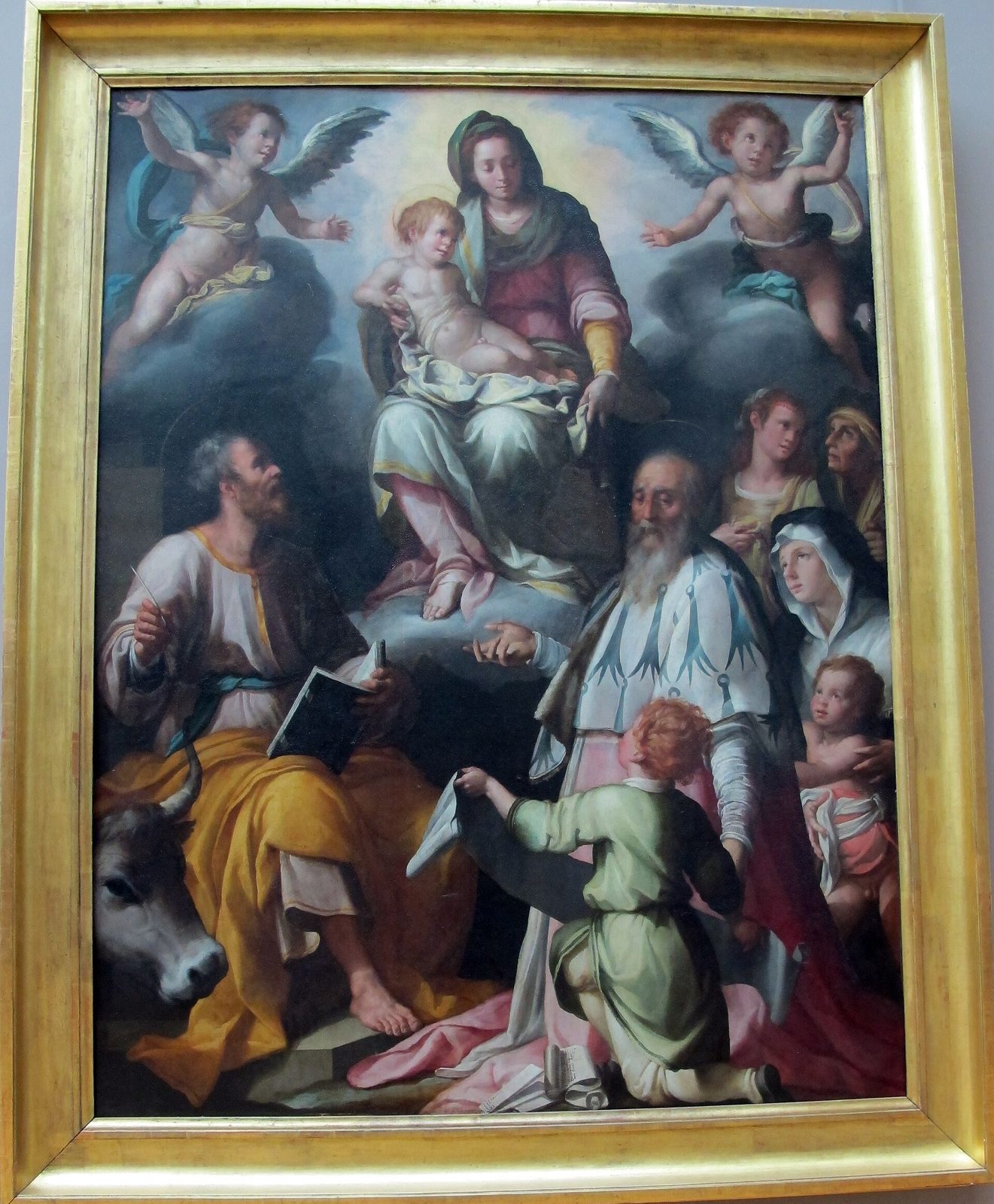
The Virgin Appearing to Saint Luke and Saint Yves
🎧 This work has audio narration — listen in the appThe Virgin sits gracefully on a cloud, cradling the Christ Child in her lap, while cherubs flutter around them, their delicate wings shimmering in the soft light. The vibrant hues of blue, pink, and yellow create a heavenly atmosphere, enhancing the ethereal quality of the scene. To the left, Saint Luke, identifiable by the ox at his side, holds an open book, symbolizing his role as an evangelist, while on the right, Saint Yves gestures towards the child, embodying his compassion and dedication to the needy.
This composition reflects Jacopo da Empoli's mastery in blending figures with a celestial backdrop, capturing a moment of divine revelation. The choice of soft colors and detailed brushwork not only highlights the figures’ expressions but also evokes a sense of serenity and reverence. Da Empoli, active during the late Renaissance, was known for his ability to convey emotion through his subjects, often drawing inspiration from the spiritual narratives of his time.
Created in 1579, "The Virgin Appearing to Saint Luke and Saint Yves" showcases the artist's commitment to religious themes, a hallmark of his oeuvre, and stands as a testament to the rich tradition of Florentine painting during this period.
Jacopo da Empoli, born Jacopo Chimenti on April 30, 1551, in Florence, was a notable Italian painter of the late Renaissance, known for his reformist approach to art. Apprenticed to Maso da San Friano, he developed a style that diverged from the crowded and contorted forms of Mannerism, aligning instead with the clearer and more structured aesthetics of contemporaries like Santi di Tito. His works often reflect a keen interest in light and form, influenced by the Caravaggisti of Tuscany.
Empoli's artistic journey included collaborations with other artists and a commitment to teaching, mentoring several pupils who would carry on his legacy. His later years saw a shift towards still-life painting, a genre he excelled in, producing remarkable works that stood out in the Florentine art scene. His innovative drawings, which hinted at stereoscopic effects, were rediscovered centuries later, showcasing his forward-thinking approach to visual perception.
Jacopo da Empoli passed away on September 30, 1640, leaving behind a rich body of work that contributed significantly to the evolution of Florentine painting, bridging the gap between Mannerism and the emerging Baroque style. His legacy endures through his diverse oeuvre, which includes religious themes and still lifes, marking him as a pivotal figure in the history of art.
In 'The Virgin Appearing to Saint Luke and Saint Yves,' Jacopo da Empoli employs oil on wood to create a vivid tableau that draws viewers into a celestial realm. The brushwork is meticulous, with each stroke contributing to the lifelike quality of the figures. Soft transitions in color enhance the ethereal atmosphere, while the vibrant palette of blues, pinks, and yellows evokes a sense of divine light. The composition is balanced, with the Virgin and Child at the center, flanked by the saints, creating a harmonious flow that guides the eye. Empoli's choice to depict the figures with detailed expressions adds depth, inviting contemplation of their spiritual significance. This technique not only showcases his skill but also reflects the emotional resonance he sought to convey.
One intriguing aspect of Jacopo da Empoli's career is his experimentation with stereoscopic effects. Around 1600, he created a pair of drawings that hinted at the principles of stereoscopy, long before the technology became widely recognized.
Jacopo da Empoli experimented with stereoscopic effects around 1600, creating drawings that hinted at the principles of stereoscopy long before the technology became widely recognized.
Jacopo da Empoli taught several notable pupils, including Felice Ficherelli, Giovanni Battista Brazzè, Giovanni Battista Vanni, and Virgilio Zaballi.
After the 1620s, Jacopo da Empoli began creating exceptional still-life paintings, a theme that was often overlooked by Florentine painters.