Diana and Endymion
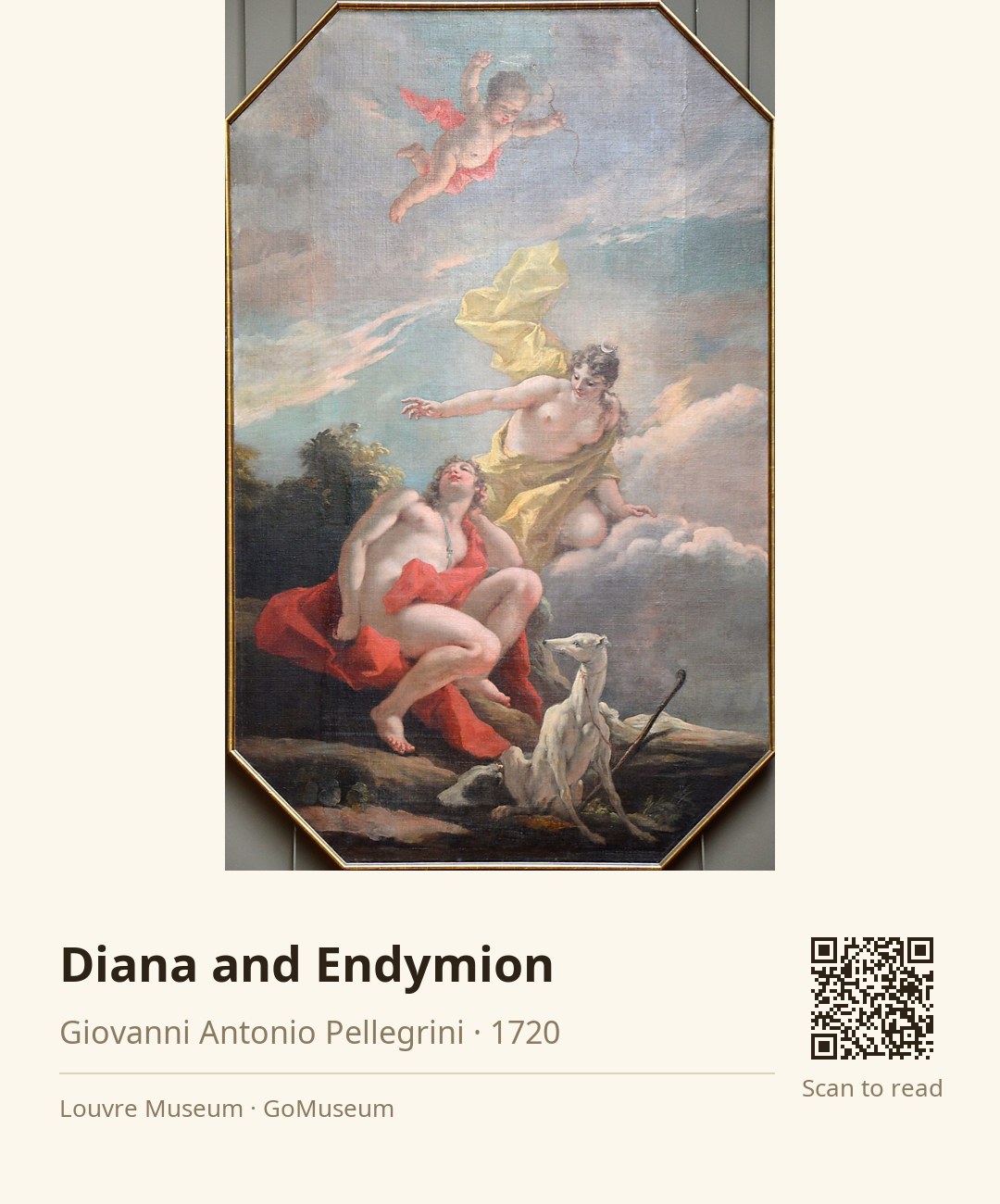
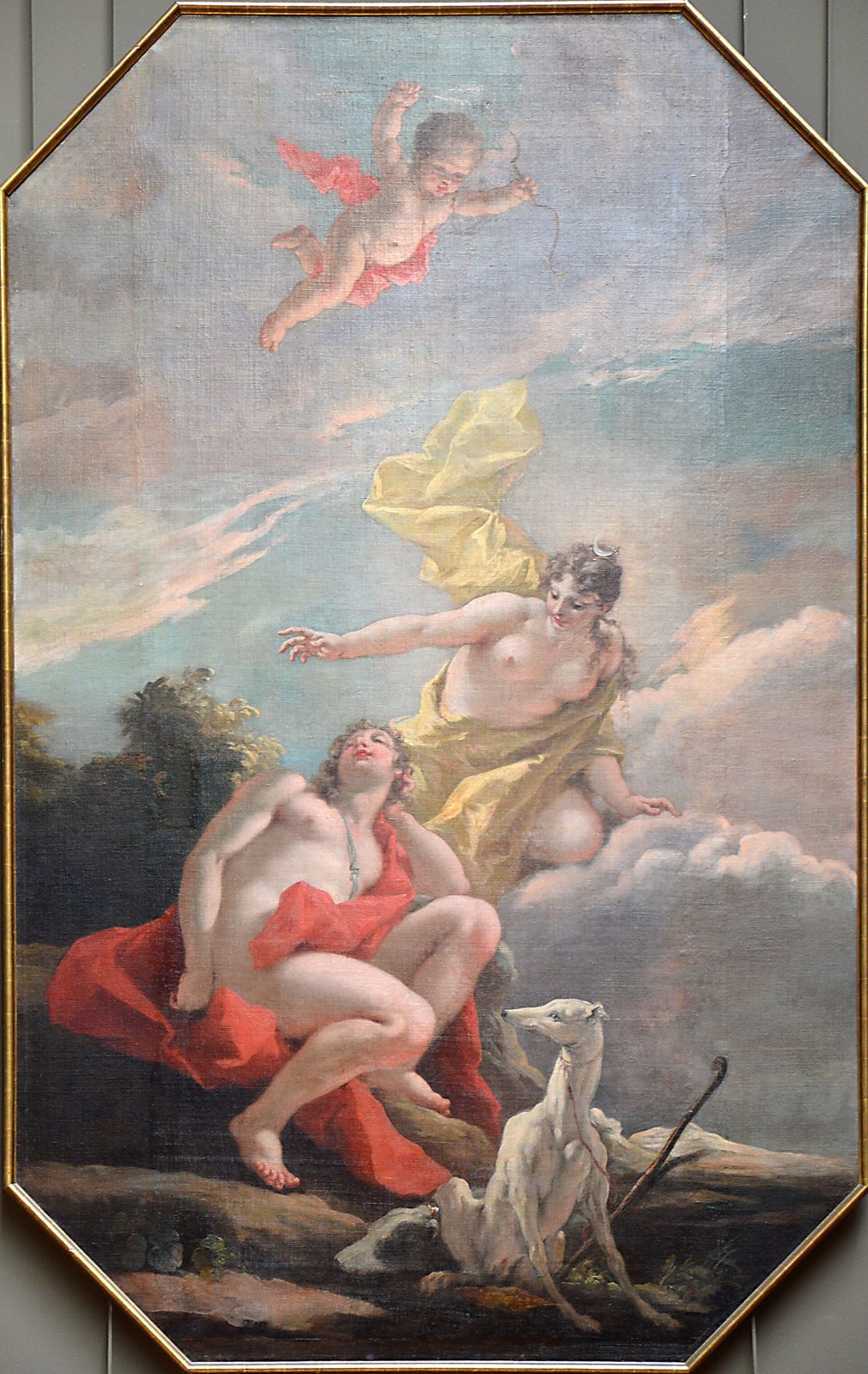
🎧 This work has audio narration — listen in the appThe reclining figure of Endymion, draped in a striking red cloth, captures your attention as he gazes dreamily upward, embodying the essence of mythological longing. Beside him, a white dog sits alert, while above, the goddess Diana reaches out in a flowing yellow garment, her celestial presence accentuated by the soft clouds that cradle her. The cherub, with its tiny wings and bow, adds a playful yet poignant touch to this ethereal scene.
This composition, painted in 1720 by Giovanni Antonio Pellegrini, reflects the artist's ability to blend Renaissance elegance with Baroque dynamism, creating a harmonious atmosphere that invites contemplation. The gentle brushwork and soft palette evoke a dreamlike quality, enhancing the narrative of love and desire between the mortal Endymion and the divine Diana. The figures are not just characters in a myth; they represent the intersection of human emotion and celestial beauty, a theme prevalent in Pellegrini's work.
Born in Venice, Pellegrini was a prominent figure in early 18th-century painting, known for his travels across Europe and his influence on the next generation of artists. His style, merging the grandeur of Venetian painting with the fluidity of Baroque, positioned him as a key precursor to Giovanni Battista Tiepolo. Pellegrini's diverse body of work includes significant commissions in England and across the continent, showcasing his adaptability and skill in various artistic environments.
Giovanni Antonio Pellegrini, born in Venice in 1675, was a prominent history painter of the early 18th century, known for blending Renaissance and Baroque styles. His artistic journey began under the tutelage of Paolo Pagani and was significantly influenced by Sebastiano Ricci. Pellegrini's career took him across Europe, from England to the Southern Netherlands, where he created notable works, including murals in English country houses and the dome at the Scuola Grande di San Rocco in Venice.
His time in England (1708-1713) marked a peak in his success, where he was invited by the Earl of Manchester and became a director at Sir Godfrey Kneller's Academy. Despite his initial acclaim, competition from other Venetian painters diminished his later success upon returning to England in 1719. Pellegrini's legacy includes a series of allegorical paintings for the elector Johann Wilhelm in Düsseldorf and decorative works in prestigious locations like the Mauritshuis in The Hague.
Regarded as a precursor to Giovanni Battista Tiepolo, Pellegrini's contributions to Venetian painting are significant, showcasing a unique synthesis of styles that influenced the trajectory of 18th-century art. He passed away in 1741, leaving behind a rich body of work that continues to be celebrated.
Giovanni Antonio Pellegrini's 'Diana and Endymion' was painted in 1720, a time when the artist was navigating the vibrant art scene of early 18th-century Europe. Commissioned by a patron whose identity remains a mystery, this work reflects Pellegrini's established reputation following his successful years in England from 1708 to 1713. During his time there, he painted murals in grand country houses, earning accolades for his ability to blend the lightness of fresco with the richness of oil. After returning to Venice, Pellegrini continued to create significant works, but 'Diana and Endymion' stands out as a hallmark of his style. The painting was later included in various collections, and its inventory number, RF 1964-2, suggests it has been part of a larger museum collection, emphasizing its importance in the art historical narrative. The work was well-received, showcasing Pellegrini's mastery of mythological themes and his ability to evoke emotion through color and form.
In 'Diana and Endymion', Pellegrini employs a delicate brushwork technique that breathes life into the figures, creating a sense of movement and softness. The oil on canvas allows for a rich layering of colors, with the vibrant red of Endymion's drapery contrasting beautifully against the ethereal yellow of Diana's garment. This choice of color not only highlights the figures but also enhances the dreamlike quality of the scene. The composition is carefully arranged, with the reclining figure of Endymion positioned in the foreground, drawing the viewer's eye upward to the celestial Diana and the playful cherub above. The soft palette, featuring hints of blue and pink in the background, contributes to the overall harmony of the piece, inviting contemplation of the narrative of longing and desire. Pellegrini's ability to blend Renaissance elegance with Baroque dynamism is evident in the way he captures the emotional depth of the mythological encounter.
Before creating 'Diana and Endymion', Pellegrini decorated the dome above the staircase at the Scuola Grande di San Rocco in 1709.
In 1711, Pellegrini became the director of Sir Godfrey Kneller's Academy in London, showcasing his significant influence in the art community.
Most of Pellegrini's work at Castle Howard was destroyed by a fire in 1940.