 Image: Poulpy
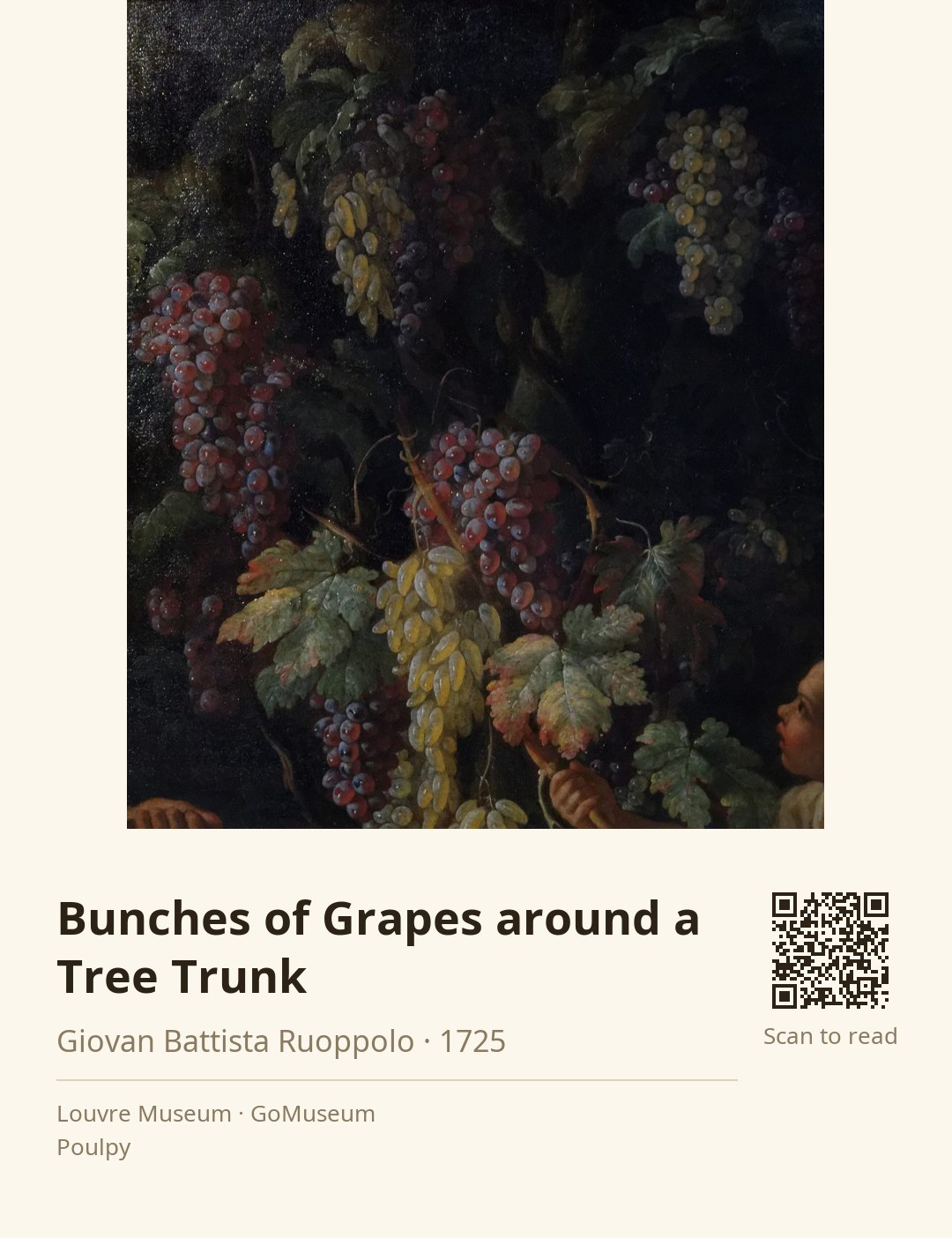
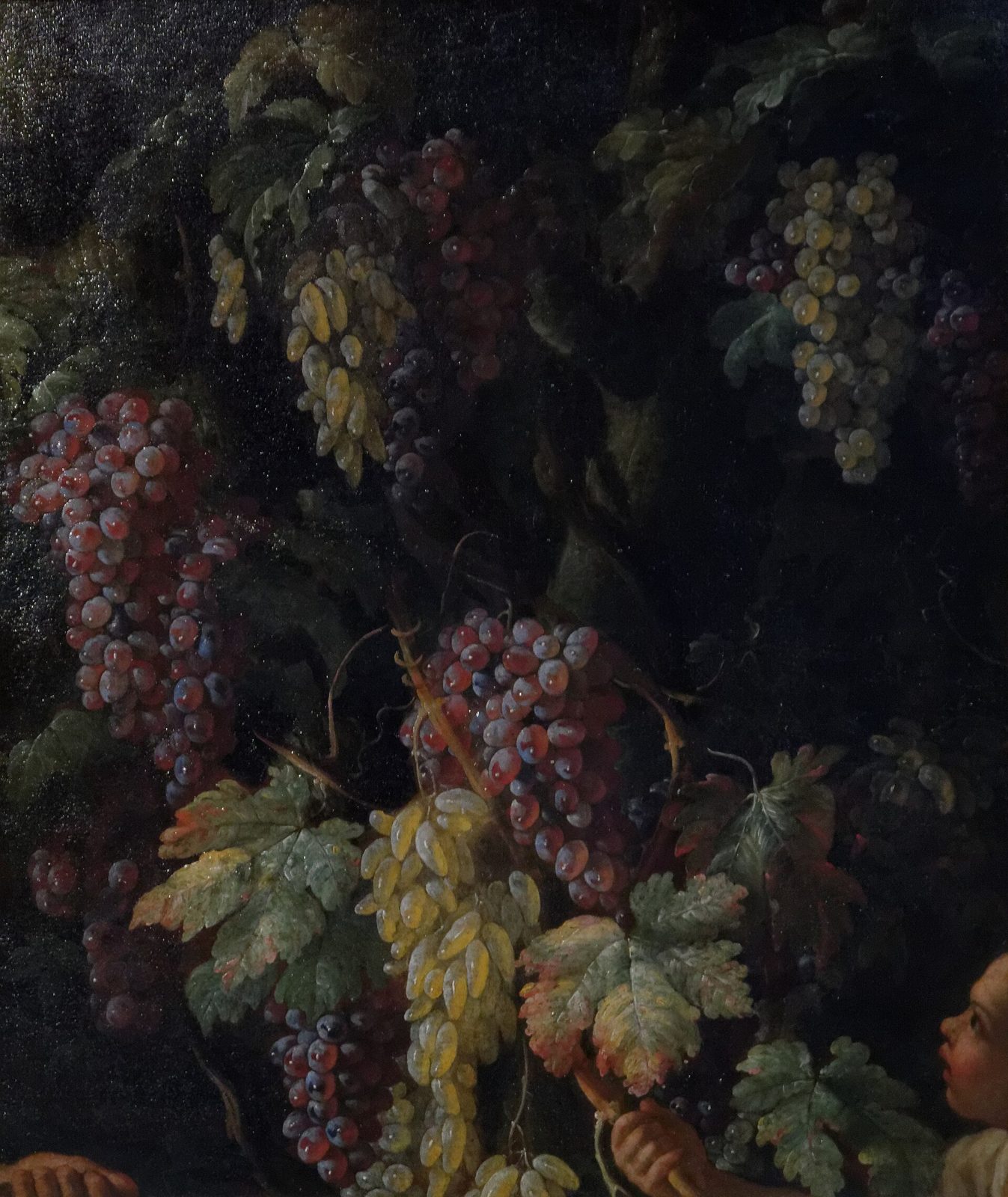
Bunches of Grapes around a Tree Trunk
🎧 This work has audio narration — listen in the appClusters of grapes in deep reds, purples, and yellows spill around a gnarled tree trunk, their rich colors almost glowing against the dark background. Large, textured leaves in shades of green and reddish-brown cradle the fruit, creating a sense of abundance and vitality. In the lower right corner, a child gazes upward, holding a vine, their curious expression adding a touch of life to this still-life composition.
The interplay of light on the grapes and leaves reveals Ruoppolo's mastery of texture, capturing the sheen and plumpness of the fruit with fine brushwork. This attention to detail not only showcases the natural beauty of the grapes but also reflects the artist's deep understanding of the still-life genre, which flourished in Naples during the late 17th century. Ruoppolo's work is characterized by lavish decorative elements, influenced by both his contemporaries and the Baroque style, which emphasized richness and depth.
Giovan Battista Ruoppolo, born in Naples in 1629, was a prominent Baroque still-life painter whose work flourished in the second half of the 17th century. Coming from a family of artisans, he was influenced by his father, a maiolica-worker, and trained under Paolo Porpora, a contemporary of Salvator Rosa. Ruoppolo's early works displayed a naturalistic style, drawing inspiration from artists like Luca Forte and Giovanni Battista Recco, and were characterized by their vibrant depictions of everyday objects.
As he matured, Ruoppolo's style evolved into grand compositions filled with intricate details, often reflecting the influence of the Antwerp painter Abraham Brueghel. His notable works from this period include lavish still lifes featuring fish, fruits, and flowers, which were highly sought after by the aristocracy and wealthy merchants. Despite some confusion with Recco due to their similar initials, Ruoppolo carved out a distinct identity in the art world.
Ruoppolo passed away in Naples on January 17, 1693, leaving behind a legacy that influenced many, including his pupils and subsequent artists like Andrea Belvedere. His contributions to still-life painting solidified his place in art history as a key figure in the Neapolitan Baroque movement.
Created in 1725, 'Bunches of Grapes around a Tree Trunk' is a vivid testament to Giovan Battista Ruoppolo's mastery in still-life painting. Ruoppolo, a prominent figure in the Neapolitan art scene, was known for his lush, detailed compositions that captured the essence of nature. His works were highly sought after by the aristocracy and wealthy merchants, showcasing the opulence of the time. This particular piece reflects the influence of the Baroque style, which emphasized richness and depth. Over the years, it has passed through various collections, including that of Elmerich Mr, before finding its home in the museum where you see it today.
The artist employs fine brushwork to create a remarkable texture, allowing the grapes to appear almost three-dimensional, as if you could reach out and pluck them. The rich reds, purples, and yellows of the grapes are layered with skillful paint handling, giving them a lustrous sheen that catches the light beautifully. The dark background serves to enhance the vibrancy of the fruit, drawing your eye immediately to the central composition. The large, textured leaves cradle the grapes, their shades of green and reddish-brown adding depth and contrast. This careful arrangement not only showcases Ruoppolo's understanding of natural forms but also reflects the Baroque fascination with abundance and vitality, creating a scene that feels alive and inviting.
Ruoppolo's early style was shaped by the naturalism of Luca Forte and Giovanni Battista Recco, as well as the still life paintings from Rome that were influenced by Caravaggio.
One notable work from Ruoppolo's early career is 'Still Life with Celery and Guelder Roses,' created around 1650-1655.