 Image: Coyau
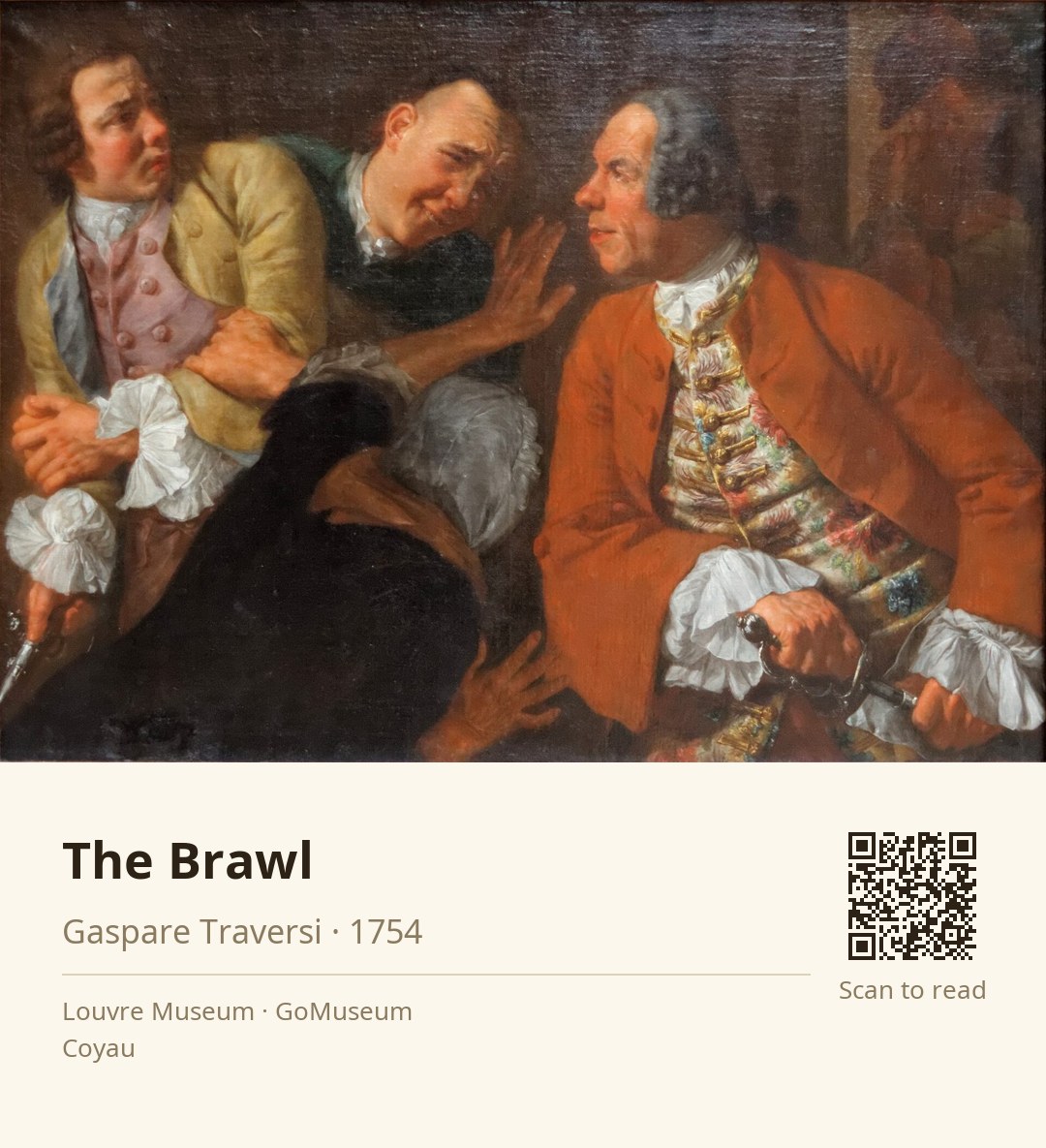
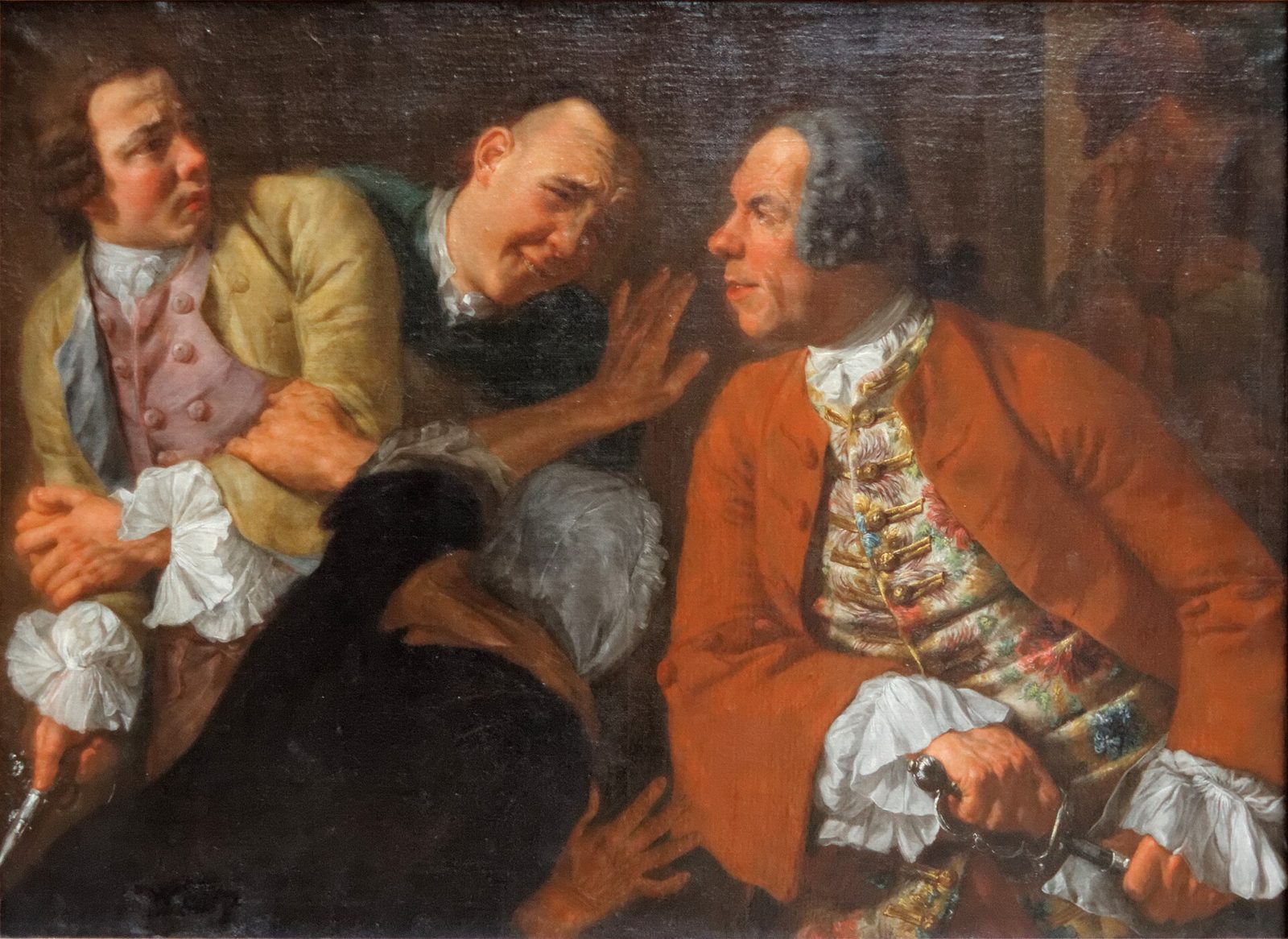
The scene in "The Brawl" captures a moment of heated exchange among four men, with the figure in the ornate red coat and embroidered waistcoat holding a sword, his expression revealing a mix of intensity and concern. Beside him, a balding man in a green coat leans in, hand raised as if to share a secret, while another man in a yellow coat watches anxiously, hands clasped together. The warm earth tones and intricate brushwork bring the textures of their clothing and the tension of the moment to life.
This vivid portrayal of conflict reflects Traversi's keen observation of human behavior, encapsulating the social dynamics of 18th-century Naples. The animated gestures and varied expressions suggest a narrative that goes beyond mere depiction, inviting viewers to ponder the underlying motivations and relationships among the figures. Traversi's ability to convey drama within a confined space mirrors the theatricality of contemporary life, where social aspirations often clashed with reality.
Active primarily in Naples and Rome, Gaspare Traversi was known for his genre paintings that satirized the bourgeois class, often depicting groups of characters in moments of tension or conflict. "The Brawl," created in 1754, exemplifies his unique style, blending realism with a touch of moral commentary, and remains a significant work within his oeuvre.
Gaspare Traversi, born in Naples in February 1722, was a prominent Italian Rococo painter known for his genre works that captured the complexities of contemporary life. Trained under Francesco Solimena, he developed a unique realism that set him apart from his peers. His early works, such as "Job Derided," showcased a keen observation of human behavior, often satirizing the social aspirations of the emerging bourgeois class in southern Italy.
In 1752, Traversi moved to Rome, where he continued to create significant religious and genre paintings, including a series for the Basilica of Saint Paul Outside the Walls. His ability to blend dramatic expressions with everyday scenes drew comparisons to Caravaggio and northern Italian painters like Giacomo Ceruti. Throughout the 1750s and 1760s, he produced some of his most powerful works, characterized by lively group dynamics and moralistic undertones.
Despite having no formal pupils, Traversi's influence permeated the works of later artists, particularly in Naples. His legacy endures as a master of genre painting, where he vividly depicted the human condition with both humor and critique, earning him a place in the annals of art history akin to that of Hogarth and Longhi. Traversi passed away in 1770, leaving behind a rich body of work that continues to resonate today.
Gaspare Traversi's "The Brawl" was created in 1754, a time when Naples was a bustling hub of culture and social tension. It was exhibited in Rouen in 1929, where it was part of a showcase on 18th-century Italian art, and later in Venice the same year, highlighting Traversi's growing recognition. The painting has a rich provenance, having passed through the hands of several notable collectors, including Emmanuel François Cassen and the Duc de Trévise.
In "The Brawl," Traversi employs a dynamic brushwork that captures the intensity of the moment. The figures are rendered with meticulous attention to detail, from the ornate embroidery of the red coat to the anxious expressions on the faces of the men. The warm earth tones create a sense of immediacy, drawing the viewer into the scene. Traversi's choice of a relatively large canvas, measuring 95.5 by 130.5 centimeters, allows for a dramatic portrayal of the figures, almost compressing them into the viewer's space. This technique enhances the feeling of tension, as if the viewer is witnessing a real confrontation. The varied textures of the clothing, achieved through layered paint application, further emphasize the social status of the characters, making their conflict all the more palpable.