 Image: Coyau
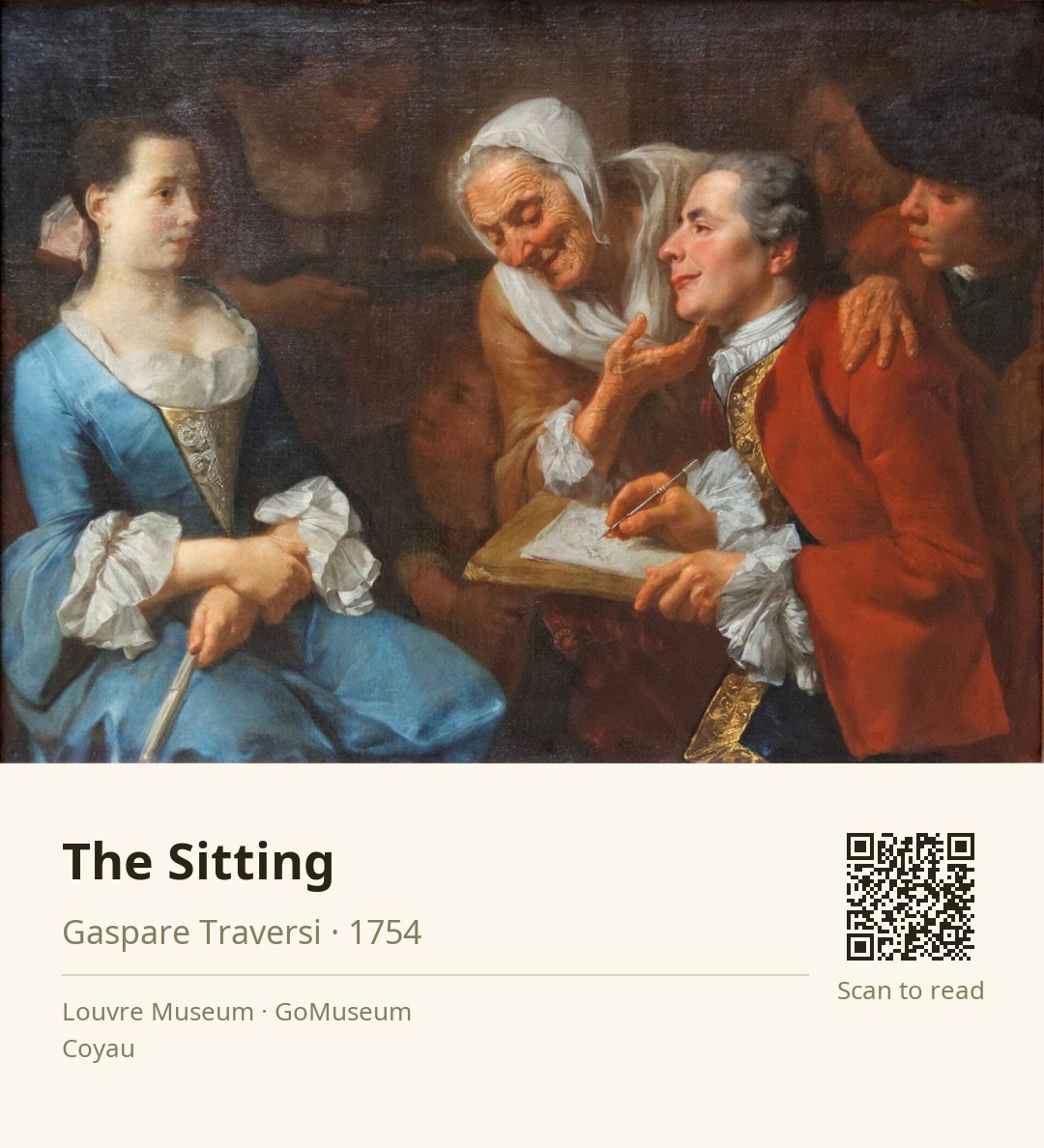
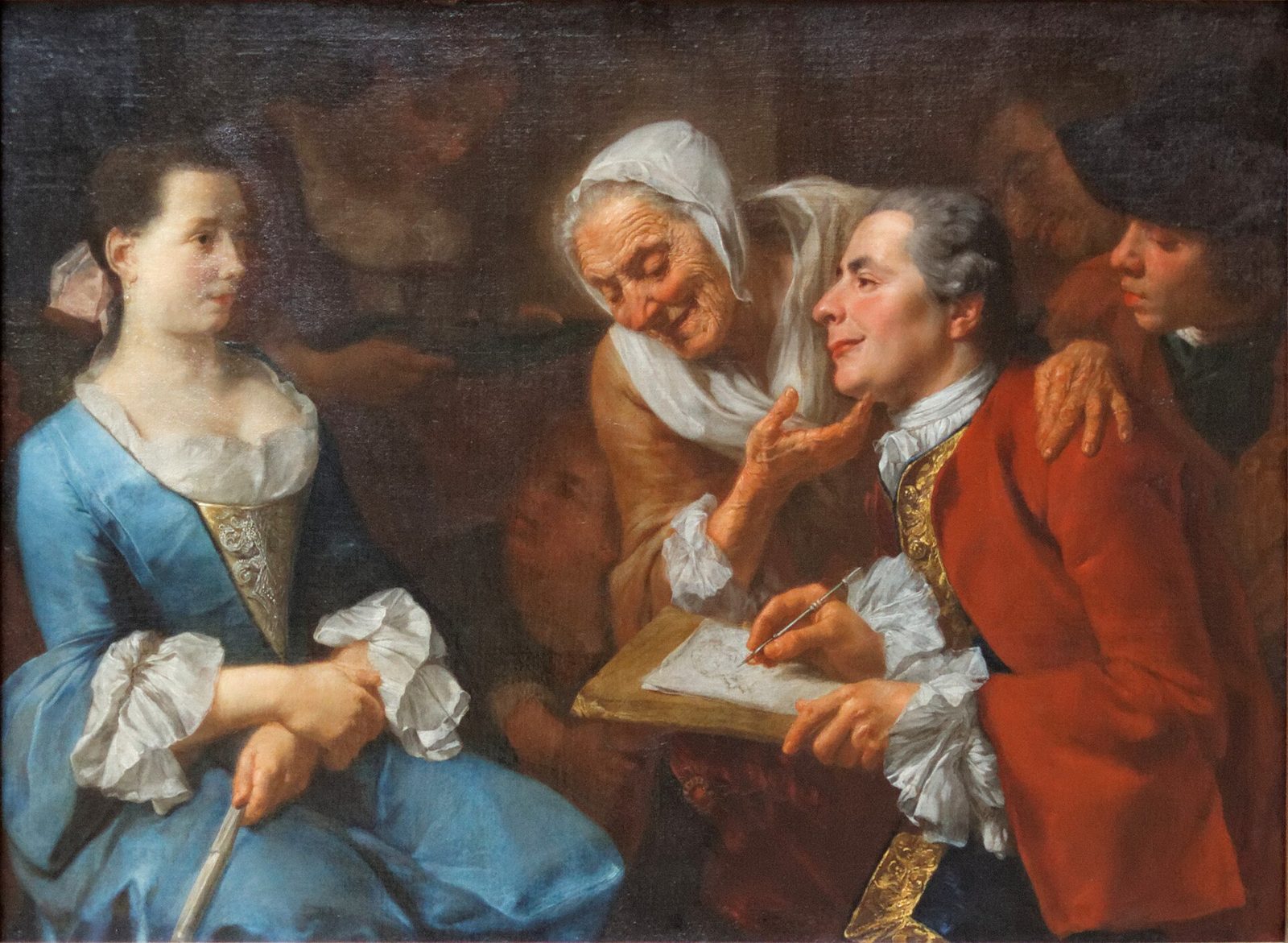
The young woman in the blue dress with white ruffled sleeves sits poised, her hands clasped delicately in her lap, while her gaze is directed towards the right, hinting at an unspoken connection with the man in the red coat. The man, holding a drawing pad and pencil, appears engrossed in his task, capturing the essence of the scene unfolding around him. The elderly woman beside him gestures animatedly, her white headscarf framing a face rich with expression, embodying the lively interaction that defines this intimate gathering.
This painting, titled "The Sitting," created by Gaspare Traversi in 1754, showcases a moment steeped in the everyday life of 18th-century Italy, where the act of drawing becomes a bridge between the figures. The warm palette and detailed brushwork not only highlight the textures of their clothing but also evoke a sense of warmth and familiarity, inviting viewers into a shared experience. Traversi's ability to capture the nuances of human interaction reflects his keen observation of social dynamics, particularly within the emerging bourgeois class of southern Italy.
Active primarily in Naples and later in Rome, Traversi was known for his genre scenes that often depicted the complexities of contemporary life. His works, like "The Sitting," reveal a deep understanding of character and emotion, often blending humor with a critical eye on societal norms. This painting stands as a testament to his skill in portraying the vibrancy of human relationships in a confined space, a hallmark of his artistic legacy. In 1754, Traversi produced this work, which remains a significant example of Rococo genre painting.
Gaspare Traversi, born in Naples in February 1722, was a prominent Italian Rococo painter known for his genre works that captured the complexities of contemporary life. Trained under Francesco Solimena, he developed a unique realism that set him apart from his peers. His early works, such as "Job Derided," showcased a keen observation of human behavior, often satirizing the social aspirations of the emerging bourgeois class in southern Italy.
In 1752, Traversi moved to Rome, where he continued to create significant religious and genre paintings, including a series for the Basilica of Saint Paul Outside the Walls. His ability to blend dramatic expressions with everyday scenes drew comparisons to Caravaggio and northern Italian painters like Giacomo Ceruti. Throughout the 1750s and 1760s, he produced some of his most powerful works, characterized by lively group dynamics and moralistic undertones.
Despite having no formal pupils, Traversi's influence permeated the works of later artists, particularly in Naples. His legacy endures as a master of genre painting, where he vividly depicted the human condition with both humor and critique, earning him a place in the annals of art history akin to that of Hogarth and Longhi. Traversi passed away in 1770, leaving behind a rich body of work that continues to resonate today.
Gaspare Traversi's painting, "The Sitting," was completed in 1754 and has a rich history of provenance. Initially owned by Emmanuel François Cassen in 1834, it changed hands multiple times, passing through notable collectors like Edouard Quesnel and Eugène Le Mire. By 1939, it was in the collection of the Duke of Trévise in Paris. The painting was exhibited in Rouen in 1929 and again in Venice the same year, showcasing its significance within 18th-century Italian art. Its journey through various collections reflects the evolving appreciation for Traversi's work, particularly as his genre scenes gained recognition for their insightful portrayal of social dynamics.
In "The Sitting," Traversi employs oil on canvas to create a vivid tableau that draws you into the intimate gathering. The brushwork is meticulous, with each stroke capturing the textures of clothing and the subtleties of skin tones. The warm palette, dominated by rich browns and blues, enhances the sense of warmth and familiarity among the figures. The composition is dynamic yet balanced; the figures are arranged in a way that creates a natural flow of interaction, with the elderly woman’s gesture directing your attention to the man sketching. This thoughtful arrangement invites viewers to feel the tension and connection within the group, making the scene resonate on a personal level.