Blessing Christ
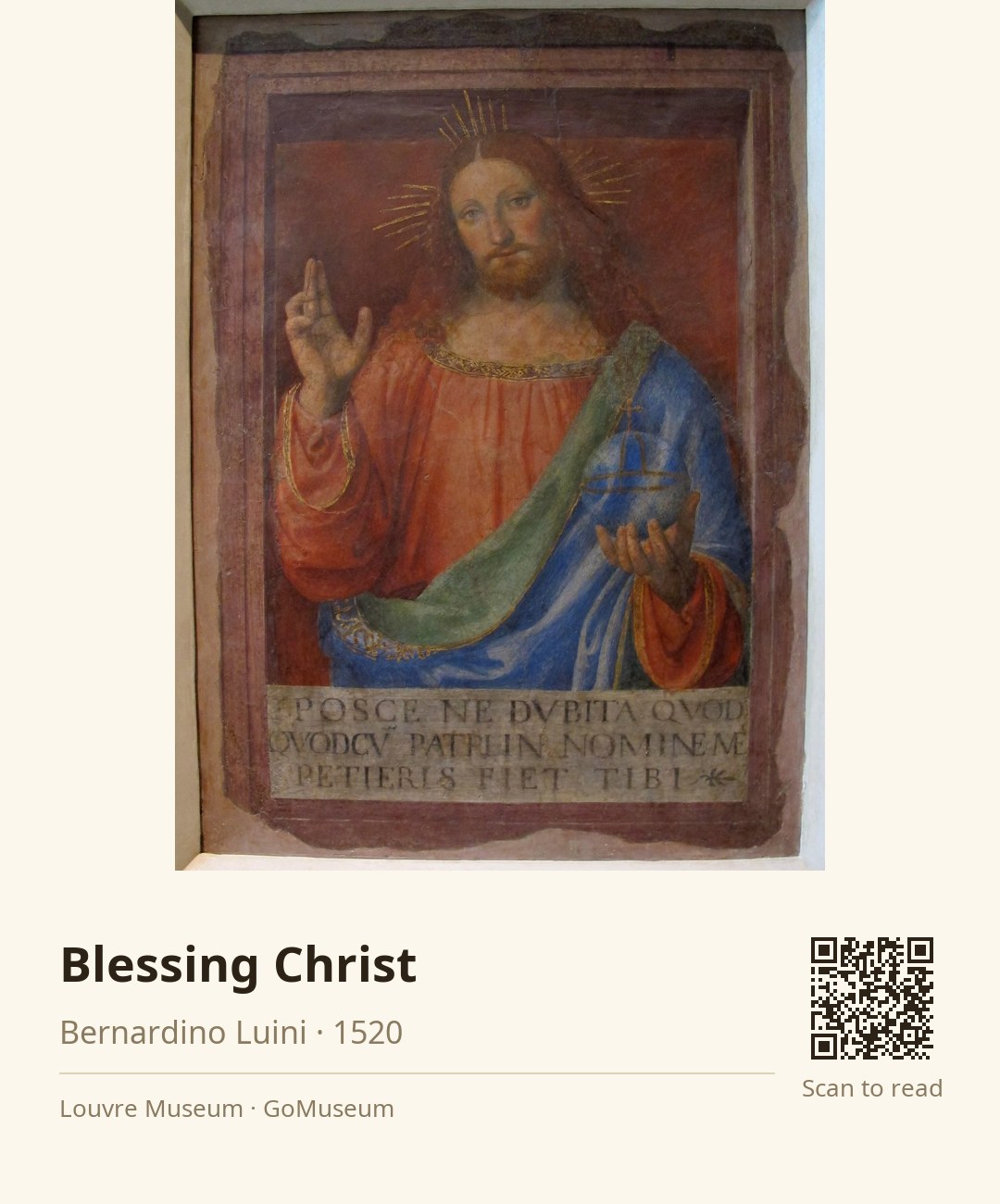
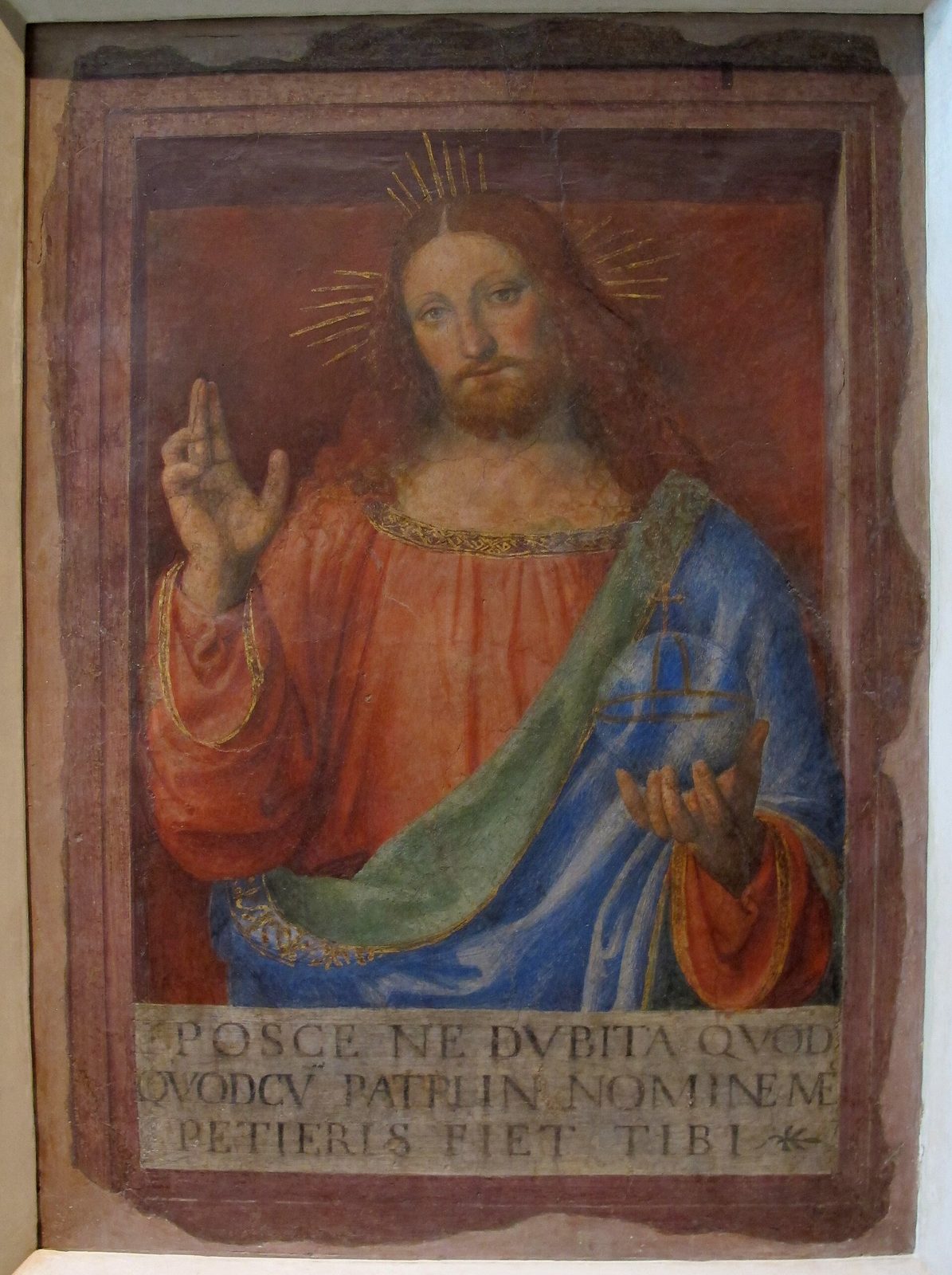
🎧 This work has audio narration — listen in the appThe figure of Christ stands out in a striking red robe with gold trim, his right hand raised in a gesture of blessing while the left cradles a globe topped with a cross. The rich palette of reds, blues, and golds enhances the solemnity of the moment, while the smooth brushwork captures the intricate folds of his garments, inviting you to appreciate the craftsmanship of Bernardino Luini.
This depiction of Christ, encircled by radiating lines that suggest a halo, embodies a moment of divine authority and grace. The inscription at the bottom, translating to "Ask and do not doubt that whatever you ask the Father in my name will be given to you," reinforces the theme of faith and intercession, making this work not just a visual feast but a profound spiritual statement.
Luini, a prominent figure in the High Renaissance, was influenced by Leonardo da Vinci and was known for his elegant compositions and graceful figures. His work often reflects the merging of religious themes with a humanistic approach, showcasing both divine and earthly beauty. Created in 1520, "Blessing Christ" exemplifies Luini's mastery in fresco and canvas, capturing the essence of his era's artistic and spiritual aspirations.
Bernardino Luini, born around 1480 in Runo, Italy, was a prominent painter of the High Renaissance, closely associated with Leonardo da Vinci's circle. His artistic journey began in Milan, where he likely trained under notable figures like Giovan Stefano Scotto and Ambrogio Bergognone. Luini's works, characterized by graceful female figures and elongated features, often drew comparisons to Leonardo, leading to many of his pieces being mistakenly attributed to the master.
Throughout his career, Luini created significant frescoes and panel paintings, including the renowned Passion and Crucifixion in Lugano and various works for the Rabia family, showcasing his evolving style influenced by both Leonardo and Raphael. His art reflects a delicate balance of verismo and idealism, earning him a reputation as a "delicate and vague" painter, as noted by contemporaries like Vasari.
Despite the scarcity of personal details about his life, Luini's contributions to Lombard painting were substantial, and he remained a respected figure in art history, particularly in the 19th century, when his works were celebrated for their beauty and craftsmanship. He passed away in Milan in 1532, leaving behind a legacy that continues to inspire artists and art lovers alike.
The smooth brushwork allows for a delicate rendering of Christ's robe, with intricate folds that suggest movement and depth. The rich color palette—vibrant reds, deep blues, and shimmering golds—creates a striking visual impact, drawing the viewer's eye to the figure of Christ. The composition is carefully balanced, with Christ's raised hand and the globe creating a dynamic tension. The use of radiating lines around his head not only suggests a halo but also enhances the sense of divine presence, making the viewer feel the weight of the moment. Luini's ability to blend realism with spiritual symbolism is what truly sets this work apart.