 Image: Sailko
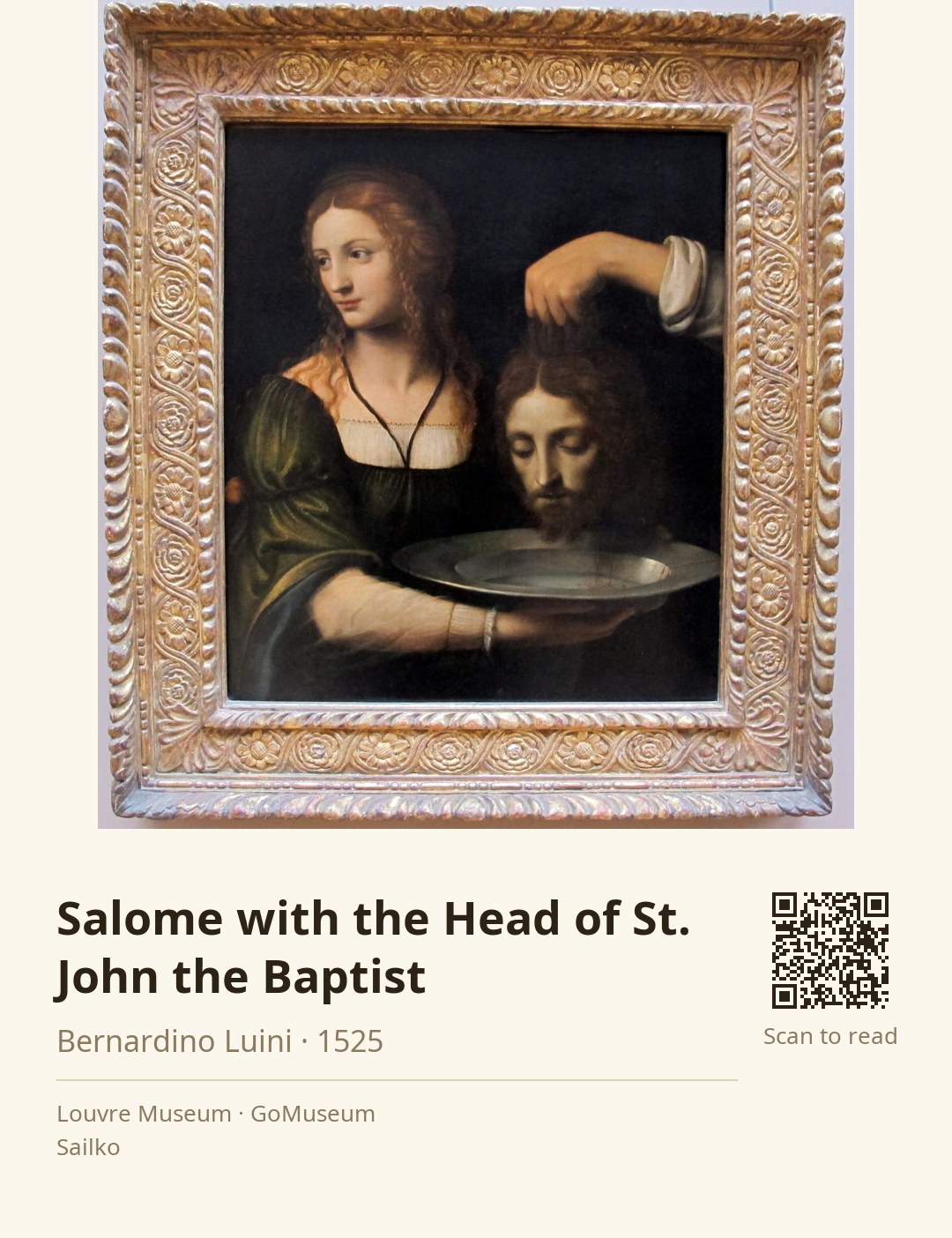
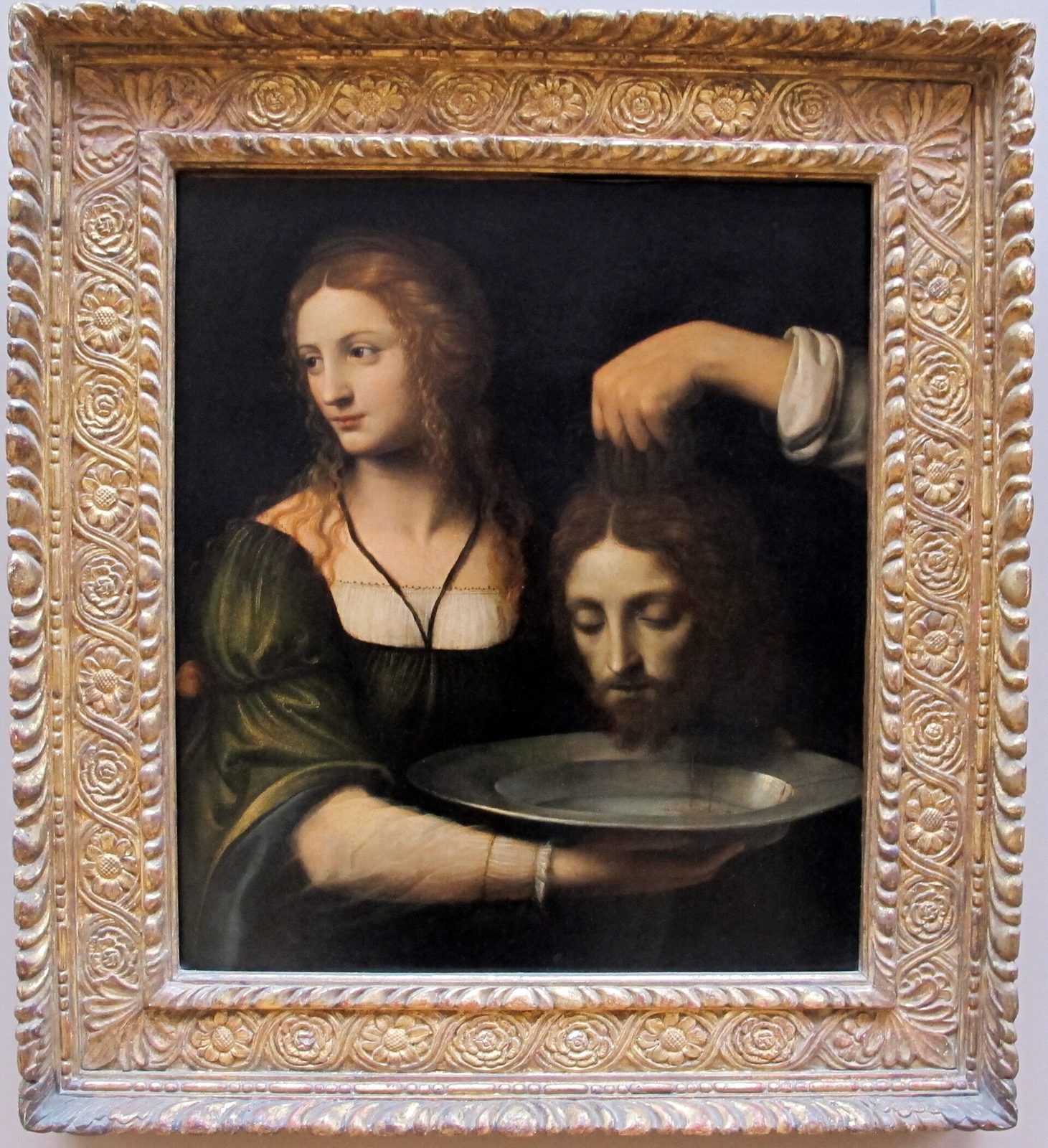
Salome with the Head of St. John the Baptist
🎧 This work has audio narration — listen in the appSalome stands poised, her dark green gown contrasting sharply with the pale platter she holds, which bears the severed head of St. John the Baptist. The head, serene with closed eyes, suggests a haunting calmness, while Salome's contemplative gaze drifts to the side, hinting at the weight of her actions. The hand grasping the hair of the head adds a chilling intimacy to the scene, emphasizing the personal nature of this biblical moment.
This composition captures the tension between beauty and horror, a hallmark of Luini's style, which often blends graceful figures with unsettling narratives. The dark background serves to isolate Salome and her grim trophy, drawing our focus to the intricate textures of her clothing and the reflective surface of the platter. Luini, influenced by Leonardo da Vinci, infused his works with a delicate balance of light and shadow, enhancing the emotional depth of his subjects.
Active in Milan during the early 16th century, Bernardino Luini created this painting in 1525, reflecting both his mastery of oil on canvas and the dramatic storytelling that characterized the High Renaissance. His works often explore complex themes, merging beauty with darker elements, as seen in this striking portrayal of Salome.
Bernardino Luini, born around 1480 in Runo, Italy, was a prominent painter of the High Renaissance, closely associated with Leonardo da Vinci's circle. His artistic journey began in Milan, where he likely trained under notable figures like Giovan Stefano Scotto and Ambrogio Bergognone. Luini's works, characterized by graceful female figures and elongated features, often drew comparisons to Leonardo, leading to many of his pieces being mistakenly attributed to the master.
Throughout his career, Luini created significant frescoes and panel paintings, including the renowned Passion and Crucifixion in Lugano and various works for the Rabia family, showcasing his evolving style influenced by both Leonardo and Raphael. His art reflects a delicate balance of verismo and idealism, earning him a reputation as a "delicate and vague" painter, as noted by contemporaries like Vasari.
Despite the scarcity of personal details about his life, Luini's contributions to Lombard painting were substantial, and he remained a respected figure in art history, particularly in the 19th century, when his works were celebrated for their beauty and craftsmanship. He passed away in Milan in 1532, leaving behind a legacy that continues to inspire artists and art lovers alike.
Commissioned in 1525, 'Salome with the Head of St. John the Baptist' was created by Bernardino Luini, a prominent figure in the Milanese art scene. This painting reflects the high drama of the early 16th century, a time when Luini was deeply influenced by Leonardo da Vinci's techniques. It was once owned by the notable collector Everhard Jabach in 1671 and later became part of the royal collection of Louis XIV, the Sun King of France. This connection to French royalty speaks volumes about its esteemed status.
Luini's technique in this painting showcases his mastery of oil on canvas, particularly in how he handles color and texture. The dark green gown of Salome is rich and deep, contrasting starkly with the pale, reflective surface of the platter that holds St. John's head. This choice of color not only draws your eye but also enhances the emotional weight of the scene. The brushwork is delicate, especially in the intricate details of Salome's gown, where you can almost feel the fabric's texture. Luini's use of light is strategic; it highlights the serene expression on the severed head, creating a chilling juxtaposition against Salome's contemplative demeanor. The composition is dynamic yet balanced, with Salome's figure slightly off-center, which adds a sense of movement and tension, inviting viewers to ponder the story behind her gaze.
Luini's later works, such as St. Anne and St. Catherine, show an increasing influence from Leonardo da Vinci.