Borghese Gladiator
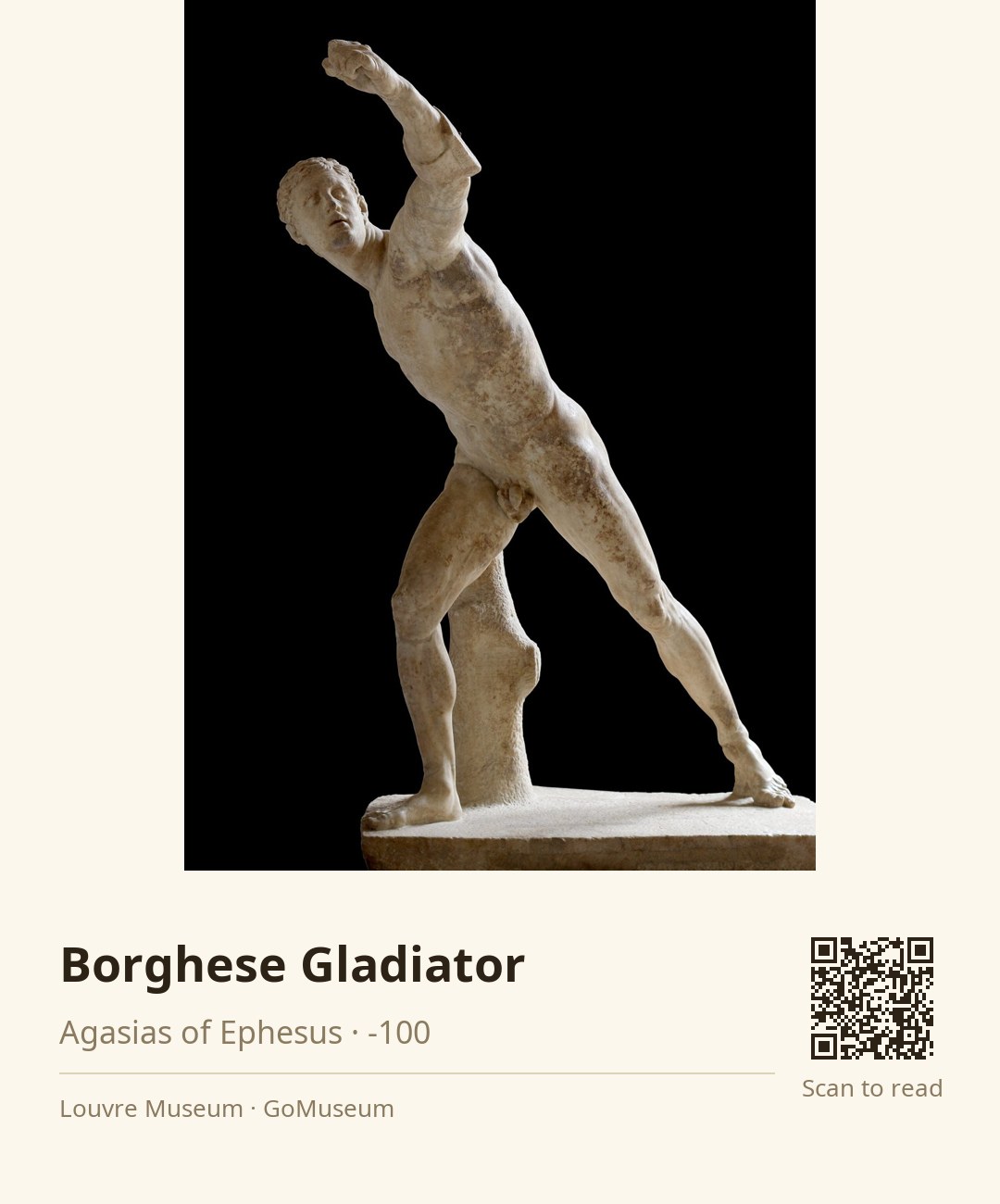
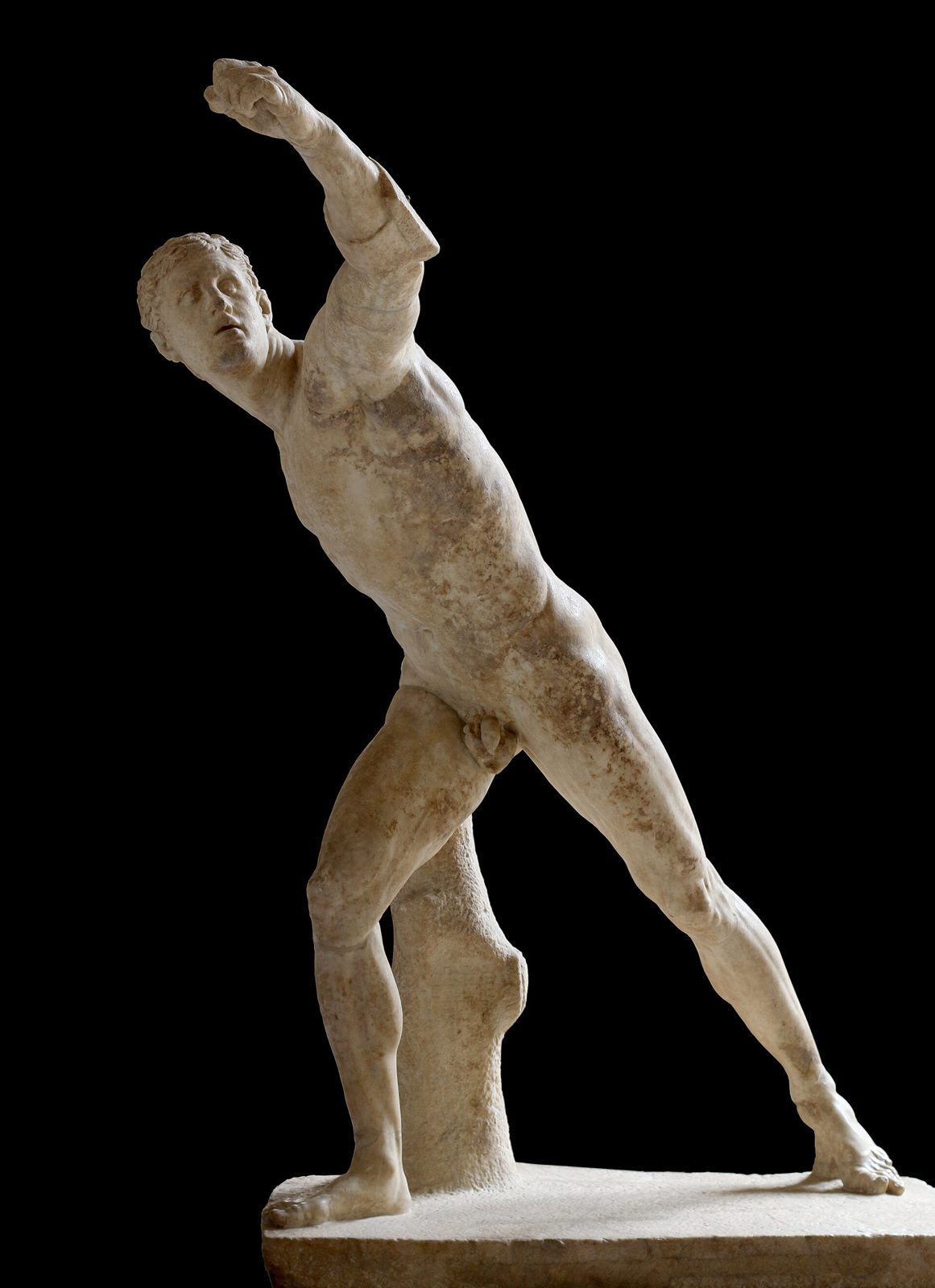
🎧 This work has audio narration — listen in the appTake a moment to really look at the Borghese Gladiator. Notice how the figure stands tall and poised, muscles taut, as if caught in a moment of fierce action. The way his head is turned, looking over his shoulder, suggests he’s engaged in a battle, perhaps against a mounted opponent.
Now, focus on the intricate details of his body. The veins in his arms, the tension in his shoulders, and the way his left arm is raised to shield himself—all these elements create a sense of movement and urgency. This isn’t just a statue; it’s a snapshot of a warrior in the heat of combat, showcasing the Hellenistic mastery of capturing human emotion and physicality.
Created around 100 BC by Agasias of Ephesus, this sculpture was initially misidentified as a gladiator due to a restoration error.
As you stand here, think about how this sculpture has traveled through time—from its discovery near Rome to its place in the Louvre today. What stories do you think this warrior could tell if he could speak?
Take a closer look at the Borghese Gladiator's surface. Carved from marble, the sculptor Agasias of Ephesus showcased remarkable skill in his technique. Notice the smoothness of the skin contrasted with the intricate detailing of the muscles. The veins are not just decorative; they pulse with life, as if the warrior is about to leap into action. The way the light plays across the figure emphasizes the tension in the arms and the defined contours of the torso, creating a dynamic sense of movement. This is not merely a static statue; it feels alive, as if it could step off its pedestal at any moment.
The Borghese Gladiator was unearthed in the early 17th century, specifically around 1611, in the ruins of a seaside palace once belonging to Emperor Nero, located in modern-day Anzio, south of Rome. Initially misidentified as a gladiator due to a restoration mishap, it was actually meant to depict a heroic warrior, possibly Achilles, in combat with the Amazon queen Penthesilea. The statue quickly became a prized possession of Cardinal Scipione Borghese, who showcased it in his villa. However, in 1807, under pressure from Napoleon Bonaparte, the Borghese collection was sold to the French emperor, leading to the statue's relocation to the Louvre, where it remains a centerpiece of ancient art today.
The Borghese Gladiator, crafted by Agasias of Ephesus around 100 BC, is a monumental piece that reshaped the world of sculpture. Initially misidentified as a gladiator, this life-size marble warrior actually depicts a heroic figure in combat, capturing the dynamic tension of battle. Its rediscovery in the early 17th century ignited a fascination for classical art across Europe, influencing countless artists and sculptors. The statue became a benchmark for proportions and form, inspiring works from Rubens to Thomas Jefferson. Its presence in the Louvre today continues to echo its legacy, reminding us of the timeless allure of Hellenistic artistry and the power of the human figure in motion.
Did you know that the Borghese Gladiator was so influential that it inspired a bronze cast for King Charles I of England? This cast, made in the 17th century, was displayed in the gardens of St. James's Palace, showcasing the statue's reach beyond Italy and into the heart of English royalty. This connection highlights how the Gladiator transcended its original context, becoming a symbol of classical beauty and strength across Europe.
The Borghese Gladiator inspired numerous copies and casts across Europe, including a bronze cast for King Charles I of England, showcasing its impact on classical beauty and strength in art.
During its restoration in 1611, the statue received a modern right arm and a new ear, along with other adjustments, which contributed to its misidentification as a gladiator.