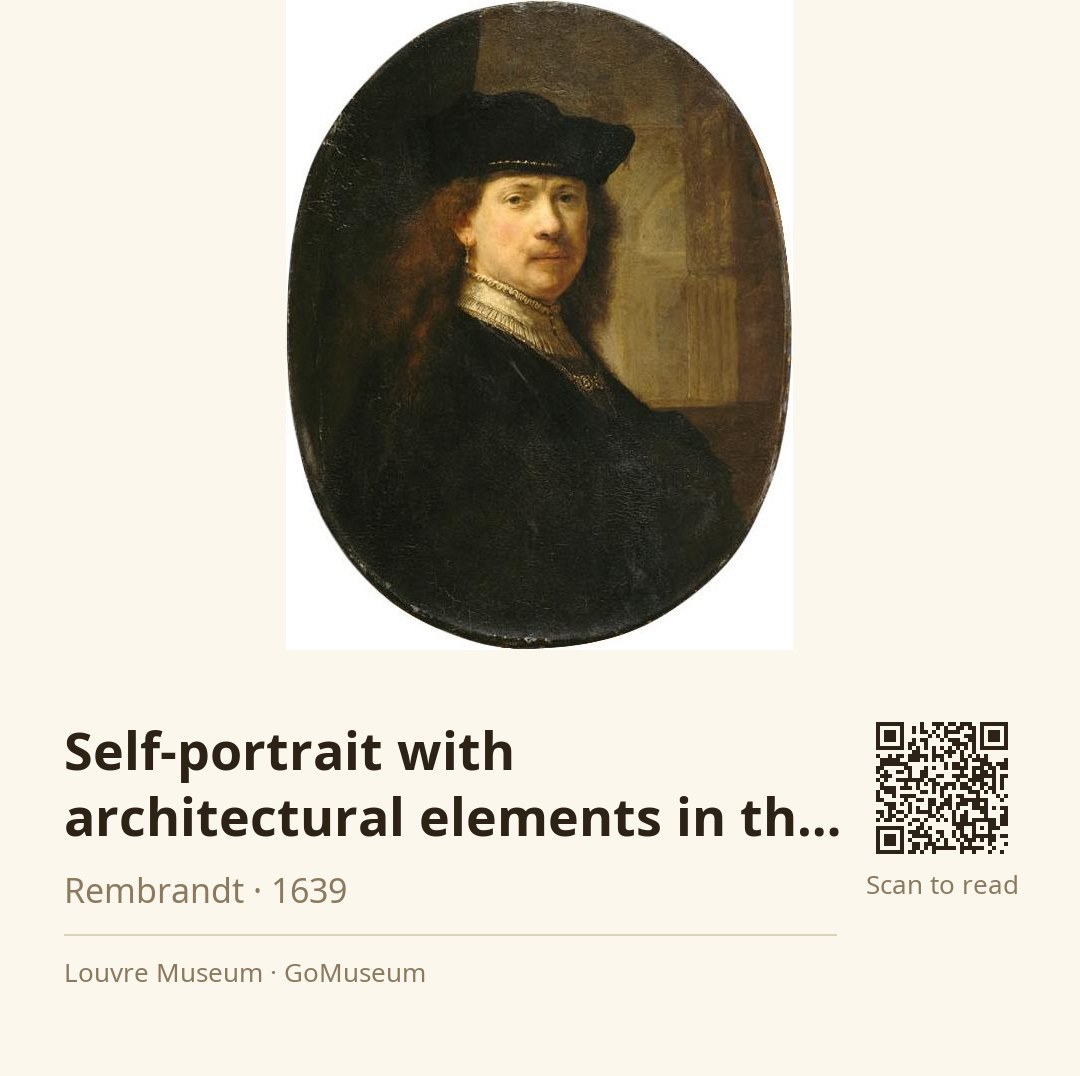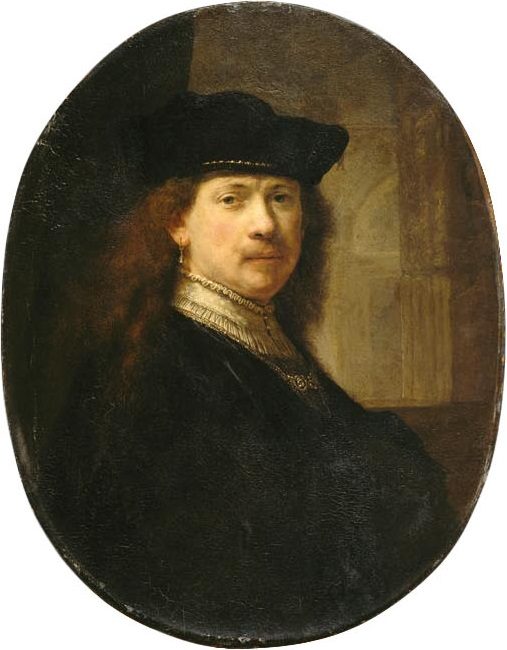
Self-portrait with architectural elements in the background
🎧 This work has audio narration — listen in the appRembrandt's self-portrait reveals a man of quiet confidence, his long, curly hair cascading beneath a dark, broad-brimmed hat. A detailed, pleated white collar frames his face, while a chain around his neck adds a touch of elegance. The architectural element in the background, possibly an archway, hints at the artist's connection to the world of structure and form, grounding his identity as both a painter and a thinker.
This juxtaposition of the artist's serene expression against the muted tones of the background reflects a moment of introspection, inviting viewers to consider the duality of his existence as both a creator and a subject. The rich, dark palette, with its subtle highlights, showcases Rembrandt's mastery of texture, capturing not just the fabric of his clothing but the very essence of his character. The painting serves as a testament to the artist's innovative approach, blending personal narrative with the grandeur of architectural elements, a hallmark of his work.
Created around 1639, this oil on oak panel self-portrait is part of a complex history, believed to have evolved from an earlier version painted by Rembrandt himself.
Rembrandt Harmenszoon van Rijn, born on July 15, 1606, in Leiden, was a pivotal figure of the Dutch Golden Age and is celebrated as one of the greatest artists in Western art history. His oeuvre includes around three hundred paintings, three hundred etchings, and numerous drawings, showcasing a remarkable range of styles and subjects, from intimate portraits to grand historical and biblical scenes.
Rembrandt's artistic journey began in Leiden, where he was influenced by both Dutch and Italian masters. He opened his studio in 1625 and quickly gained recognition for his portrait work. His move to Amsterdam marked a significant turning point, as he became a sought-after portraitist and married Saskia van Uylenburgh, a union that brought both joy and tragedy. The couple faced immense personal losses, including the deaths of their children and Saskia's own passing in 1642, which deeply affected his work.
Despite financial struggles later in life, Rembrandt's innovative techniques, particularly in etching, transformed the medium into a respected art form. His mastery of light and shadow, known as chiaroscuro, and his empathetic portrayal of human experience set him apart from his contemporaries. Rembrandt's legacy endures through his profound ability to capture the complexities of the human condition, making him a cornerstone of art history.
Rembrandt's technique in this self-portrait is nothing short of masterful. The oil paint glides over the oak panel, creating a rich texture that draws you in. His brushwork is both deliberate and fluid, capturing the softness of his curly hair and the intricate details of his collar. The dark palette, punctuated by subtle highlights, creates a sense of depth and dimension. The architectural element in the background isn't just a backdrop; it serves to elevate Rembrandt's presence, framing him as both a painter and a thinker. The three-quarter view invites intimacy, making you feel as though he is engaging directly with you. This combination of technique and composition showcases Rembrandt's innovative approach, blending personal narrative with the grandeur of his surroundings.