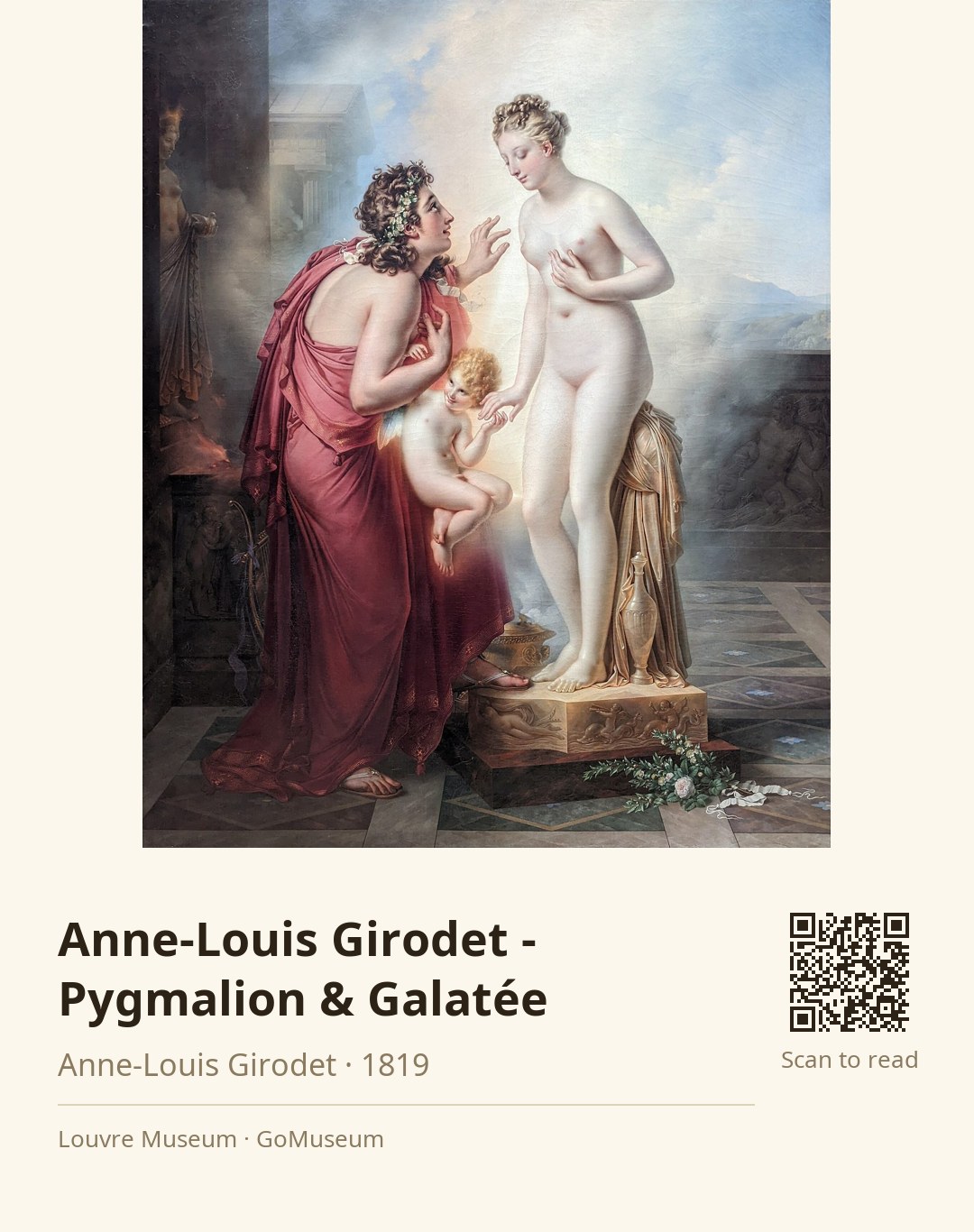
Anne-Louis Girodet - Pygmalion & Galatée
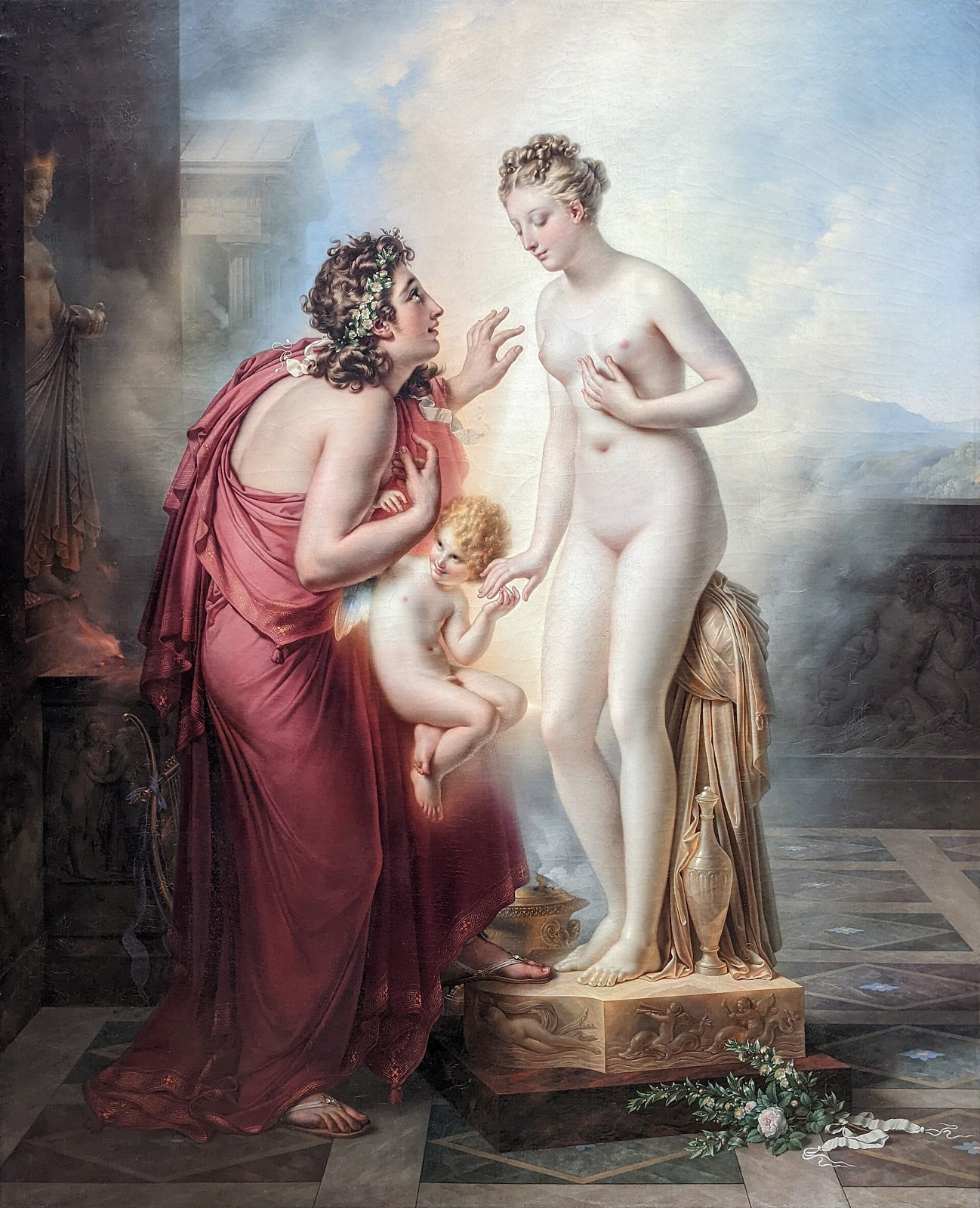
🎧 This work has audio narration — listen in the appTake a moment to really soak in the magic of Anne-Louis Girodet's "Pygmalion and Galatée." Look closely at Galatée's face—notice how her cheeks blush with a soft pink, almost like a newborn's? That delicate touch isn’t just about beauty; it captures the very moment she springs to life from stone, embodying the myth of creation itself.
Now, shift your gaze to Pygmalion. His expression is a mix of awe and disbelief, as if he can't quite grasp the miracle unfolding before him. The red robe he wears, adorned with a crown of dog roses, symbolizes both his royal lineage and the passionate love he holds for his creation. This interplay of light and shadow around him draws your eye to his face, emphasizing the emotional weight of this moment.
Girodet spent six long years on this painting, reflecting not only his dedication but also the challenges he faced, from finding models to personal illness. This piece, completed in 1819, marked the end of his career, blending Neoclassical precision with Romantic emotion.
As you stand here, think about the story behind this artwork. What does it mean to you to witness a moment where art transcends its medium, breathing life into the inanimate? How does that resonate with your own experiences of love and creation?
Anne-Louis Girodet de Roussy-Trioson, born on January 29, 1767, in Montargis, was a pivotal figure in the transition from Neoclassicism to Romanticism in French art. A talented pupil of Jacques-Louis David, he gained recognition for his precise style and innovative approach, incorporating elements of eroticism and emotional depth into his works. After losing both parents in his youth, he was adopted by his guardian, Dr. Benoît-François Trioson, whose influence shaped his career.
Girodet's artistic journey began with a focus on architecture before he shifted to painting, winning the prestigious Prix de Rome at just 22. His time in Italy profoundly impacted his style, leading to acclaimed works like "Endymion" and "Hippocrates Refusing the Gifts of Artaxerxes." Upon returning to France, he painted notable portraits, including members of the Bonaparte family, and won the decennial prize for "Scène du déluge."
Despite his success, Girodet faced personal challenges, including declining health in his later years. His final works, such as "Pygmalion and Galatea," reflected a deterioration in his artistic vigor. He passed away on December 9, 1824, in Paris, leaving behind a legacy that bridged classical ideals and Romantic sensibilities, influencing future generations of artists. His contributions were later celebrated in major exhibitions, affirming his place in art history.
Anne-Louis Girodet's "Pygmalion and Galatée" was commissioned by Giovanni Battista Sommariva, an Italian patron who sought to pay homage to the sculptor Antonio Canova. The painting's journey began in 1813, but it took Girodet six years to complete, a timeline marked by personal challenges, including the death of his guardian and his own illness. The piece debuted at the Salon of 1819, where it was met with a mix of admiration and critique, reflecting the transitional period of art from Neoclassicism to Romanticism. This work, completed in the twilight of Girodet's career, encapsulates not just his artistic evolution but also his struggles, making it a poignant testament to his legacy. It now resides in the Louvre, a fitting home for a piece that bridges two significant artistic movements.
In "Pygmalion and Galatée," Girodet masterfully blends light and shadow to create a sense of ethereal beauty. The soft, diffused light enveloping Galatée enhances her transformation from marble to flesh, while the incense smoke adds an air of mystique. Notice how the brushwork varies—delicate strokes define Galatée's skin, contrasting with the more robust, textured application on Pygmalion's robe. This choice highlights the emotional weight of the moment, drawing your eye to their expressions. The composition is carefully structured, with Pygmalion's upward gaze and Galatée's serene demeanor creating a visual dialogue between hope and wonder. The use of color is equally striking; the vibrant red of Pygmalion's robe symbolizes passion, while the soft pink of Galatée's cheeks suggests innocence and new life. This interplay of elements not only captures the myth's essence but also evokes a visceral response from the viewer.
Anne-Louis Girodet's 'Pygmalion and Galatée' isn't just a stunning visual; it marks a pivotal moment in art history, bridging Neoclassicism and Romanticism. This painting, completed in 1819, showcases Girodet's unique ability to infuse classical themes with emotional depth, influencing future artists who sought to explore the human experience beyond mere representation. The way he captures the moment of Galatea's transformation from marble to flesh resonates with the Romantic ideal of individual emotion, setting a precedent for later movements. Remember, this work isn't just about beauty; it's about the very essence of creation and desire, a theme that continues to inspire artists today.
One intriguing aspect of Girodet's process is his struggle to find suitable models for Galatée. He was so dedicated to capturing the perfect representation of flesh that he faced considerable challenges in selecting individuals who could embody his vision. This quest for authenticity not only delayed the painting's completion but also reflects Girodet's commitment to his craft, illustrating the lengths he would go to achieve the ideal beauty he envisioned.
Girodet struggled to find suitable models that could embody his vision of Galatée, which delayed the painting's completion. His dedication to capturing the ideal representation of flesh highlights his commitment to authenticity in his art.
Sommariva, who commissioned the work, had a tumultuous history, including fleeing to France after the invasion of Milan and later becoming a dictator in Italy. His love for Neoclassical art and mythological themes shaped his desire for a piece that paid homage to the sculptor Antonio Canova.