Portrait of a Young Man
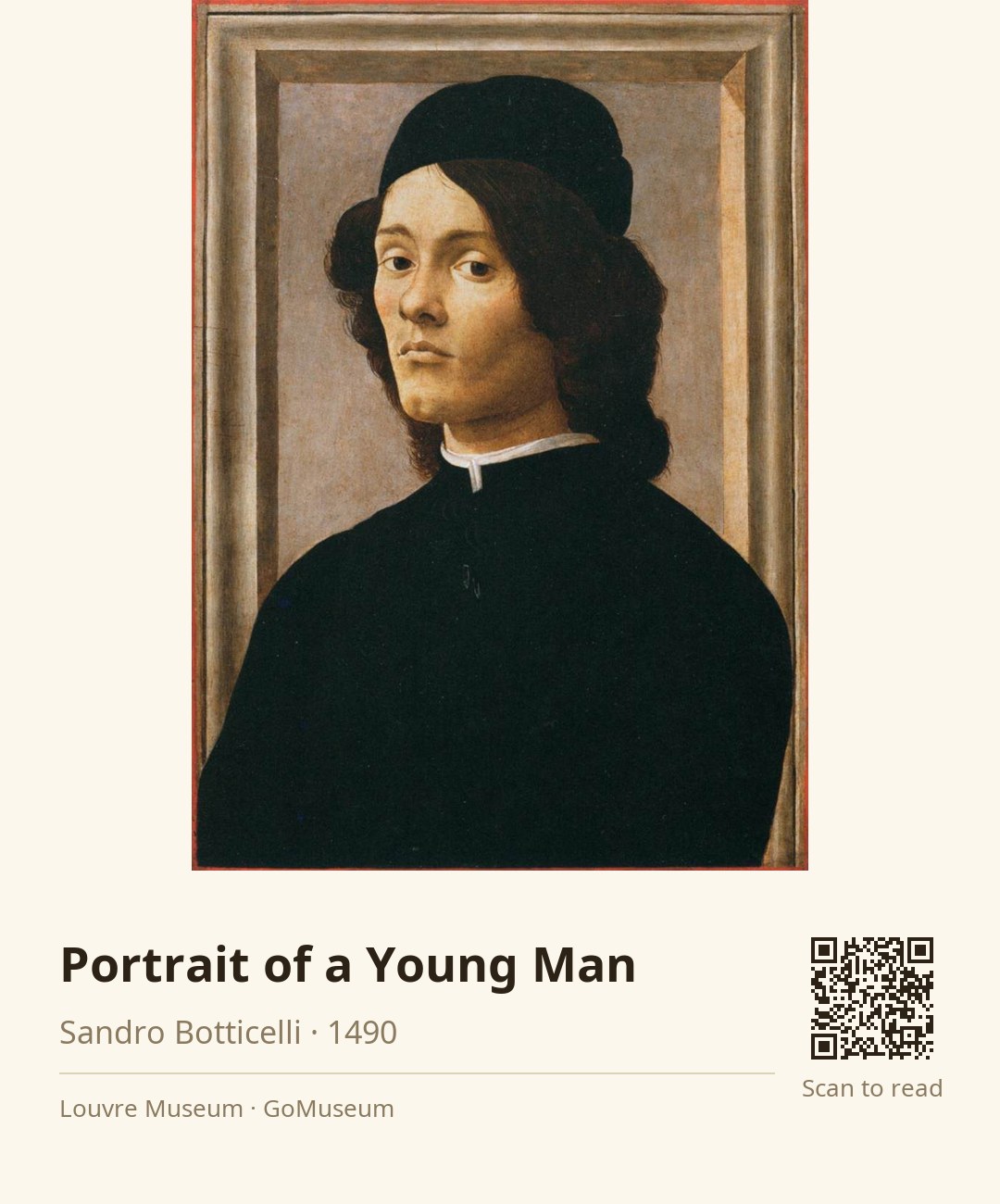
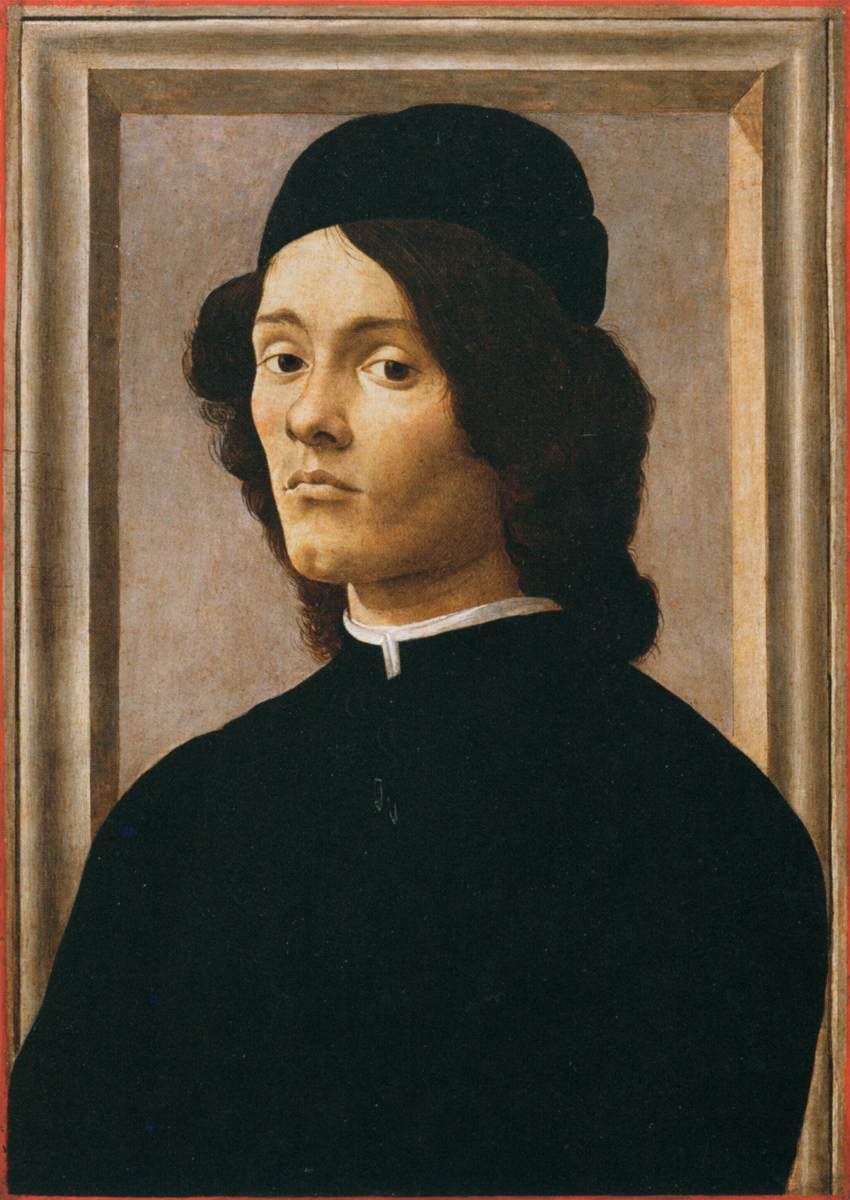
🎧 This work has audio narration — listen in the appThe young man in this portrait gazes directly at you, his expression both inviting and enigmatic. Dressed in a dark garment with a high collar and a black cap, his shoulder-length wavy hair frames a face that seems to hold a story of its own. The muted background, painted in soft, earthy tones, enhances the subject's presence, while the trompe-l'œil frame creates an illusion of depth that draws you in.
This straightforward composition emphasizes the young man's attire and expression, reflecting the Renaissance focus on individual character and emotion. Botticelli's smooth brushwork highlights the textures of the fabric and the subtle nuances of the subject's features, showcasing his skill in capturing the essence of humanity. The choice of a simple, neutral background allows the viewer to concentrate entirely on the young man, making him the focal point of the piece.
Created around 1490, this painting exemplifies Botticelli's mastery during a period when he was transitioning towards a more personal style.
Filippino Lippi, born around 1457 in Prato, Tuscany, was an influential Italian Renaissance painter, the illegitimate son of the renowned artist Fra Filippo Lippi. His upbringing was marked by the artistic environment of his father's workshop, where he began his training. After his father's death, Filippino continued to hone his skills under Sandro Botticelli, contributing to a blend of styles that defined his early works.
As a painter, Filippino specialized in religious themes, often depicting elongated figures and intricate details that conveyed a sense of the surreal. His style evolved significantly after a formative period in Rome, where he absorbed classical influences and developed a unique approach characterized by vibrant, imaginative compositions. His notable works include the frescoes in the Brancacci Chapel and the altarpiece for the Strozzi Chapel, which reflect the political and religious tensions of his time.
Filippino's contributions to art history are significant; he is recognized for bridging the Early and High Renaissance styles, paving the way for the expressive tendencies that would lead to Mannerism. His innovative techniques, including visible brushwork, influenced later artists and positioned him as a pivotal figure in the evolution of Renaissance art. He passed away in Florence on April 18, 1504, leaving behind a legacy that continues to resonate in the art world.
The 'Portrait of a Young Man' was created by Sandro Botticelli around 1490, during a pivotal time in his artistic journey. This painting is housed in the Louvre Museum in Paris, where it has captivated audiences for centuries. The painting's reception has varied over time; initially overshadowed by Botticelli's more famous mythological works, it gained recognition in the late 19th century as art historians began to appreciate his portraiture. Pillet, which adds to its rich history. The inventory number RF 323 indicates its significance within the museum's collection, marking it as a key piece of Botticelli's oeuvre.
The brushwork is remarkably refined, with each stroke contributing to the lifelike quality of the young man's features. The subdued palette of earthy tones enhances the emotional depth of the subject, while the high collar and dark garment create a striking contrast against the muted background. This choice of color and texture draws the viewer's attention directly to the young man's expression, which is both inviting and mysterious. The straightforward composition, with the subject in a three-quarter view, emphasizes his gaze, creating an intimate connection with the audience. The trompe-l'œil frame cleverly adds a sense of depth, making the viewer feel as if they are peering into a window rather than simply observing a painting.
One intriguing aspect of the 'Portrait of a Young Man' is its uncertain identity. Unlike many portraits of the time that clearly depict known figures, this young man remains anonymous, leading to much speculation about who he might be. This mystery adds an air of intrigue to the painting, inviting viewers to ponder the story behind his gaze and the life he led. Some art historians suggest he could represent an idealized version of youth or even a symbolic figure, which only deepens the allure of Botticelli's work.
The young man remains anonymous, which leads to much speculation about who he might be, adding an air of mystery to the painting.
Living in Florence allowed Botticelli to remain deeply connected to the city's artistic community and patrons, influencing his style and subject matter throughout his career.