The Young Martyr
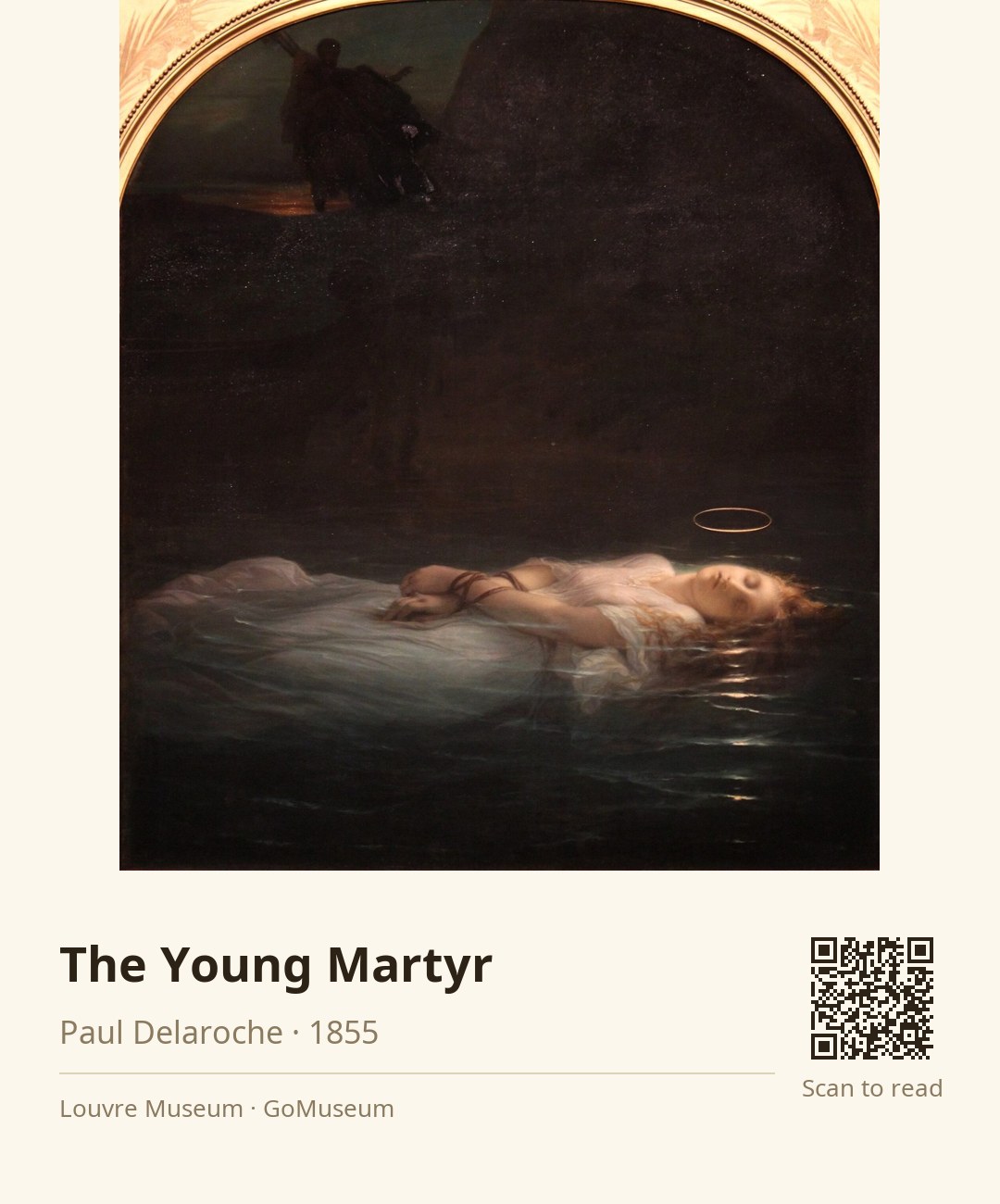
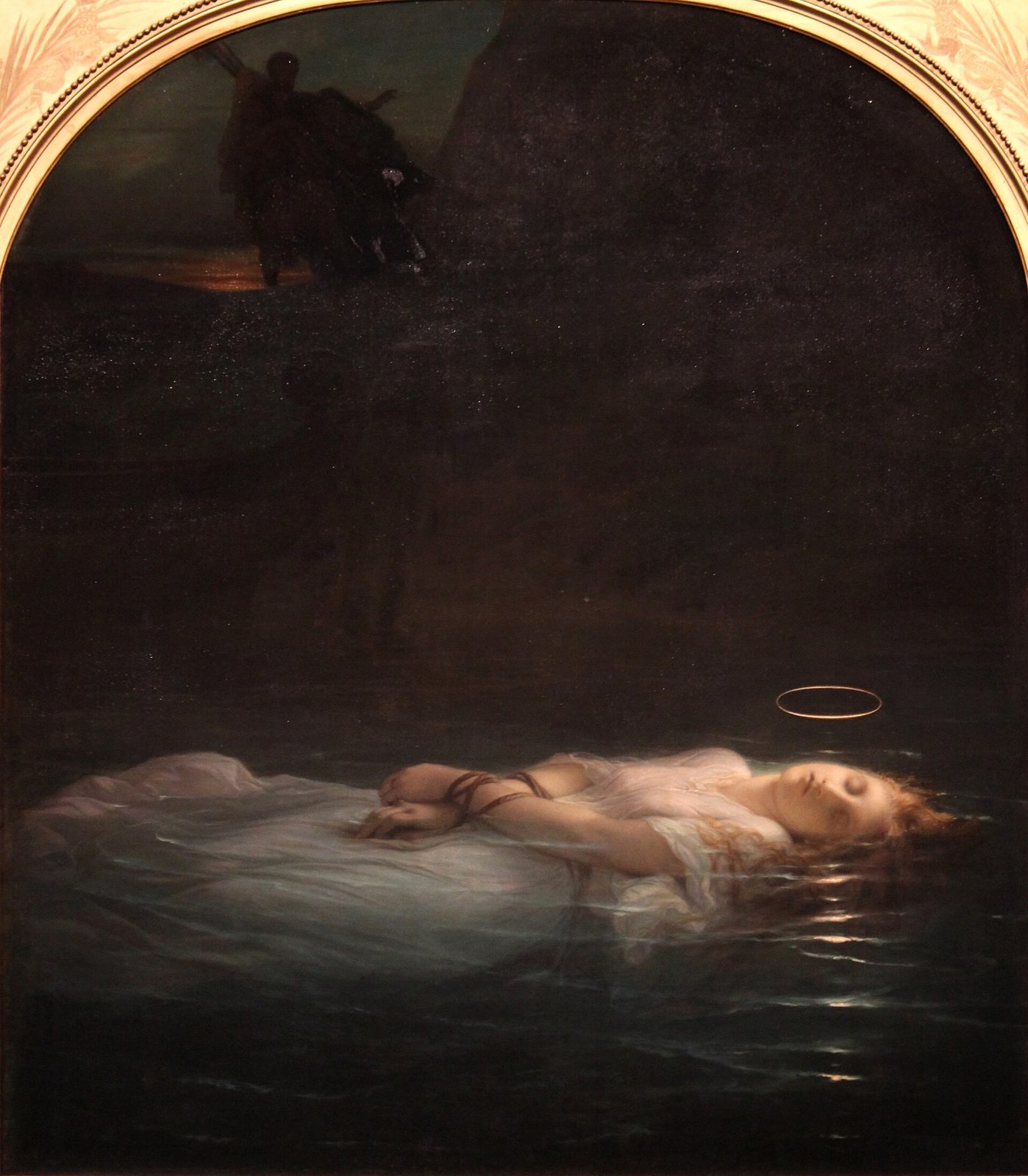
🎧 This work has audio narration — listen in the appTake a moment to really absorb the scene before you in Paul Delaroche's "The Young Martyr." Notice how the young woman, bound and floating on the Tiber, seems to hover between life and death. Her serene expression contrasts sharply with the turmoil of the figures in the background, who are clearly in despair.
Look closely at the halo above her head; it’s not just a symbol of her sanctity but also the primary source of light in this otherwise dimly lit painting. This halo creates a striking focal point, illuminating her face and hands, while the rest of the scene fades into shadow. It’s a powerful reminder of the hope and faith that can shine through even the darkest moments.
By depicting a young female martyr, he not only highlights the tragedy of her fate but also reflects his own personal grief over the loss of his wife a decade earlier. This emotional weight adds depth to the painting, making it resonate on multiple levels.
As you stand here, consider what the young martyr represents. Is she merely a figure of suffering, or does she embody resilience and faith? What emotions does her expression evoke in you? Let that linger as you take in the rest of the artwork.
Hippolyte-Paul Delaroche was a prominent French painter born on July 17, 1797, in Paris, where he spent most of his life until his death on November 4, 1856. Known for his historical scenes, Delaroche's work straddled the lines between Romanticism, Academicism, and Neoclassicism, reflecting the emotional depth of Romantic ideals while adhering to the meticulous detail favored by Academics. His pragmatic realism allowed him to portray historical figures, such as Marie Antoinette and Napoleon Bonaparte, with a sense of equality, devoid of glorification.
Delaroche emerged as a significant figure in the art world during a time of stylistic conflict between Romanticism and Classicism. His early works, particularly "The Execution of Lady Jane Grey," garnered acclaim and established him as a leading historical painter. He was a student of Antoine-Jean Gros and later mentored notable artists like Jean-Léon Gérôme and Jean-François Millet. Despite his success, Delaroche faced criticism for his later religious works, leading him to withdraw from public exhibitions after 1837.
His artistic journey began at L'École des Beaux-Arts, where he initially focused on landscapes but soon shifted to history painting under Gros's influence. Delaroche's legacy includes a rich body of work that resonated with the public and influenced future generations, making him a key figure in 19th-century art history. His marriage to Louise Vernet and the subsequent loss of her in 1845 deeply affected him, yet his contributions to the art world remain significant. Delaroche's paintings continue to be celebrated for their narrative quality and emotional resonance, solidifying his place in the annals of art history.
Completed in 1855, Paul Delaroche's 'The Young Martyr' is a poignant oil painting that captures the emotional weight of martyrdom. The painting finds its home in the Louvre, Paris, while a smaller version from 1853 resides at the Hermitage Museum in Saint Petersburg. Delaroche's work was well-received, reflecting his ability to blend historical accuracy with dramatic flair, a hallmark of the Romantic style. As he painted, he drew upon the historical context of Christian persecution under the Roman Emperor Diocletian, which adds layers of meaning to the scene depicted. The painting's emotional resonance and Delaroche's meticulous attention to detail made it a significant work in his oeuvre, showcasing the artist's mastery during the latter years of his life.
Delaroche's technique in 'The Young Martyr' showcases his mastery of oil painting, allowing for intricate details and a rich texture that draws viewers in. Notice how the chiaroscuro—strong contrasts between light and dark—creates a dramatic atmosphere, emphasizing the young martyr's serene face against the shadowy despair of the figures in the background. The halo above her head serves as the primary light source, casting a soft glow that highlights her features and hands, while the rest of the scene fades into darkness. This choice not only elevates her presence but also symbolizes hope amidst suffering. The ripples around her fingers suggest a gentle movement, adding a sense of life to her otherwise still form. The composition, with its elongated verticality, enhances her ethereal quality, making her appear suspended between two worlds—life and death.
Completed in 1855, this painting not only showcases Delaroche's flair for dramatic storytelling but also reflects a pivotal moment in art history where Romanticism began to intertwine with historical narrative. This work stands as a testament to the power of art to comment on the human condition, resonating with viewers long after its creation. Remember, it's not just a painting; it's a bridge connecting us to the struggles of the past.
The faint white star in the upper left corner may allude to various historical or religious narratives, potentially representing either the morning star, which could symbolize the presence of evil, or the North Star, suggesting a divine presence.
Delaroche was initially celebrated for his historical paintings, but after 1837, he faced criticism for his religious works, leading him to stop exhibiting, even as he continued to paint diligently until his death.