Manchester Madonna
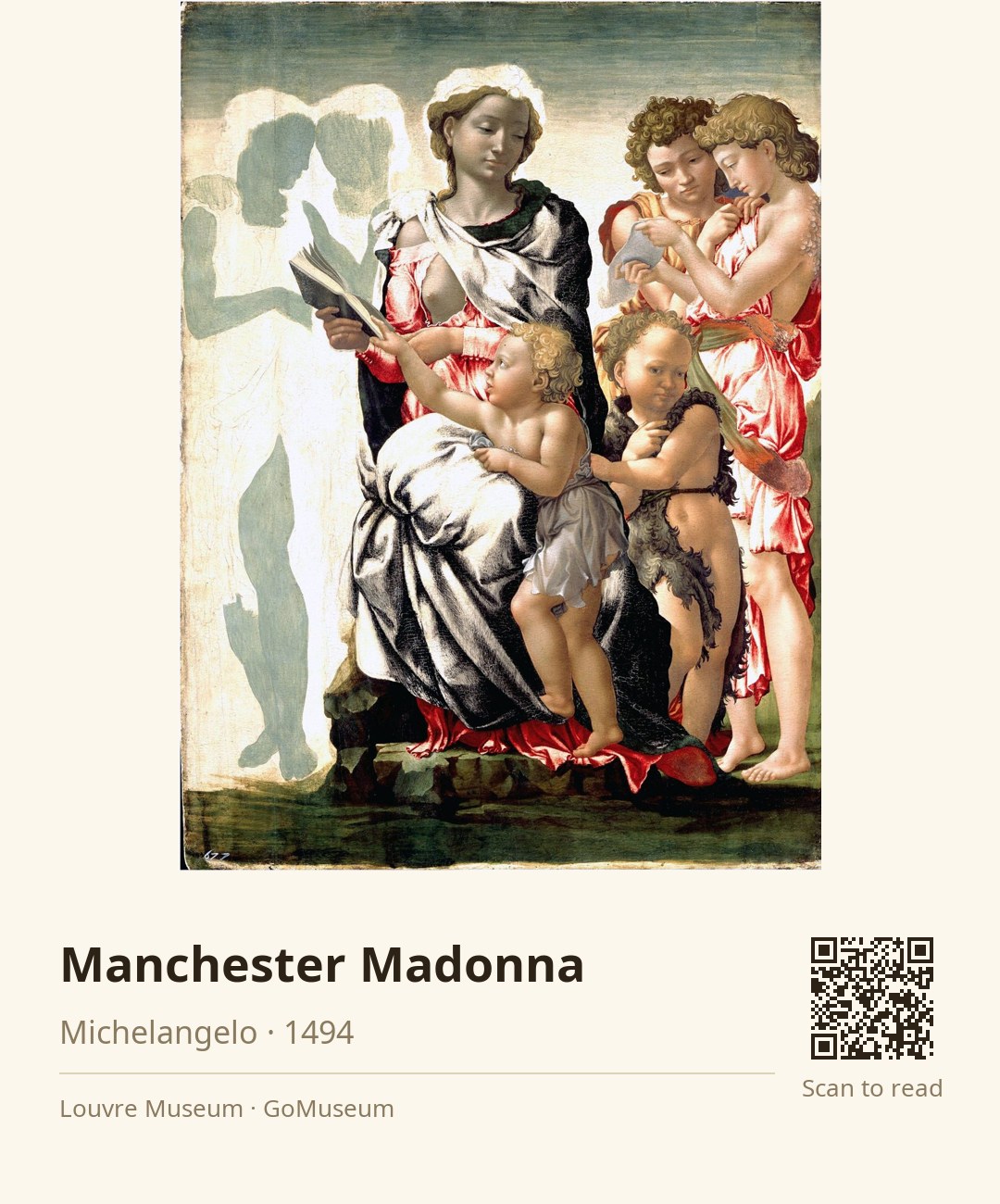
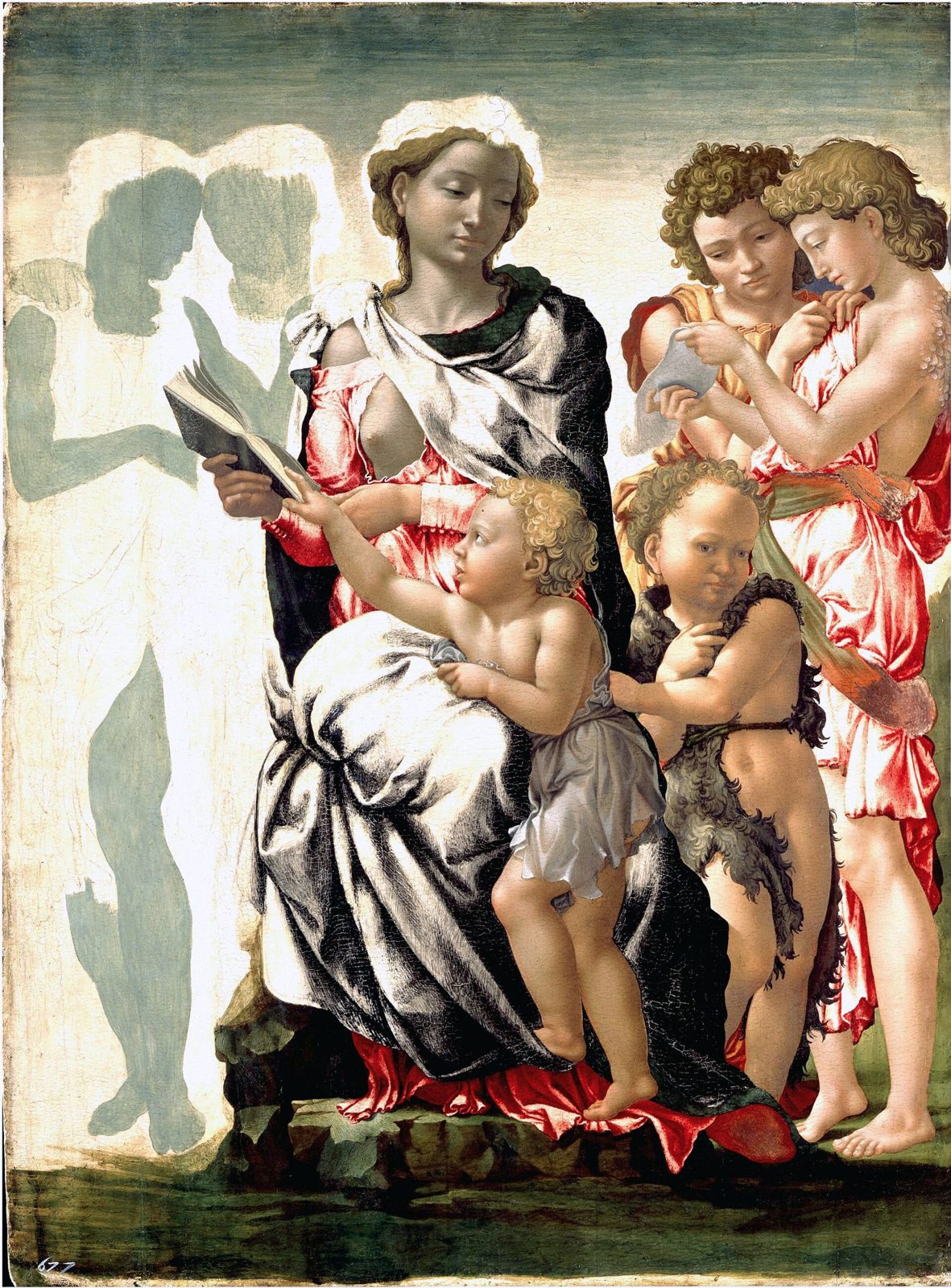
🎧 This work has audio narration — listen in the appTake a moment to really look at the Manchester Madonna. Notice how the Virgin Mary cradles the infant Jesus, her gaze turned over her shoulder, as if she's aware of something profound just out of sight. Look closely at her bare breast—it's a striking detail that hints at the intimate bond of motherhood, evoking the medieval tradition of the Virgin breastfeeding.
This isn't just a casual depiction; it speaks volumes about the nurturing aspect of Mary, while also foreshadowing the sacrifice that awaits Jesus.
Created by Michelangelo in 1494, this unfinished piece captures the artist's sculptural mindset, with figures arranged like a frieze, drawing your eye to the center where Mary and Jesus stand. The plain background, devoid of elaborate scenery, emphasizes the figures and their emotional weight, a choice that reflects Michelangelo's innovative approach to painting.
As you stand here, think about the unfinished nature of this work. What stories do you think Michelangelo intended to tell? How does this sense of incompletion affect your view of the divine?
Michelangelo di Lodovico Buonarroti Simoni, known simply as Michelangelo, was a towering figure of the High Renaissance, born on March 6, 1475, in Caprese, Italy. He grew up in Florence, where his early exposure to marble and art ignited a lifelong passion for sculpting. His formative years were marked by a profound influence from classical antiquity, shaping his artistic vision and driving his relentless pursuit of perfection across various mediums, including sculpture, painting, architecture, and poetry.
Michelangelo achieved remarkable fame early in his career, creating masterpieces such as the Pietà and David before turning 30. Though he considered himself primarily a sculptor, his frescoes on the Sistine Chapel ceiling and The Last Judgment are among the most significant works in Western art history. His architectural contributions, notably the design of St. Peter's Basilica, further solidified his legacy.
Regarded as "Il Divino" by his contemporaries, Michelangelo's ability to evoke awe through his art was unparalleled. He was one of the first artists to have his biography published during his lifetime, with Giorgio Vasari proclaiming him the greatest artist of all time. His impact on art is profound, influencing the Mannerist movement and leaving a lasting legacy that continues to inspire artists today. Michelangelo passed away on February 18, 1564, in Rome, but his work endures as a testament to the genius of the Renaissance.
This event marked its debut, and it was here that the painting earned its name. For much of the 19th and 20th centuries, the painting's attribution to Michelangelo was debated, but today, most scholars agree on its authenticity. This piece is one of only three surviving panel paintings attributed to him, showcasing his early work during his first period in Rome. The painting's journey through history reflects the changing perceptions of Michelangelo's artistry, as it transitioned from doubt to recognition, ultimately becoming a celebrated example of Renaissance art.
As you gaze at the Manchester Madonna, notice the way Michelangelo's brushwork captures a sense of movement and emotion. The unfinished quality of the painting reveals his sculptural mindset; the figures are arranged in a frieze-like composition that draws your eye to the center. The Virgin Mary and the Child Jesus are positioned prominently, with the background kept deliberately plain, emphasizing their emotional weight. The use of light and shadow creates a striking contrast, enhancing the three-dimensionality of the figures. Michelangelo's choice to leave areas in a preliminary state, such as the Virgin's robe, which was intended to be painted in rich lapis lazuli, invites you to ponder the artist's process and intentions. This technique, known as 'non finito,' not only showcases his mastery but also evokes a sense of anticipation, as if the work is still in dialogue with its creator.
This unfinished work not only reflects the artist's innovative approach but also influenced generations of artists who sought to capture the emotional depth and physicality of figures. The way Michelangelo arranged the figures in a frieze-like composition, emphasizing the Virgin and Child, shifted the narrative focus in religious art. It paved the way for future explorations of the Madonna theme, inspiring artists like Raphael and beyond. Remember, this painting is more than just a depiction; it’s a glimpse into the evolution of art during the High Renaissance, where the boundaries of sculpture and painting began to blur, forever changing the landscape of Western art.
One intriguing aspect of the Manchester Madonna is that the completed angel nearest the Virgin bears a striking resemblance to a sketch Michelangelo created while he was still an apprentice to Domenico Ghirlandaio. This connection highlights the continuity of Michelangelo's artistic development and suggests that even in his early years, he was already laying the groundwork for his later masterpieces.
The unfinished areas, particularly the Virgin's robe and the angels, illustrate Michelangelo's 'non finito' technique, which invites viewers to engage with the artist's creative process and consider what the final work might have looked like.
The completed angel nearest to the Virgin closely resembles a sketch Michelangelo made during his apprenticeship to Domenico Ghirlandaio, showcasing the continuity and evolution of his artistic style from his early years.