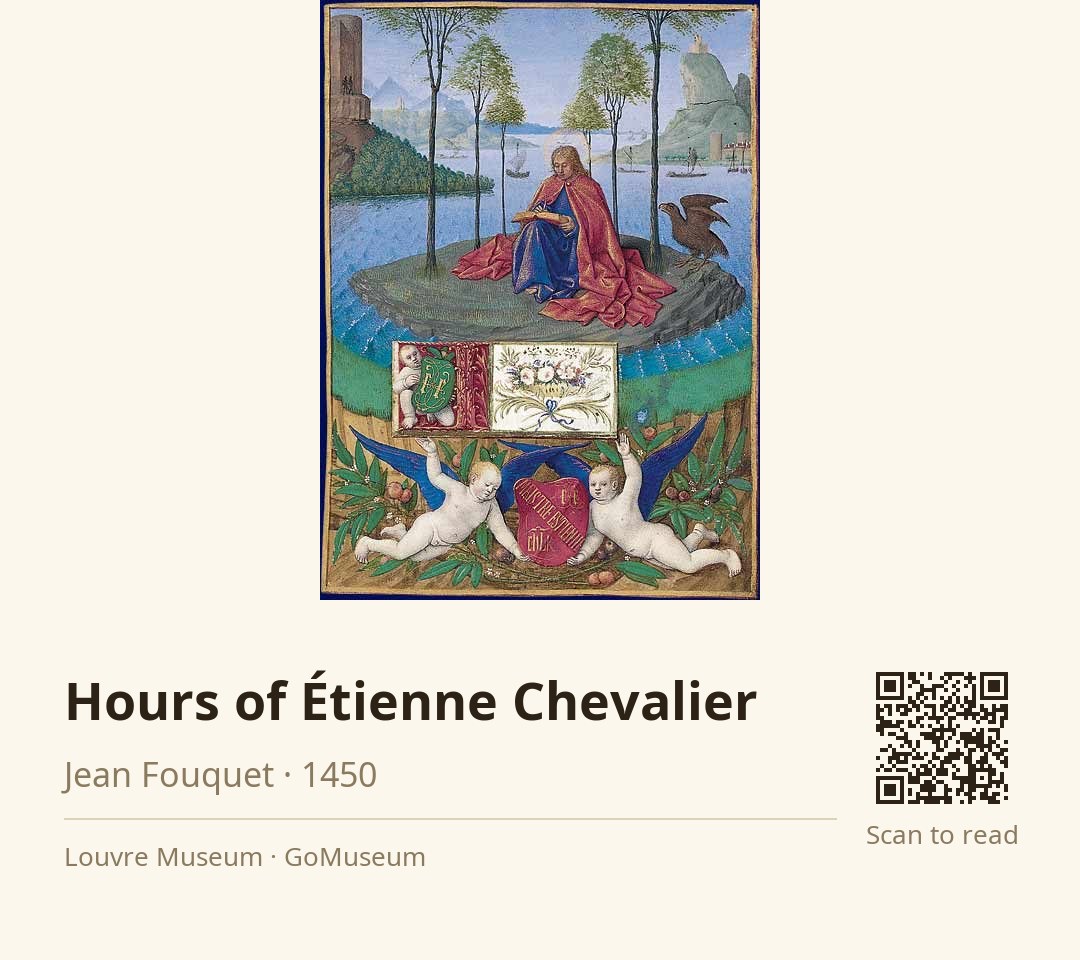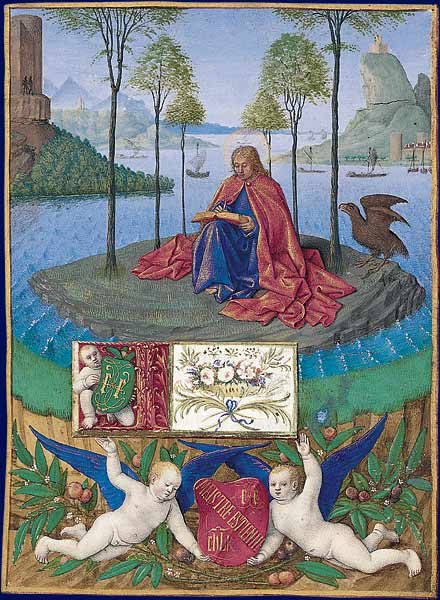
Hours of Étienne Chevalier
🎧 This work has audio narration — listen in the appTake a moment to really look at the Hours of Étienne Chevalier. Notice how the rich colors and intricate details draw you in, especially the delicate gold leaf that glimmers in the light. Focus on the figure of Étienne Chevalier himself, depicted in prayer before the Virgin. His expression is one of deep devotion, and the way he is framed by the ornate border emphasizes his importance.
These details matter because they reveal not just the artistry of Jean Fouquet, but also the personal connection between the artwork and its commissioner. Chevalier was treasurer to King Charles VII, and this book of hours was likely created shortly after the death of his wife, making it a deeply personal work. The presence of his monogram throughout the miniatures signifies his status and the intimate nature of this commission.
Fouquet was one of the first French artists to embrace the techniques of the Italian Renaissance, blending them with the Gothic style. This fusion created a unique visual language that would influence generations of artists.
As you stand here, consider what it must have been like for Chevalier to hold this book in his hands, turning its pages in quiet reflection. What thoughts or prayers might he have whispered as he sought solace in its illuminations?
Jean Fouquet, born around 1420 in Tours, was a pivotal French painter and miniaturist whose work bridged the late Gothic and early Renaissance periods. Little is known about his early life, but he likely trained under the Jouvenal Master in Nantes before traveling to Italy between 1445 and 1447. There, he absorbed the influences of Quattrocento artists, notably Fra Angelico and Filarete, which he later integrated into his own style, blending it with the techniques of the Van Eycks.
Fouquet gained prominence at the French court, serving patrons like Charles VII and Louis XI. His art played a significant role in shaping French national identity post-Hundred Years' War, exemplified by his portrayal of Charles VII as a magus. His miniatures, particularly from the Hours of Étienne Chevalier, showcase his meticulous detail and characterization, establishing him as a master illuminator.
His most renowned work, the Melun Diptych, reflects his innovative approach to portraiture and religious themes. Despite falling into obscurity after his death, Fouquet's legacy was revived in the 19th century, and he is now celebrated as a foundational figure in French art history, credited with the invention of the portrait miniature and influencing generations of artists.
The Hours of Étienne Chevalier was commissioned by Étienne Chevalier himself, who served as treasurer to King Charles VII of France. This illuminated manuscript was likely created around 1452, shortly after the death of Chevalier's wife, making it a deeply personal work. The manuscript includes 48 leaves, with 47 miniatures, but only a fraction survives today, scattered across various collections in Europe and the United States. Most notably, 40 miniatures are housed at the Musée Condé in Château de Chantilly. The manuscript remained with Chevalier's descendants until the 17th century, when it began to be divided and sold off. By the end of the 18th century, many miniatures were mounted on panels, and during the French Revolution, they were sold to art dealers, eventually making their way into private collections and museums. This journey through time reflects the shifting tides of ownership and appreciation for this remarkable work.
Jean Fouquet, the artist behind this work, was not just a miniaturist; he was a pioneer who integrated Italian techniques into French art, setting a precedent for future generations. This manuscript, commissioned by Étienne Chevalier, reflects the personal and spiritual journey of its patron, making it a deeply intimate piece. Its intricate miniatures, filled with vibrant colors and innovative compositions, influenced the direction of French illumination, inspiring artists to explore more complex narratives and emotional depth in their works. Remember this: Fouquet's ability to capture the essence of his subjects not only immortalized Chevalier but also marked a significant shift in how art could convey personal stories within religious contexts.
One particularly intriguing aspect of the Hours of Étienne Chevalier is its tumultuous journey through history. Originally a complete manuscript, it was meticulously cut apart in the 18th century, with each miniature sold separately, transforming them into individual artworks. This act of division not only obscured the original text but also scattered its beauty across various collections. Imagine the shock of art lovers today, realizing that what was once a unified masterpiece is now a puzzle spread across continents, with only fragments of its original glory remaining.
After the 17th century, the manuscript was divided and sold off, with many miniatures cut out to be sold as separate artworks. This led to a scattering of its pages across various collections in Europe and the United States.
Chevalier's monogram 'EE' appears throughout the miniatures, symbolizing his personal connection to the work and serving as a mark of his status, as he was a prominent figure in the royal administration.