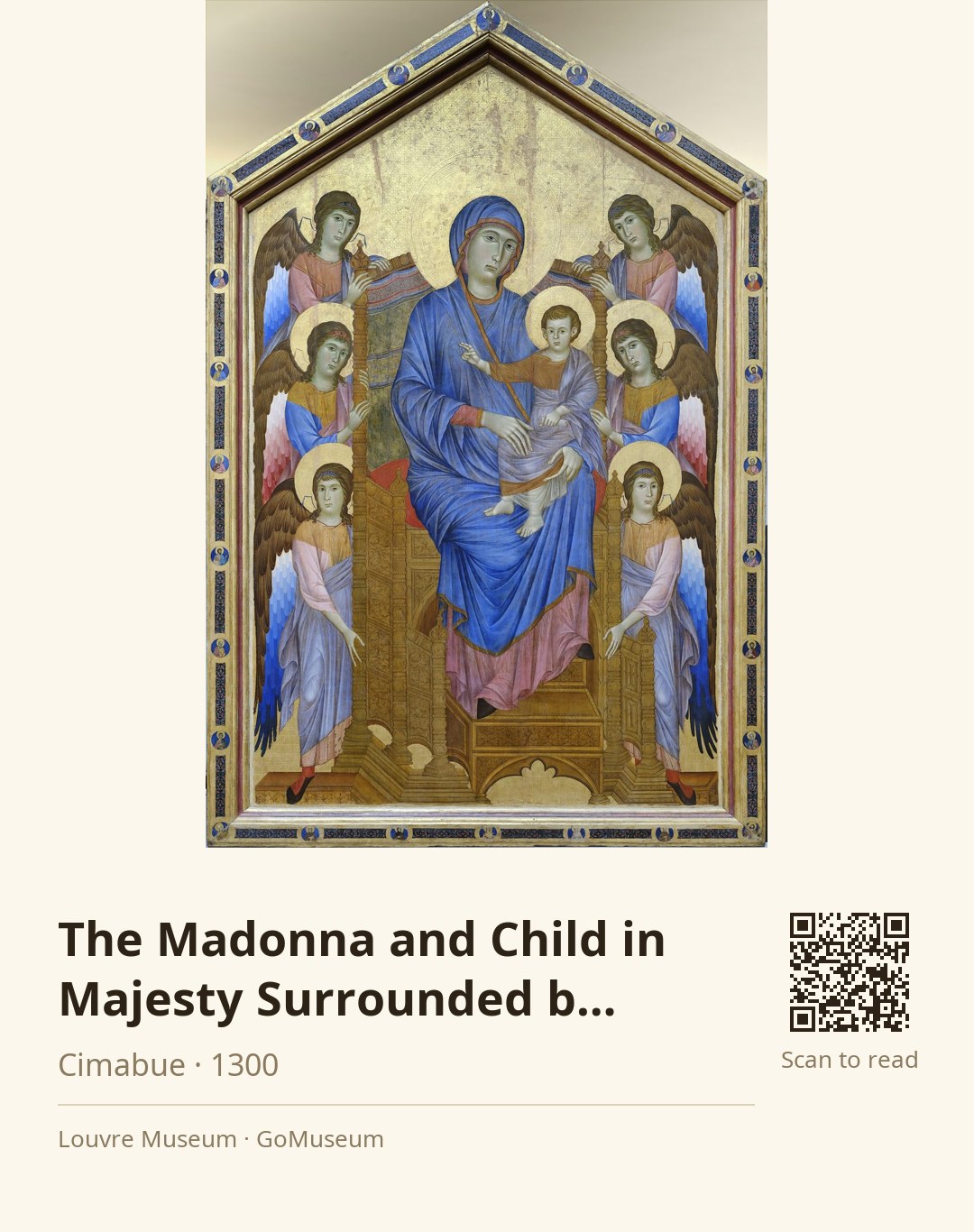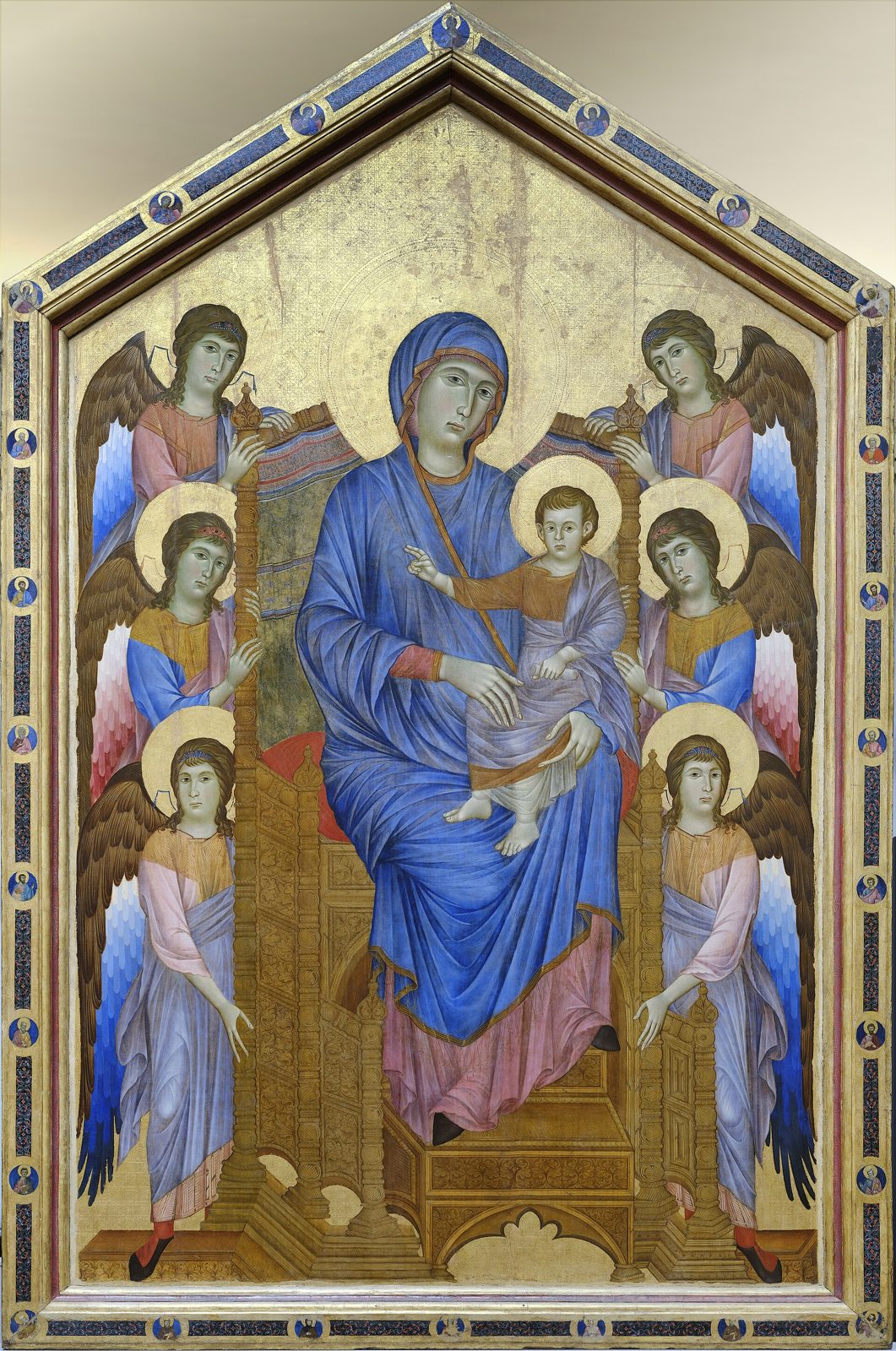
The Madonna and Child in Majesty Surrounded by Angels
🎧 This work has audio narration — listen in the appTake a moment to really look at Cimabue's "The Madonna and Child in Majesty Surrounded by Angels." Notice how the Virgin Mary sits regally on her throne, draped in deep blue, a color that symbolizes her royal status. Now, focus on the expressions of the angels surrounding her—each one has a gentle, almost melancholic look, their faces echoing a shared sense of reverence and sorrow.
These details matter because they reveal Cimabue's innovative approach to emotional depth in religious art. Unlike many of his predecessors, he captures not just the divine majesty of Mary and Jesus, but also the human emotions that connect us to them.
Cimabue was one of the first artists to break away from the rigid forms of Byzantine art, paving the way for future masters like Giotto. His work was originally housed in the church of San Francesco in Pisa, before being taken to the Louvre during the Napoleonic era.
As you stand here, think about how this artwork invites you into a moment of divine grace. What emotions does it stir in you? How does it change the way you see the relationship between the sacred and the human?
Giovanni Cimabue, born around 1240 in Florence and passing in 1302 in Pisa, is a pivotal figure in the transition from Byzantine to early Renaissance art. Known as Cenni di Pepo, he is celebrated for his innovative approach to painting, which introduced more naturalistic proportions and emotional depth to figures, marking a departure from the rigid Italo-Byzantine style. His seminal works, such as the Crucifixion in Arezzo and the Maestà, reflect a blend of Byzantine influence and emerging Gothic elements, setting the stage for future artists like Giotto, whom he is often credited with mentoring, though this claim is debated among scholars.
Cimabue's career flourished through commissions from religious orders, particularly the Franciscans, which shaped his artistic vision. His frescoes in Assisi and the Maestà of Santa Trinita exemplify his ability to evoke human emotion and spirituality. Despite limited documentation of his life, his legacy is profound; he is recognized as a precursor to the naturalism that would dominate the Renaissance. His influence extended beyond Italy, impacting the trajectory of Western art. Cimabue's work remains a testament to the evolving nature of artistic expression in the late medieval period, bridging the gap between the sacred traditions of the past and the burgeoning humanism of the future.
Cimabue's 'The Madonna and Child in Majesty Surrounded by Angels' was originally painted around 1280 and displayed in the church of San Francesco in Pisa. This work, significant in the evolution of religious art, was acquired by the Louvre in 1813 during the Napoleonic looting of Italian artworks. The painting's journey reflects the turbulent history of art during this period, as many masterpieces were displaced from their original homes. Despite the tumult, this piece has remained a cornerstone of Cimabue's legacy, showcasing the transition from Byzantine rigidity to a more humanistic approach in art.
In this painting, Cimabue employs a pseudo-perspective that draws the viewer's eye directly to the Virgin Mary, seated regally on her throne. The use of gold leaf in the background creates a luminous effect, enhancing the divine quality of the scene. Notice how the deep blue of Mary's robe contrasts with the warm tones of the angels, emphasizing her importance. The brushwork is meticulous, with each angel's face rendered with a delicate touch that conveys both beauty and sorrow. The vertical alignment of the angels, three on each side, creates a sense of harmony and order, while their expressions evoke a shared emotional depth. Cimabue's choice to depict the figures without spatial arrangement reflects a transitional style, bridging the gap between the flatness of Byzantine art and the emerging naturalism of the Renaissance.
Cimabue's work set a new standard for the depiction of the Madonna and Child, influencing generations of artists who followed. His innovative approach to emotional expression in religious art paved the way for the more humanistic styles that would flourish in the Renaissance. Artists like Duccio and Giotto drew inspiration from Cimabue, further developing the narrative and emotional depth in their own works. This painting is not just a representation of the sacred; it marks a shift in how art could engage with viewers on a personal level, making it a critical piece in the history of Western art.
One intriguing anecdote about Cimabue involves his relationship with the young Giotto. According to legend, Cimabue discovered Giotto drawing sheep in the dirt and was so impressed by the boy's talent that he invited him to apprentice.
The angels in the painting are arranged vertically, with three on each side, rather than in a spatially dynamic arrangement, which reflects a transitional style from Byzantine art to more naturalistic approaches.
Cimabue's Maestà established a new canon for the depiction of the Madonna and Child that was emulated by later artists, including Duccio and Giotto, who sought to enhance emotional expression in religious art.
The pseudo-inscriptions in the border of the painting, resembling Arabic script, indicate Cimabue's interest in exotic textiles and objects from the East, reflecting the cultural exchanges of the time.