Madame Rivière
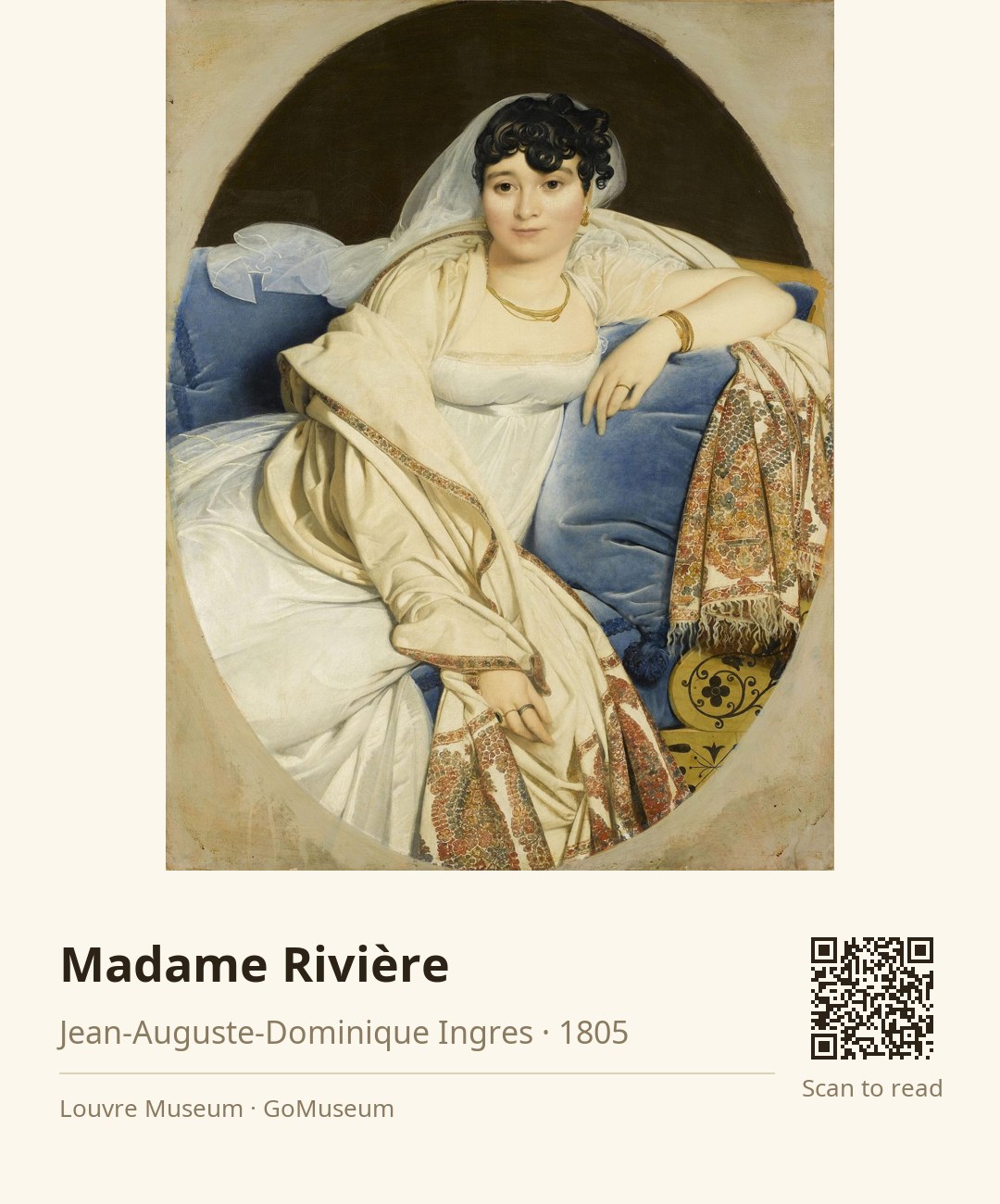
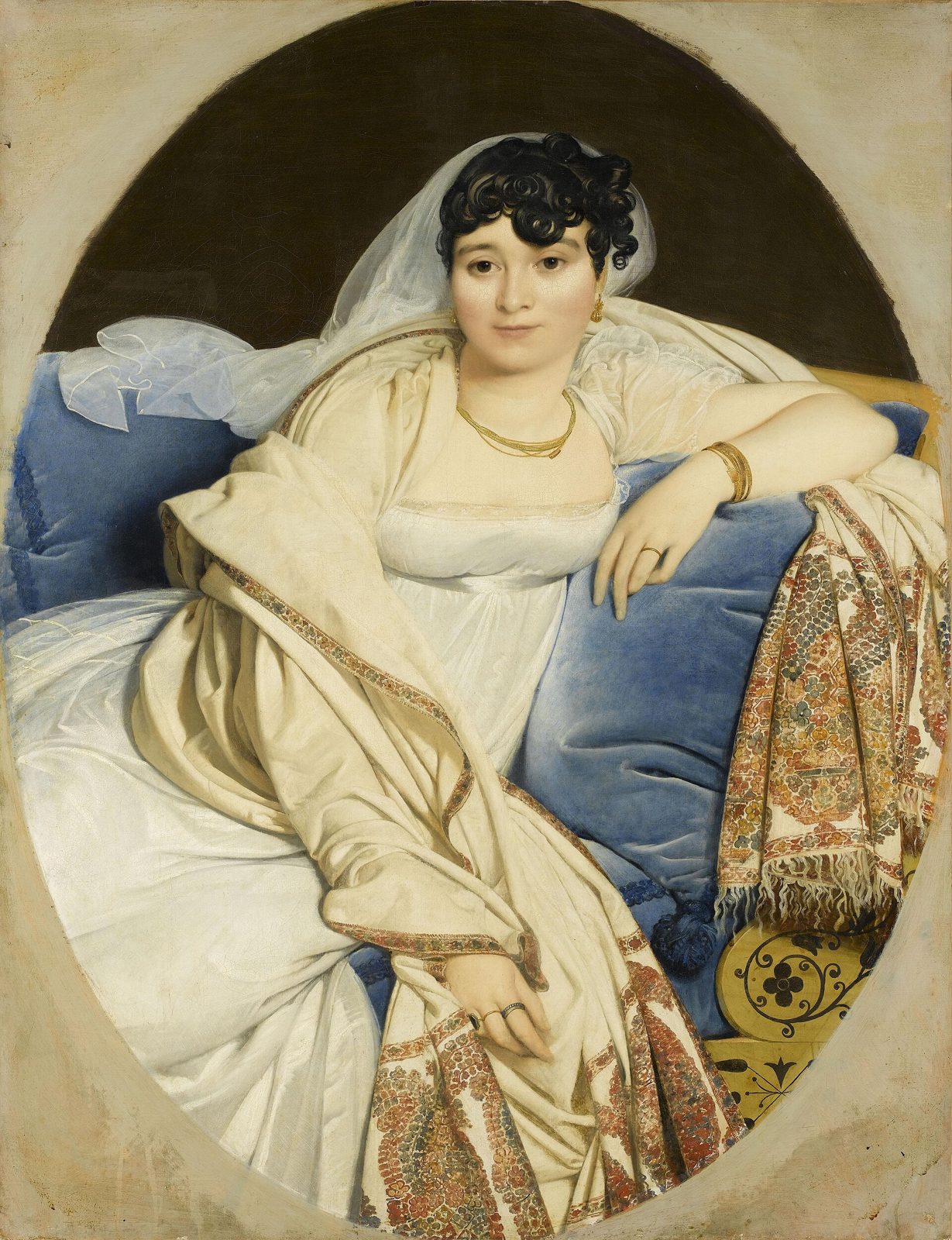
🎧 This work has audio narration — listen in the appTake a moment to really look at Madame Rivière. Notice how her right arm is elongated, almost stretching out of the frame. It’s not just a quirk; it’s a deliberate choice by Ingres, designed to echo the graceful curves of the oval shape of the painting. This technique creates a sense of harmony and rhythm, drawing your eye across the canvas and emphasizing her elegance.
Now, why does this matter? Ingres was pushing the boundaries of portraiture, blending idealized beauty with a strikingly modern approach. This painting, created in 1805, was a bold statement in a time when traditional forms were the norm. Critics were baffled by the unnatural anatomy, but this very distortion would later influence modern artists like Picasso and Matisse.
Madame Rivière, born Marie-Françoise, was the wife of a prominent Napoleonic official, and her portrait was commissioned to showcase not just her beauty but her status. Ingres, who aspired to be more than just a portraitist, captured her with a sense of both intimacy and grandeur.
As you stand here, think about the story behind this painting. What do you think Ingres wanted to convey about Madame Rivière and her world?
Jean-Auguste-Dominique Ingres was a pivotal figure in French Neoclassicism, born on August 29, 1780, in Montauban. He was the son of a versatile artist, which nurtured his early artistic inclinations. Ingres studied under Jacques-Louis David in Paris, where he developed a commitment to academic traditions, aspiring to elevate history painting above all genres. His early career was marked by struggles, as critics dismissed his style as archaic, yet he persevered, achieving recognition with works like "The Vow of Louis XIII" in 1824.
His portraits, characterized by expressive distortions, became his most celebrated contributions, influencing modern artists such as Matisse and Picasso. Ingres's time in Italy, from 1806 to 1824, was crucial; he immersed himself in the study of Renaissance masters, which shaped his distinctive style. Despite facing criticism for his meticulous approach, he remained steadfast in his vision of beauty, emphasizing drawing over color.
Later in life, he returned to Paris, where he continued to create significant works, including "The Turkish Bath." Ingres's legacy endures as a bridge between classical traditions and modern art, embodying the tension between adherence to established norms and the evolving landscape of artistic expression. He passed away on January 14, 1867, leaving behind a profound impact on the art world.
The portrait of Madame Rivière, commissioned by Philibert Rivière de L'Isle, was created around 1805 and first exhibited at the Salon of 1806. This event marked a pivotal moment in Ingres' career, as critics were taken aback by the painting's unconventional portrayal of anatomy, particularly the elongated right arm of Madame Rivière. The reception was mixed; while some appreciated its elegance, others were baffled by its 'unnatural' features. After the Salon, the painting's whereabouts became a mystery, as Ingres never saw it again after 1808. It remained in the possession of the Rivière family until it was eventually bequeathed to the nation in 1870, three years after Ingres' death, highlighting its journey from a personal commission to a national treasure.
As you examine Madame Rivière, notice the way Ingres employs a flat, shadow-less technique that emphasizes the painting's two-dimensionality. The colors—chilly blues, soft beiges, and ochres—create a serene yet striking atmosphere. Ingres deliberately elongates Madame Rivière's right arm to echo the oval shape of the canvas, creating a rhythm that guides your eye across the painting. This choice not only enhances her elegance but also serves to challenge the viewer's perception of form and space. The composition is meticulously structured, with the figure seated against a blue cushion, her attire flowing seamlessly into the background. The lack of volume in her portrayal invites you to focus on the contours and lines, reflecting Ingres' belief in the primacy of drawing over color. This technique, while controversial at the time, laid the groundwork for future explorations in modern art.
Interestingly, there are no known preparatory drawings for Madame Rivière, which is quite unusual for Ingres. It suggests a level of confidence in his technique, allowing him to execute such a complex portrait without the usual preliminary sketches.