Portrait of Philibert Rivière
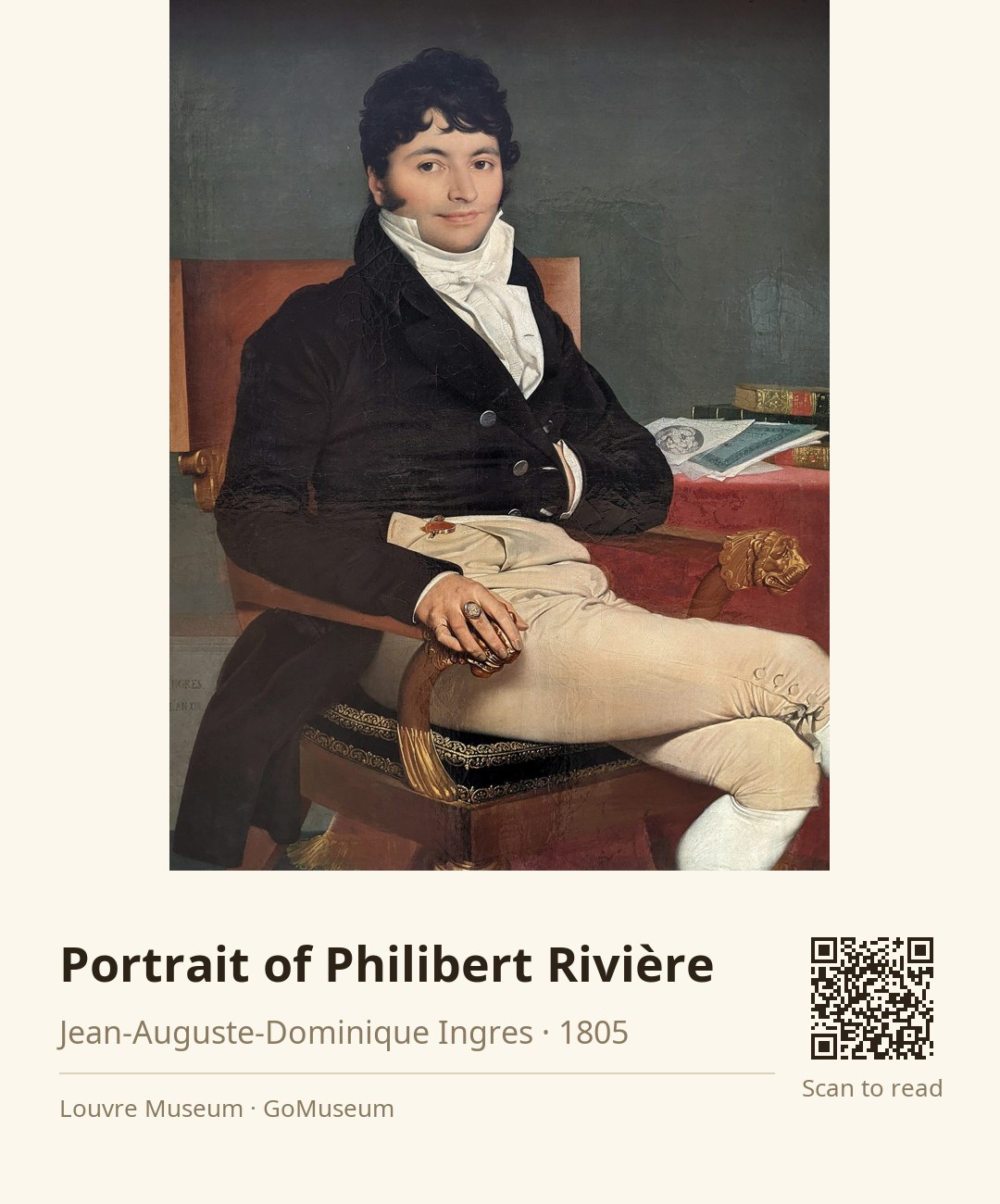
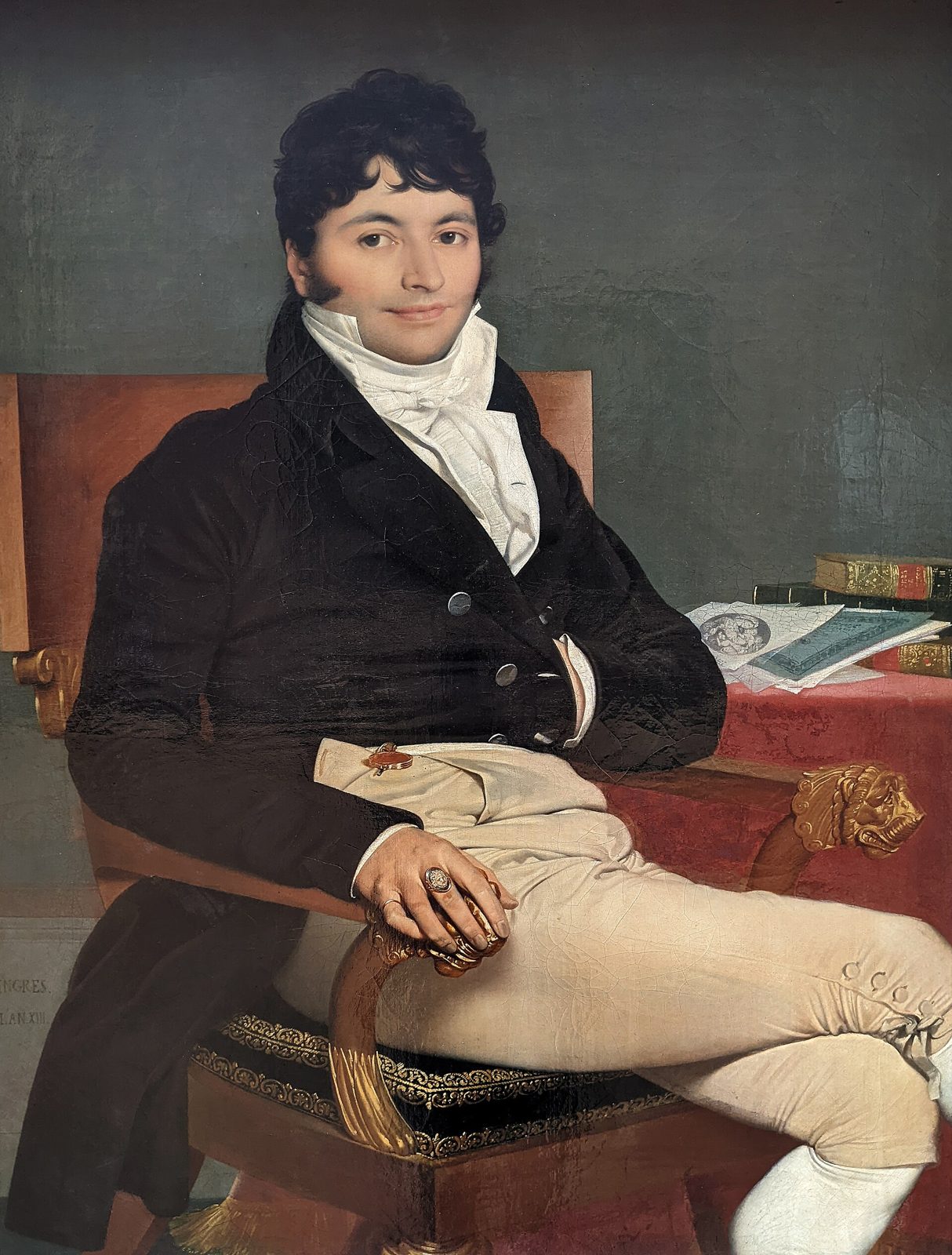
🎧 This work has audio narration — listen in the appTake a moment to really look at this striking portrait of Philibert Rivière. Notice how he sits confidently in that ornate chair, his hand tucked inside his vest—a pose that echoes the authority of Napoleon himself. This isn’t just a casual likeness; it’s a carefully crafted image meant to convey power and sophistication.
Now, focus on the rich red velvet draped over the table beside him. It’s not just a backdrop; it symbolizes wealth and status, enhancing Rivière’s role as a high-ranking official in the Napoleonic Empire. Ingres, at just 23 years old, captures this blend of formality and approachability, making Rivière appear both imposing and friendly.
This painting marks Ingres’ first major commission, a significant moment in his career that set the stage for his future masterpieces. Unlike his earlier, more informal portraits, this work reflects the influence of Jacques-Louis David, the leading Neoclassical artist of the time.
As you stand here, think about how Ingres was just beginning to carve his path in the art world, balancing the expectations of his era with his own artistic vision. What do you think this portrait reveals about the man behind the official title?
Jean-Auguste-Dominique Ingres was a pivotal figure in French Neoclassicism, born on August 29, 1780, in Montauban. He was the son of a versatile artist, which nurtured his early artistic inclinations. Ingres studied under Jacques-Louis David in Paris, where he developed a commitment to academic traditions, aspiring to elevate history painting above all genres. His early career was marked by struggles, as critics dismissed his style as archaic, yet he persevered, achieving recognition with works like "The Vow of Louis XIII" in 1824.
His portraits, characterized by expressive distortions, became his most celebrated contributions, influencing modern artists such as Matisse and Picasso. Ingres's time in Italy, from 1806 to 1824, was crucial; he immersed himself in the study of Renaissance masters, which shaped his distinctive style. Despite facing criticism for his meticulous approach, he remained steadfast in his vision of beauty, emphasizing drawing over color.
Later in life, he returned to Paris, where he continued to create significant works, including "The Turkish Bath." Ingres's legacy endures as a bridge between classical traditions and modern art, embodying the tension between adherence to established norms and the evolving landscape of artistic expression. He passed away on January 14, 1867, leaving behind a profound impact on the art world.
The 'Portrait of Philibert Rivière' was painted around 1805 and marks a pivotal moment in the career of Jean-Auguste-Dominique Ingres. Commissioned by Philibert Rivière de L'Isle, a prominent court official in the Napoleonic Empire, this work was part of a series that included portraits of Rivière's wife and daughter. These portraits were unveiled at the Salon of 1806, where they received considerable acclaim, establishing Ingres as a serious artist at just 23 years old. Unlike his earlier, more casual portraits, this painting reflects the formal expectations of the time, influenced heavily by Jacques-Louis David's neoclassical style. The success of this commission not only solidified Ingres's reputation but also set the stage for his future masterpieces, showcasing his ability to blend authority with approachability in his subjects.
As you gaze at this portrait, take note of Ingres's meticulous brushwork and the way he handles light and color. The flatness of the composition creates a sense of spatial restriction, drawing your focus directly to Rivière's imposing figure. Ingres uses a limited color palette dominated by rich reds and deep shadows, enhancing the sense of luxury and authority. The red velvet draped over the table is not just a decorative element; it serves to elevate Rivière's status. The way Rivière's hand is tucked into his vest echoes the pose of Napoleon, suggesting power and confidence. Ingres's choice to omit preparatory sketches for this piece is unusual, indicating his confidence in executing this formal portrait. The overall composition, with its careful balance and symmetry, reflects the ideals of neoclassicism while also hinting at Ingres's emerging personal style.
Interestingly, despite the success of this painting, there are no surviving preparatory sketches for it. This absence is quite rare for Ingres, who typically planned his compositions meticulously. It suggests that he approached this commission with a level of confidence and assurance that perhaps marked a new chapter in his artistic journey.
Studying under David, Ingres absorbed neoclassical techniques and ideals, which are evident in the formal pose and composition of Rivière's portrait, reflecting David's influence on his early artistic development.