Landscape with a river and a bay in the background
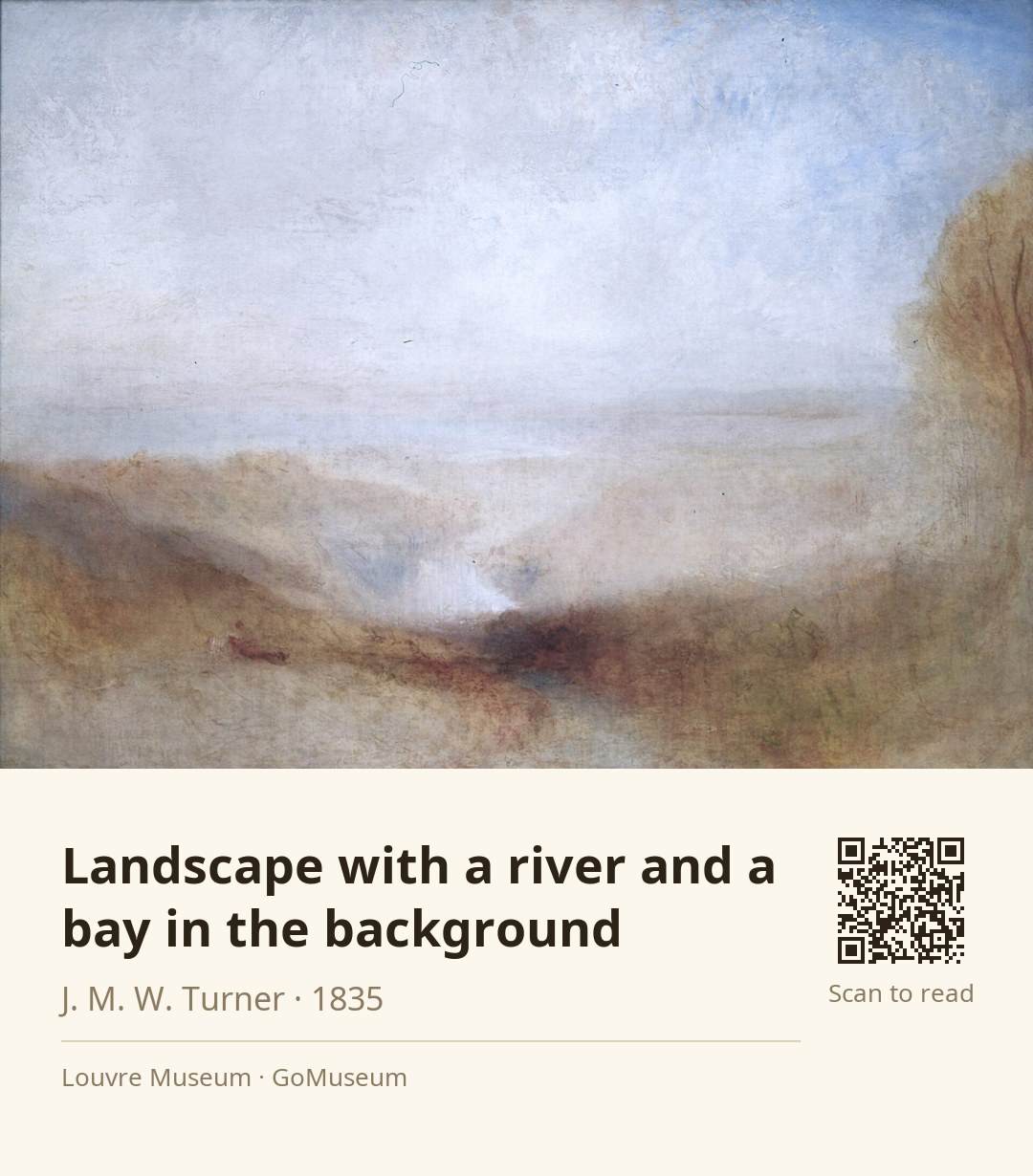
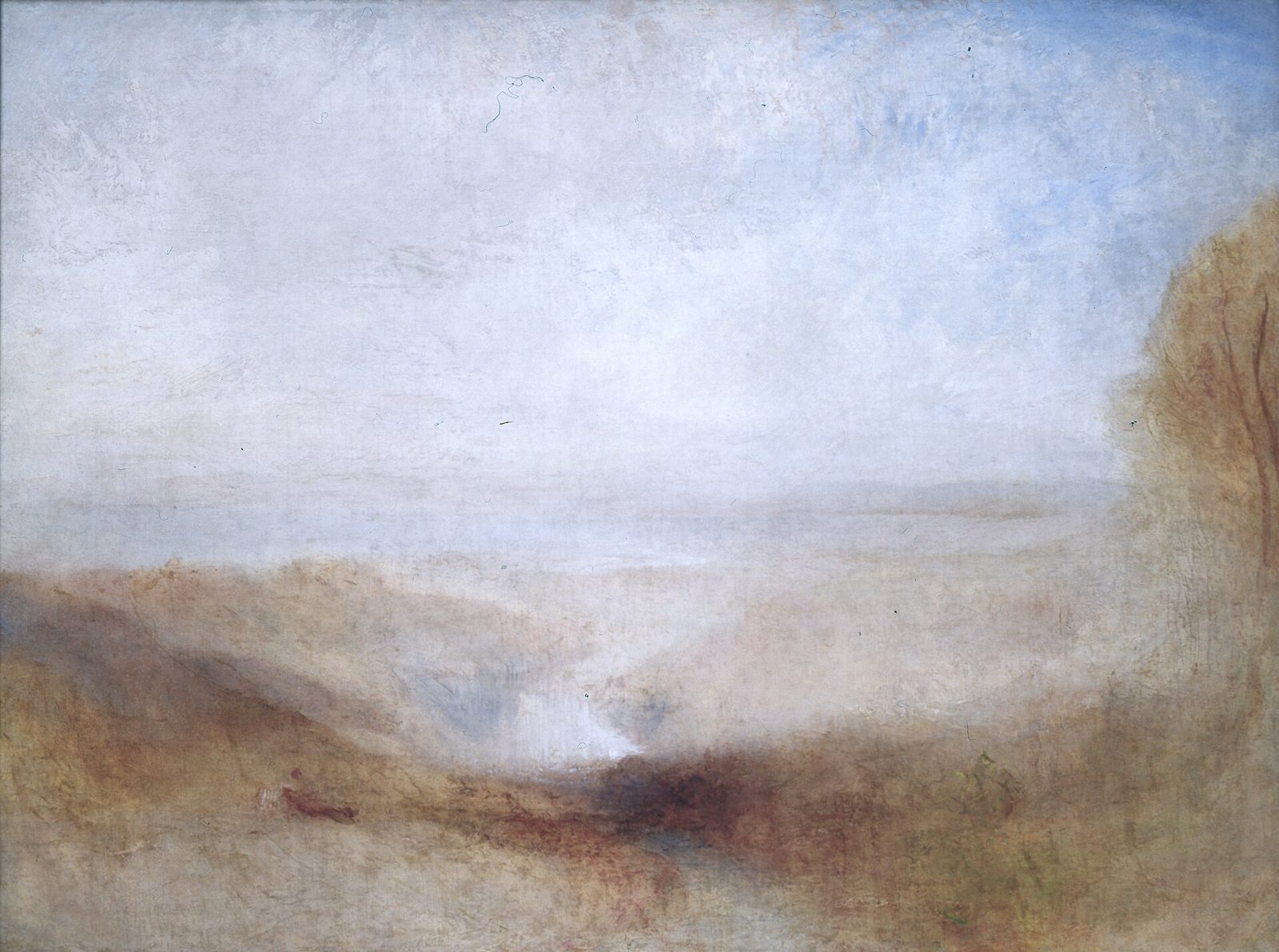
🎧 This work has audio narration — listen in the appThe soft, muted palette of browns and blues in this painting invites you into a tranquil world where a river gently flows toward a distant bay. Turner’s delicate brushwork creates an ethereal atmosphere, with indistinct earthy tones in the foreground suggesting gentle slopes, while the background features a vast, pale sky that merges seamlessly with hints of mist and water. The faint outlines of trees on the right provide a subtle structure to this dreamlike landscape.
This composition reflects Turner's innovative approach to capturing light and atmosphere, which was revolutionary for his time. The fluidity of the brushstrokes enhances the sense of movement and depth, allowing viewers to feel the serenity of the scene. Turner’s ability to evoke emotion through color and form was a precursor to the Impressionist movement, influencing artists like Monet and Pissarro. His exploration of natural phenomena, such as fog and sunlight, showcases his deep connection to the landscapes he painted, often inspired by his extensive travels.
Created in 1835, "Landscape with a river and a bay in the background" exemplifies Turner's mastery of oil painting on canvas, a medium he used to produce around 550 works during his prolific career.
Joseph Mallord William Turner, born on April 23, 1775, in London, was a pivotal figure in 19th-century British art, celebrated for his innovative use of light and color in landscape painting. A child prodigy, he entered the Royal Academy of Arts at just 14, quickly gaining acclaim and financial success. By 27, he was a Royal Academician, one of the youngest to achieve this honor.
Turner's artistic journey began as an architectural draughtsman and watercolourist, but he soon evolved into a master of oil painting. His works, inspired by extensive travels across England and Europe, captured the essence of natural phenomena, from sunlight to storms. Although his later, more abstract landscapes faced criticism during his lifetime, they are now hailed as masterpieces, influencing the Impressionists like Monet and Pissarro.
Despite his professional triumphs, Turner faced societal prejudice due to his working-class origins. He remained a private individual, never marrying, and maintained a discreet relationship with his housekeeper. In his later years, his unkempt appearance belied the beauty of his art, which included around 550 oil paintings and over 2,000 watercolours. Turner passed away in 1851, leaving a significant legacy, including a bequest to support future artists. His works are prominently displayed in institutions like the National Gallery and Tate Britain, solidifying his place in art history as the "painter of light."
Turner created 'Landscape with a river and a bay in the background,' a work commissioned by the art collector Camille Groult. This painting was part of Turner's prolific output during a period when he was gaining significant recognition. Displayed in various exhibitions, it was well-received, showcasing Turner's innovative approach to landscape painting. Over the years, the painting changed hands several times, with its provenance tracing back to Groult, highlighting its journey through the art world. It has been documented in several bibliographies, including Butlin and Joll's catalog, which emphasizes its importance in Turner's oeuvre. The painting's inventory number, RF 1967-2, marks its place in the collection of the Louvre, where it continues to captivate audiences today.
Turner’s technique in this painting is a masterclass in oil handling. He employs a soft, muted palette that creates an almost dreamlike quality, inviting viewers into a serene landscape. The brushwork is fluid and delicate, allowing colors to blend seamlessly into one another. This approach not only captures the essence of the natural world but also evokes emotion, making the viewer feel as if they are part of the scene. The composition is expansive, with the horizon line gently guiding the eye toward the distant bay, while the indistinct forms in the foreground suggest rolling hills. This layering of tones and textures enhances the depth, creating an atmospheric effect that was groundbreaking for its time. Turner's choice of scale, with dimensions of 93.5 by 123.5 centimeters, allows for an immersive experience, drawing the viewer into the tranquil embrace of the landscape.
Turner was accepted as a student at the Royal Academy of Arts when he was just 14 years old.
Turner expressed a disdain for marriage, believing that married men do not make sacrifices for their art.