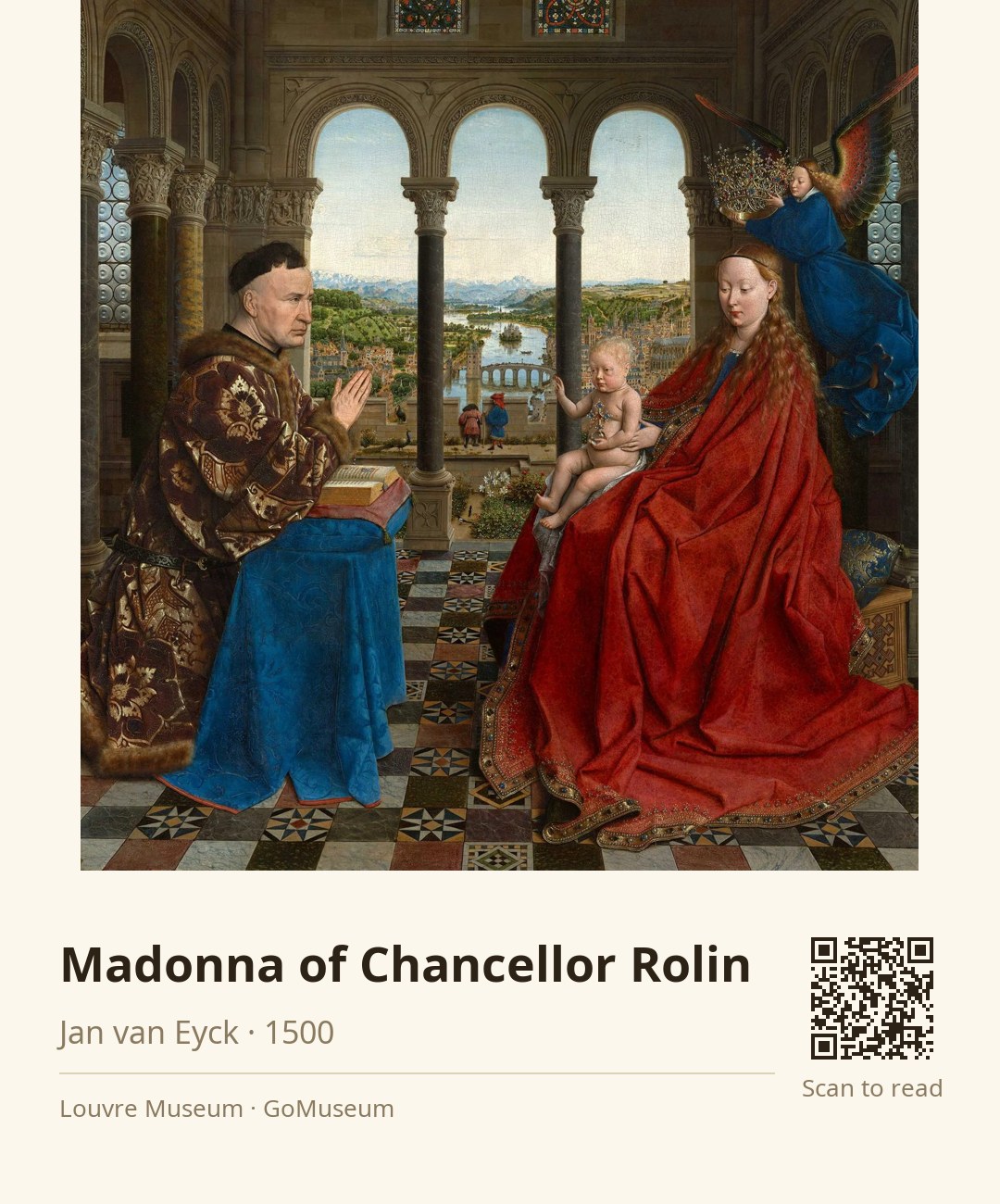
Madonna of Chancellor Rolin
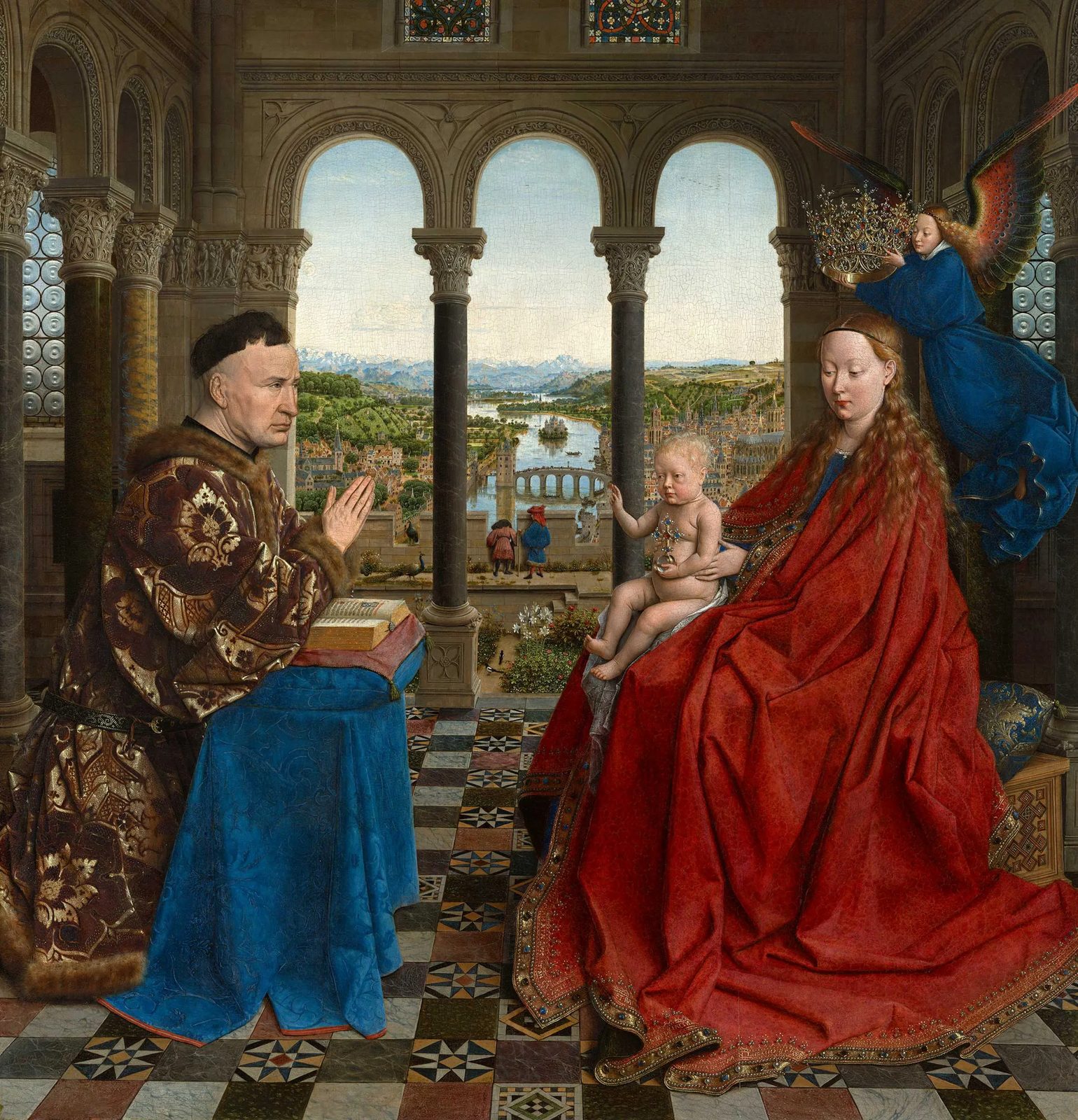
🎧 This work has audio narration — listen in the appLook closely at the Madonna of Chancellor Rolin by Jan van Eyck. Notice how the Virgin Mary and the infant Jesus are not just figures in a painting; they are central to a profound dialogue between the divine and the earthly. The way Mary holds Jesus on her knee, a traditional motif known as the Throne of Wisdom, symbolizes her as an altar of faith, inviting you to reflect on the sacredness of motherhood.
Now, take a moment to observe the intricate details around them—the lush garden filled with flowers like lilies and roses, each symbolizing purity and virtue. This garden isn’t just decorative; it’s a visual representation of Mary’s qualities, contrasting beautifully with the peacocks and magpies nearby, which hint at the duality of pride and morality that even someone as powerful as Chancellor Rolin must navigate.
Van Eyck’s meticulous attention to detail and light creates an intimate space that feels both grand and personal, drawing you into the scene as if you’re witnessing a moment of devotion.
As you stand here, consider what it means to be caught between the sacred and the worldly. How does this painting challenge your perception of power, faith, and the human experience?
Jan van Eyck was an early Netherlandish painter born around 1390 in Maaseik, Belgium. He became a pivotal figure in the Early Northern Renaissance, celebrated for his meticulous naturalism and innovative use of oil paint, which transformed the landscape of European art. Van Eyck's career flourished under the patronage of Philip the Good, Duke of Burgundy, for whom he served as court painter and diplomat. His artistic legacy includes around twenty surviving works, notably the Ghent Altarpiece and the iconic Arnolfini Portrait, both exemplifying his mastery of detail and light.
His early work reflected the International Gothic style, but he soon eclipsed it with a focus on realism and intricate textures. Van Eyck's ability to capture human emotion and the subtleties of the natural world set new standards for portraiture and religious art. He was one of the first artists to sign his works, asserting his identity and contribution to art history. His techniques and approach laid the groundwork for future generations, solidifying his status as a foundational figure in the development of Western painting. Van Eyck passed away in Bruges in 1441, leaving behind a profound influence that continues to resonate in the art world today.
As you gaze at the Madonna of Chancellor Rolin, notice the meticulous brushwork that brings every detail to life. Van Eyck's use of oil paint allows for a rich texture and depth, creating a luminous quality that seems to breathe. The light sources in the painting are complex; it streams in from both the central portico and side windows, illuminating the figures and enhancing the three-dimensionality of the space. The composition is carefully structured, with a symmetrical arrangement that contrasts the divine and the earthly. The figures are positioned in a way that draws your eye naturally from Rolin to Mary and Jesus, creating a dialogue between them. The intricate patterns of the floor tiles and the lush garden outside the columns not only ground the scene but also symbolize the virtues of Mary, inviting you to reflect on the sacredness of the moment.
This piece not only exemplifies van Eyck's meticulous attention to detail and innovative use of light but also reflects the growing importance of individual patronage in art. Nicolas Rolin, the chancellor depicted, commissioned this work, symbolizing the merging of personal devotion with public identity. The painting influenced countless artists, setting a standard for realism and emotional depth that would resonate through the Renaissance and beyond. Its intricate symbolism and composition invite viewers to explore the balance between the sacred and the secular, a theme that would echo in the works of future generations. Remember, this painting is not just a religious image; it's a dialogue between the divine and the human experience, forever altering the landscape of art history.
One intriguing detail about the Madonna of Chancellor Rolin is that infrared reflectograms revealed changes made during its creation. Originally, Rolin was depicted with a large purse at his belt, a symbol of his wealth, but this was removed, likely to maintain the painting's focus on piety rather than materialism. Additionally, the infant Jesus was initially pointing at the floor, a gesture that was altered to better convey his divine authority.
The painting was commissioned as a votive offering for Nicolas Rolin's parish church, Notre-Dame-du-Chastel in Autun, serving as a devotional piece meant to inspire prayer and reflection.
Originally housed in Rolin's parish church, the painting was moved to Autun Cathedral after the church burned down in 1793, and it eventually found its way to the Louvre in 1805.
Infrared reflectograms uncovered that the infant Jesus was initially depicted pointing at the floor, a gesture that was later changed to better express his divine authority.