Orsini Polyptych
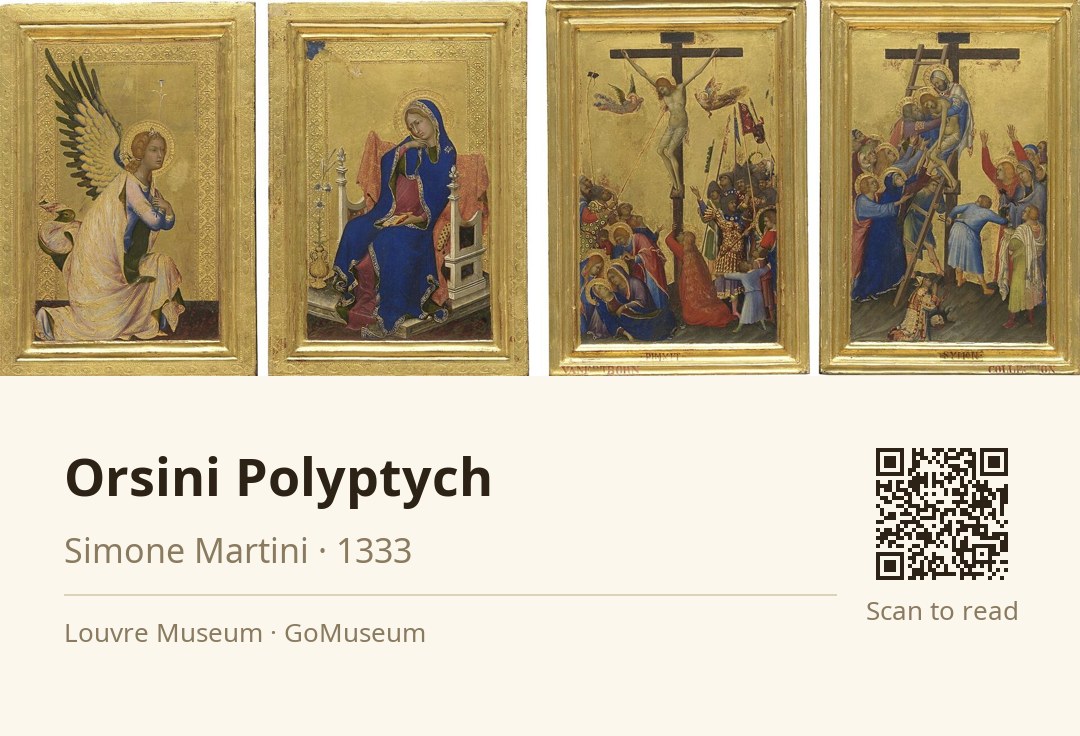
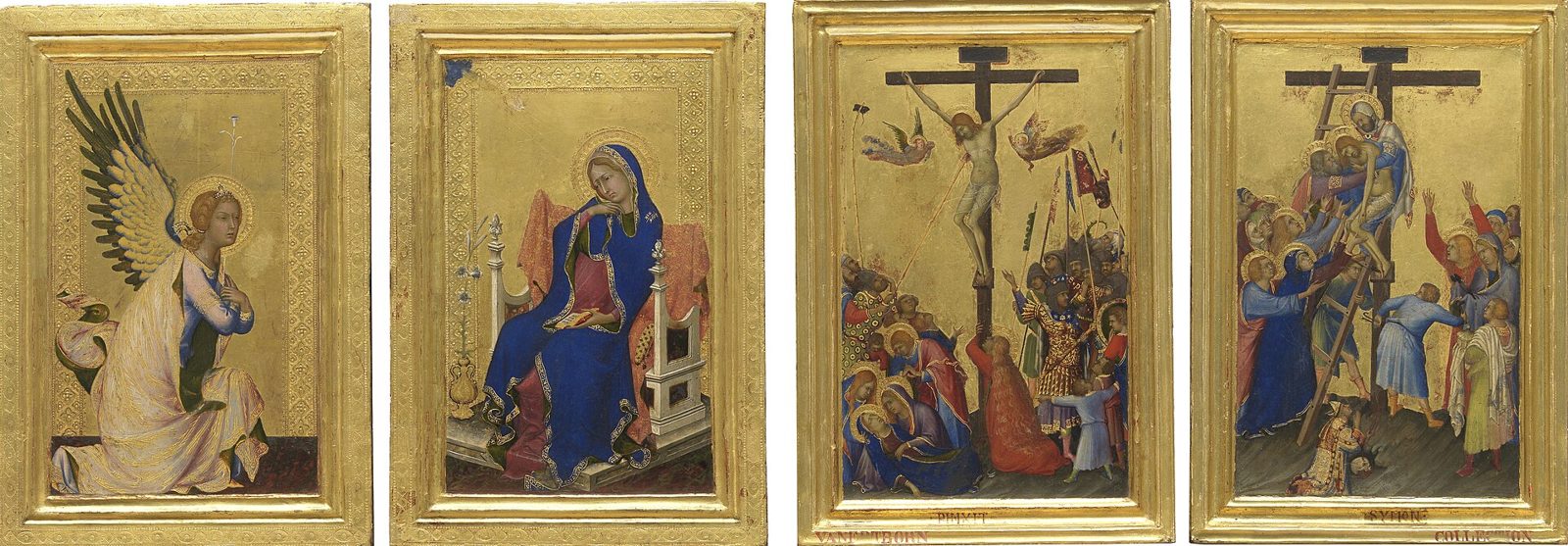
🎧 This work has audio narration — listen in the appAs you stand before the Orsini Polyptych, take a moment to really look at the figures. Notice the way Christ is depicted, bearing the weight of the cross—his expression a mix of sorrow and resolve. Now, shift your gaze to the intricate details of the cardinal at the foot of the cross, adorned in his rich robes.
These details matter because they connect the viewer directly to the spiritual and historical context of the artwork. The Orsini family’s coat of arms on the back of the panel signifies not just ownership, but a legacy intertwined with the sacred. Created in 1333 by Simone Martini, this polyptych was designed for private worship, reflecting the intimate relationship between faith and art during the late medieval period.
Martini, a key figure in the early Italian Renaissance, infused this piece with a sense of elegance and emotion that would influence generations of artists, especially in France, where it traveled early in its history.
So, as you take in the Orsini Polyptych, think about the personal devotion it represents. What emotions does it evoke in you? What stories might the figures tell if they could speak?
Simone Martini, born around 1284 in Siena, was a pivotal Italian painter whose influence shaped early Italian art and the International Gothic style. Likely a pupil of Duccio di Buoninsegna, he also drew inspiration from Giotto, reflecting a blend of Sienese tradition and emerging innovations. His works, characterized by soft lines, decorative elegance, and a courtly aesthetic, marked a departure from the more austere Florentine style.
Martini's notable pieces include the Maestà of 1315 in Siena and the Saint Louis of Toulouse Crowning His Brother Robert of Anjou, showcasing his mastery of fresco and tempera. His art was enriched by the influence of French manuscript illumination, which was brought to Siena via trade routes. A friend of poet Petrarch, he is said to have painted a portrait of Laura, further intertwining his legacy with literary history.
Despite the scarcity of documentation about his life, Martini's contributions to art are undeniable. He died in Avignon in 1344, leaving behind a legacy that positioned him as one of the foremost artists of the 14th century, rivaling even Giotto in significance. His stylistic innovations and decorative flair continue to resonate in the art world today.
This altarpiece was designed for private devotion, reflecting the intimate relationship between faith and art during the late medieval period. Early in its history, the polyptych was transported to France, where it significantly influenced late medieval French artists. By the end of the 14th century, it was housed in the Champmol Charterhouse near Dijon. The artwork was still there in 1791, but it was sold and subsequently split up. Today, the panels are dispersed among several museums: the Louvre in Paris, the Royal Museum of Fine Arts in Antwerp, and the Gemäldegalerie in Berlin.
Originally commissioned for private devotion, it quickly found itself in France, where it influenced late medieval French artists. But here's the twist: the altarpiece was not just a static piece of art; it was split up and scattered across various locations. Today, parts of it reside in the Louvre, the Royal Museum of Fine Arts in Antwerp, and the Gemäldegalerie in Berlin.
The polyptych's intricate emotional expressions and elegant style set a precedent for late medieval French artists, who adopted Martini's techniques and themes in their own works, contributing to the development of the International Gothic style.