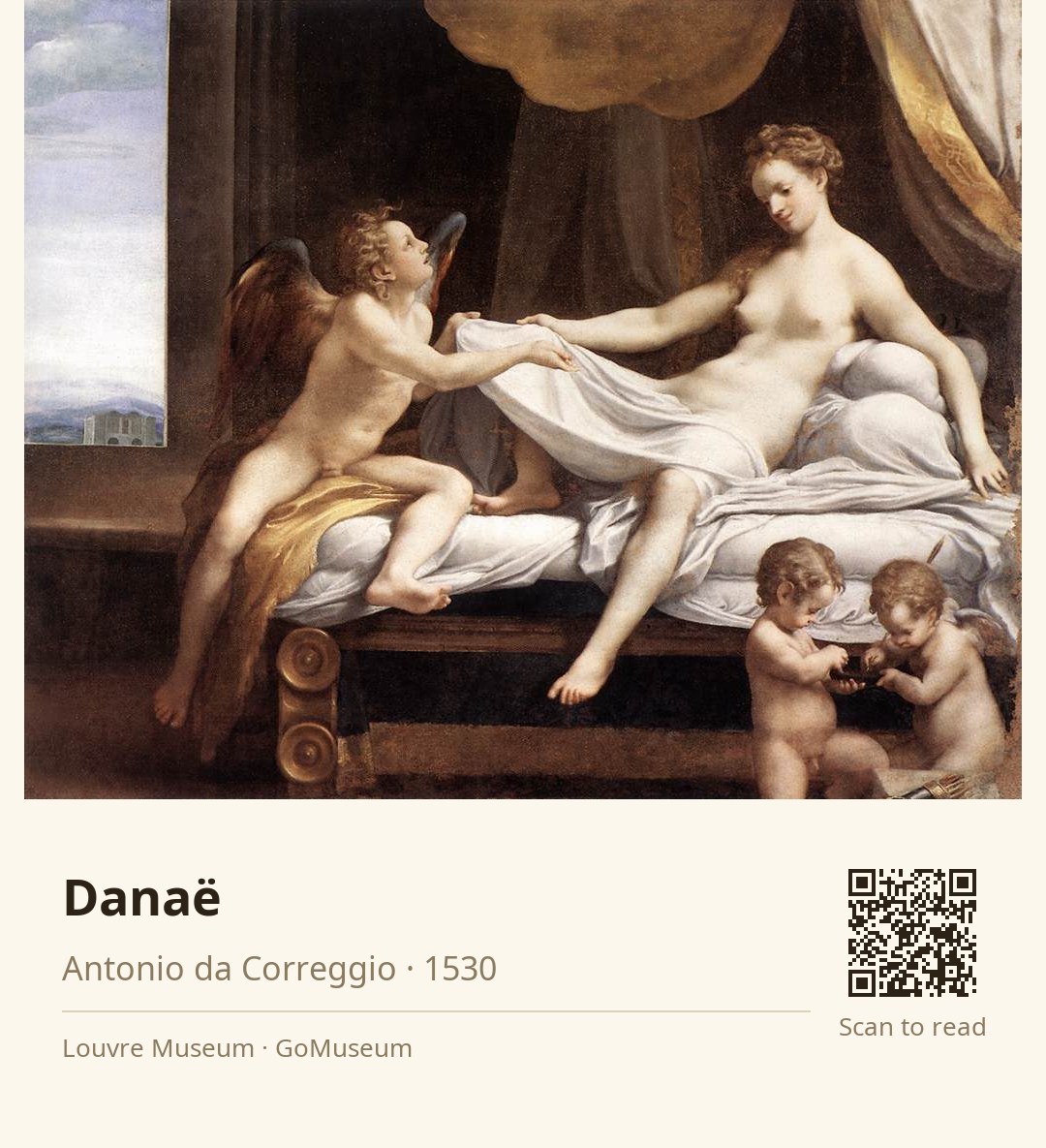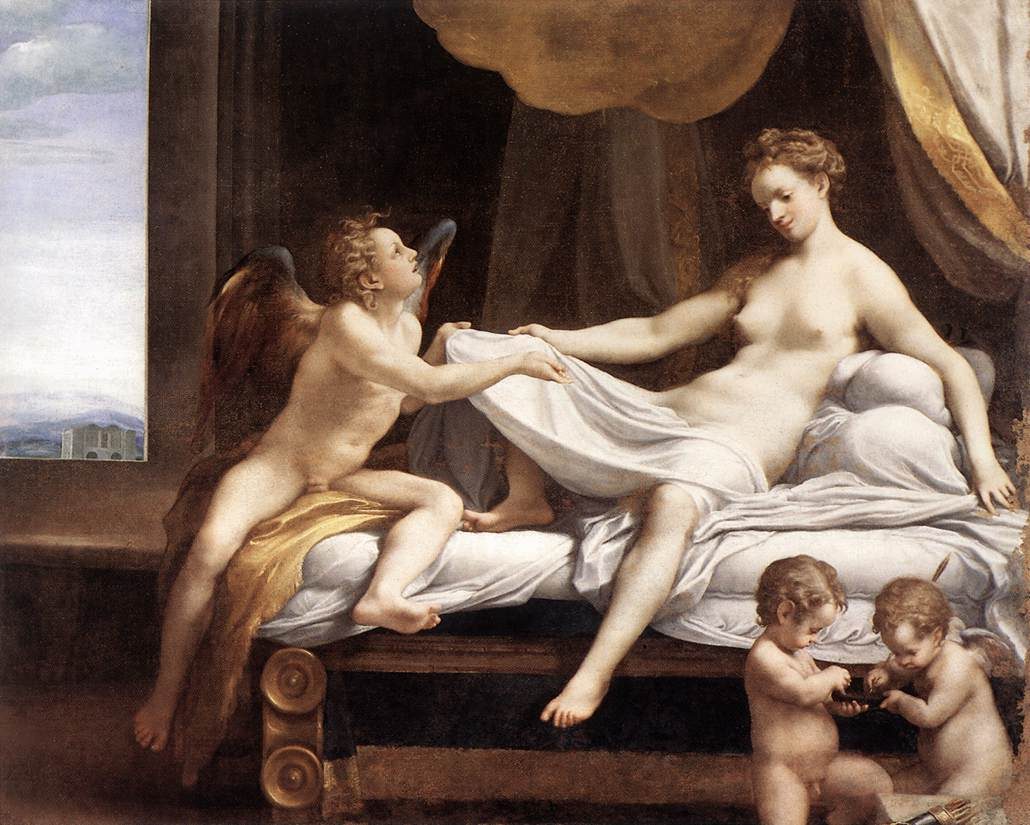
Take a moment to really absorb the scene before you in Correggio's "Danaë." Notice how the soft, golden light cascades down from above, enveloping the figure of Danaë in a warm embrace. The delicate way her body reclines on the bed, almost as if she is caught in a dream, invites you into her world.
Now, focus on the playful figure of Eros at her side, gently undressing her as the gold rain falls. This detail isn’t just about seduction; it symbolizes divine intervention and the merging of the mortal with the celestial. In this moment, Danaë is not merely a victim of fate but a participant in a transformative experience, one that leads to the birth of the legendary hero Perseus.
Commissioned by the Duke of Mantua, this painting is part of a series that explores Jupiter's many loves, showcasing Correggio's mastery in blending myth with sensuality. His use of light and shadow here is groundbreaking, setting the stage for future artistic movements like Baroque and Rococo.
As you stand here, consider what it means for Danaë to receive such a gift from the heavens. How does this moment of vulnerability and beauty resonate with you today?
Antonio Allegri da Correggio, known simply as Correggio, was an influential Italian Renaissance painter born around August 1489 in Correggio, Emilia-Romagna. He emerged as a leading figure in the Parma school, celebrated for his dynamic compositions and mastery of chiaroscuro. Little is known about his early life, but he likely received his initial training from his uncle, Lorenzo Allegri, and later apprenticed with Francesco Bianchi Ferrara in Modena.
Correggio's career flourished in Parma, where he created some of his most significant works, including the ceiling frescoes of the Camera di San Paolo and the dome of the Cathedral of Parma. His innovative use of illusionistic perspective and foreshortening prefigured the Baroque style, influencing future generations of artists. His mythological series, particularly the Loves of Jupiter, showcased his ability to blend sensuality with narrative depth.
Despite a relatively short life, ending in 1534, Correggio's contributions to art were profound, establishing him as a precursor to Baroque painting and a master of emotional expression. His legacy endures, with his works continuing to inspire artists and captivate audiences.
Correggio's "Danaë" was commissioned by Duke Federico II Gonzaga of Mantua around 1531, intended for the Ovid Hall in the Palazzo Te, a space dedicated to the exploration of Jupiter's romantic escapades. After the Duke's passing, the painting embarked on a remarkable journey. It made its way to Spain, possibly as a gift to Emperor Charles V. By 1584, it was noted in Milan as part of sculptor Leone Leoni's collection. The canvas eventually found its way to Emperor Rudolph II, and after a tumultuous history during the Thirty Years' War, it became war booty for King Gustavus Adolphus of Sweden. The painting was later inherited by Queen Christina of Sweden, who brought it to Rome. After her death, it changed hands several times, eventually being acquired by Prince Camillo Borghese in 1827 for his collection in Rome. This painting has not only survived centuries but has also witnessed the shifting tides of power and art across Europe.
As you gaze at "Danaë," notice how Correggio's brushwork creates a soft, almost ethereal quality. The delicate interplay of light and shadow is masterfully executed, with the golden rain cascading down, illuminating Danaë's body in a warm embrace. The composition is carefully structured; Danaë reclines on a bed, her form a harmonious blend of curves that draws your eye across the canvas. The use of chiaroscuro enhances the three-dimensionality of her figure, making her appear almost lifelike. The light source, coming from the right, casts gentle shadows that add depth, while the vibrant colors create a sense of warmth and intimacy. The playful Eros, undressing Danaë, adds a dynamic element, contrasting with the serene expression on her face. This balance of movement and stillness is a hallmark of Correggio's style, inviting you to linger in this moment of divine intervention.
By blending sensuality with a masterful use of light and shadow, he set a new standard for depicting divine encounters. This painting not only captivated his contemporaries but also laid the groundwork for future Baroque artists, who drew inspiration from his dynamic compositions and emotional depth. The way Correggio captures the moment of divine intervention, with Danaë receiving the golden rain, speaks to the human experience of grace and vulnerability, influencing generations of artists to explore similar themes. Remember, this painting isn't just about mythology; it's a bridge to the emotional storytelling that would define art for centuries to come.
One intriguing aspect of "Danaë" is that it was part of a larger series depicting the loves of Jupiter, which was quite daring for its time. The series was commissioned to celebrate the Duke's romantic interests, and it was said that the paintings were meant to be displayed in a private setting, making them intimate pieces meant for personal enjoyment rather than public exhibition. This context adds a layer of intrigue, suggesting that the artwork was not just a display of artistic prowess but also a reflection of the Duke's own life and desires.
After being commissioned for the Duke of Mantua, 'Danaë' traveled through various collections across Europe, becoming war booty during the Thirty Years' War, and eventually ending up in the hands of Queen Christina of Sweden before being acquired by Prince Camillo Borghese.