Designs for Various Weapons
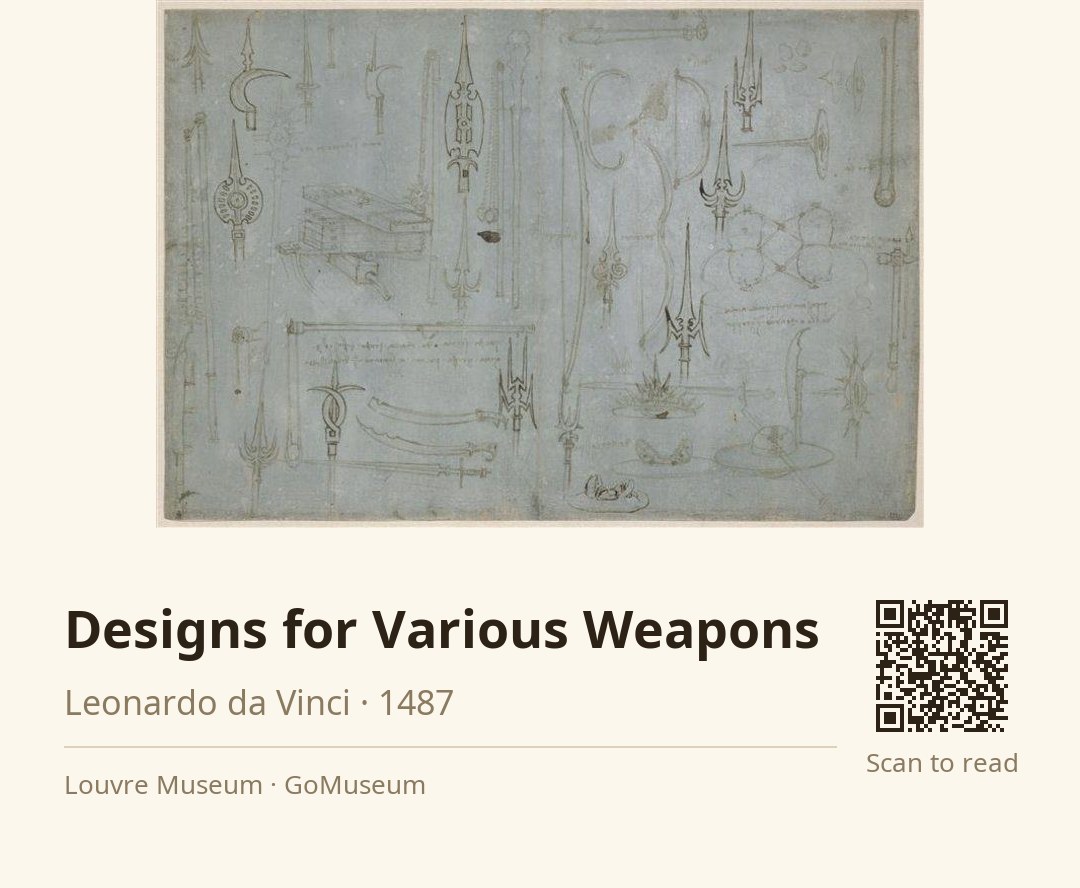
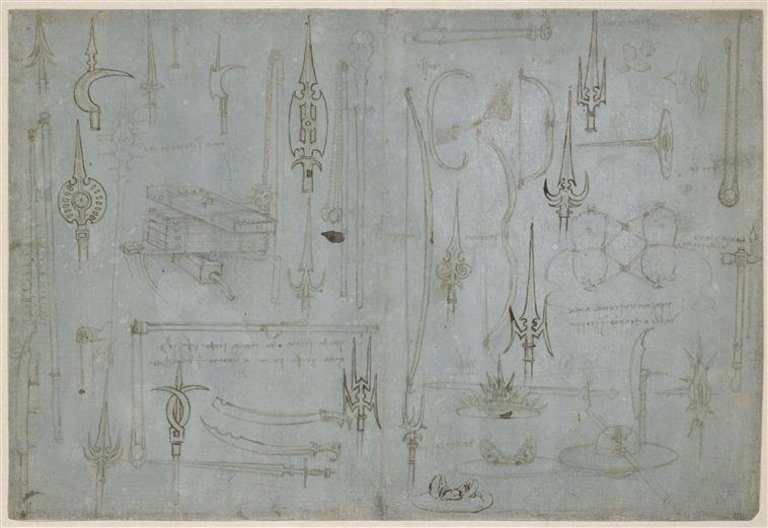
🎧 This work has audio narration — listen in the appThe intricate designs of polearms and blades in Leonardo da Vinci's "Designs for Various Weapons" reveal a fascinating blend of artistry and engineering. On the left, you can see a variety of weapons, each adorned with meticulous detailing that showcases Leonardo's deep understanding of form and function. In the center, a stack of books hints at his scholarly approach, suggesting that these designs were not merely for combat but also for study and innovation.
These elements reflect Leonardo's role as a polymath during the High Renaissance, where art and science were intertwined. The dense composition of this sketch, filled with various weapon forms and styles, illustrates his relentless curiosity and inventive spirit. While many of his designs were never built, they represent a forward-thinking mindset that sought to push the boundaries of technology and warfare.
Created in 1487, this work is part of a series of sketches that highlight Leonardo's diverse interests, ranging from anatomy to engineering. His notebooks, including this piece, have become invaluable in understanding the breadth of his genius and the era's intellectual pursuits.
Leonardo da Vinci, born on April 15, 1452, in Vinci, Italy, was a quintessential figure of the High Renaissance, renowned for his multifaceted genius as a painter, scientist, and inventor. Raised by his grandparents after being born out of wedlock, he received artistic training under Andrea del Verrocchio in Florence. His career flourished in Milan under Ludovico Sforza, where he produced iconic works like "The Last Supper" and began his extensive studies in anatomy and engineering.
Leonardo's notebooks reveal a relentless curiosity, encompassing subjects from botany to mechanics, showcasing his innovative spirit. Despite creating fewer than 25 major works, his influence on Western art is profound, with the "Mona Lisa" standing as a cultural icon. His visionary designs for flying machines and other inventions, though largely unfeasible in his time, reflect a forward-thinking approach that laid groundwork for future scientific exploration.
In his later years, he moved to France, where he continued to work until his death in 1519. Leonardo's legacy endures as a symbol of the Renaissance ideal, blending art and science, and inspiring generations with his empirical observations and artistic mastery. His life and work remain a testament to the boundless potential of human creativity.
Leonardo da Vinci's 'Designs for Various Weapons' was created in 1487, a time when he was deeply engaged in the exploration of both art and engineering. This work is part of his extensive notebooks, which were not originally intended for public display but rather as personal reflections and studies. While the exact circumstances of its commission remain unclear, it is known that Leonardo often shared his designs with patrons, particularly in Milan under Ludovico Sforza. The reception of his sketches was mixed; while some contemporaries recognized his genius, many of his ideas were considered too advanced for their time.
In this intricate sketch, Leonardo employs fine, precise lines to convey the complexity of each weapon design. The muted blue-gray background serves to highlight the delicate details of the polearms and blades, creating a striking contrast that draws your attention to the craftsmanship. Leonardo's technique is meticulous; he uses hatching and cross-hatching to suggest depth and texture, enhancing the three-dimensionality of the forms. The arrangement of the weapons is not random; each piece is carefully positioned to create a sense of density and variety, reflecting Leonardo's understanding of both aesthetics and functionality. The inclusion of the stack of books in the center suggests a scholarly approach, merging the realms of art and science. This thoughtful composition invites viewers to appreciate not just the designs themselves but the intellectual curiosity that drove Leonardo's work.
One fascinating aspect of Leonardo's approach to weapon design is that many of his creations were never built during his lifetime. Instead, they served as theoretical explorations of mechanics and engineering principles. This highlights Leonardo's role not just as an artist but as an innovator who was ahead of his time, envisioning technologies that would only be realized centuries later.
Most of Leonardo's weapon designs remained theoretical and were not constructed during his lifetime.