Standing Nude Old Man
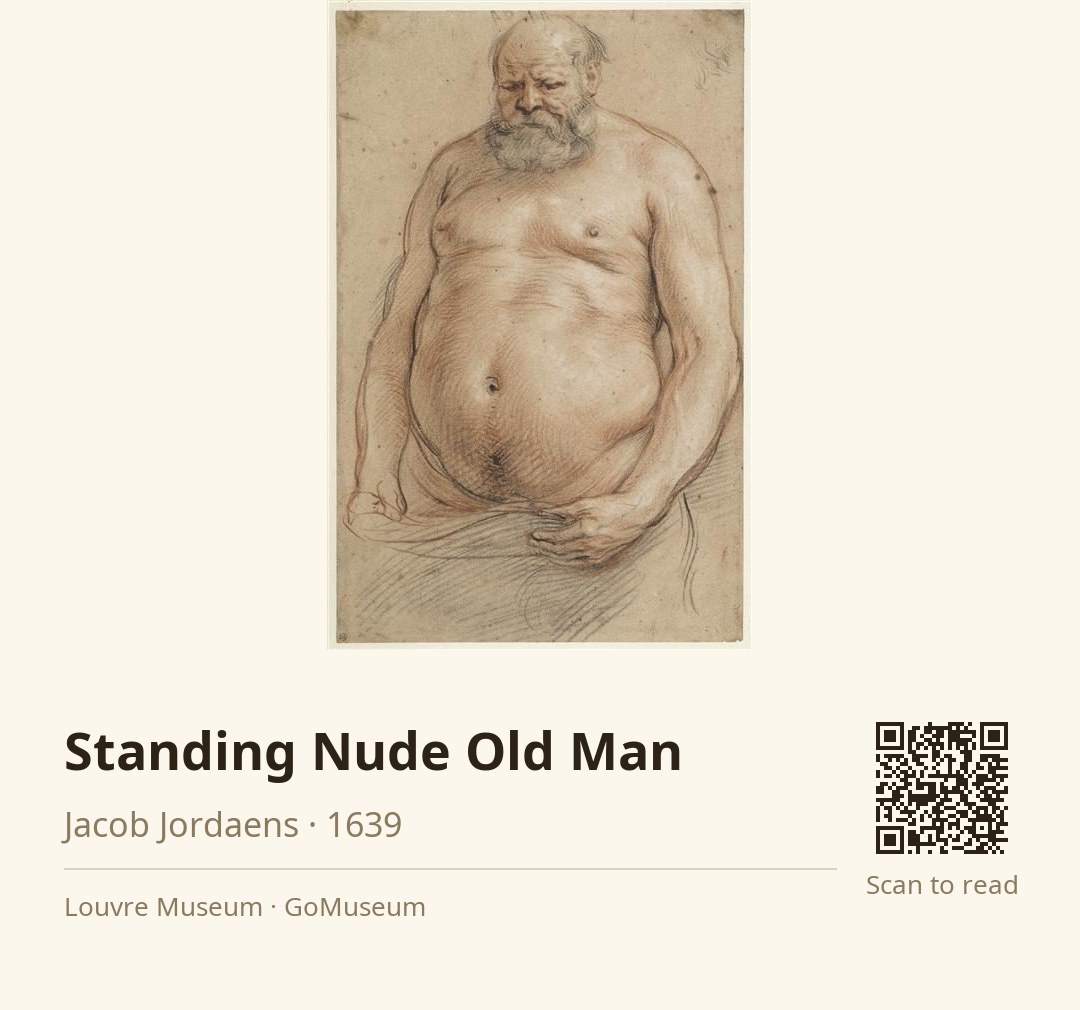
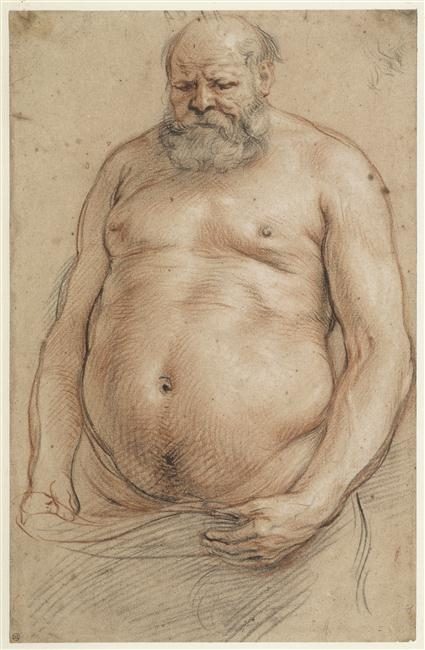
🎧 This work has audio narration — listen in the appTake a moment to really look at this striking piece by Jacob Jordaens, created in 1639. Notice how the old man stands, his body slightly hunched, yet there’s a certain dignity in his posture. The play of light and shadow across his skin, captured with crayon and sanguine, brings out the texture of age—every wrinkle tells a story.
These details matter because they reveal Jordaens’ masterful ability to convey human emotion and experience. Unlike many artists of his time who idealized their subjects, Jordaens embraced the rawness of life, celebrating the beauty in imperfection. This approach connects us to the humanity of the figure, making him relatable, almost as if he could step out of the frame and share his wisdom with us.
Jordaens was a leading Flemish Baroque painter, known for his vibrant scenes of everyday life, yet he never traveled to Italy like many of his contemporaries. Instead, he found inspiration in his own community of Antwerp, where he lived and worked his entire life. This piece, titled "Vieillard nu, debout," reflects his unique perspective and deep understanding of the human condition.
As you stand here, think about the stories this old man might tell if he could speak. What wisdom do you think he has gathered over the years?
Jacques Jordaens, born on May 19, 1593, in Antwerp, was a prominent Flemish painter and designer known for his vibrant biblical, mythological, and genre scenes. As a leading figure in the Flemish Baroque movement after the deaths of Rubens and van Dyck, he carved out a unique niche by focusing on the everyday lives of people rather than the idealized forms favored by his contemporaries. Jordaens spent his entire life in Antwerp, never traveling to Italy, which set him apart from many artists of his time. His work often reflected a robust, earthy quality, emphasizing the human experience.
Educated under Adam van Noort, Jordaens became a master in the Guild of Saint Luke in 1615. He married van Noort's daughter, Catharina, and had three children. His early career involved collaborations with Rubens, but he maintained an independent style, favoring a more direct and less intellectual approach to his subjects. His patrons included the bourgeoisie and local churches, and he eventually received royal commissions later in life.
Jordaens is best known for large-scale works like "The King Drinks" and "As the Old Sing, So Pipe the Young," which showcase his mastery of chiaroscuro and his ability to capture the essence of human emotion. While often considered a follower of Rubens, Jordaens's distinct voice in art history remains influential, marking him as a key figure in the evolution of Flemish painting. He passed away on October 18, 1678, leaving behind a legacy that continues to resonate in the art world.
In 1639, Jacob Jordaens created 'Vieillard nu, debout,' a work that reflects his deep connection to the human experience. Commissioned by Aimé-Charles-Horace His de la Salle, this piece was later exhibited in 1882 at the Louvre, where it was noted for its raw emotional power. The provenance of this artwork traces back to His de la Salle, emphasizing its significance in Jordaens' oeuvre and the esteem in which it was held. This piece stands as a testament to Jordaens' lifelong dedication to portraying the unvarnished truth of life, a theme that resonated with the bourgeois patrons of his time.
Jordaens employed crayon and sanguine to create 'Vieillard nu, debout,' utilizing a technique that allows for rich texture and depth. Notice how the lines flow and intertwine, giving life to the old man's skin, each wrinkle meticulously rendered to evoke a sense of age and wisdom. The interplay of light and shadow is masterful; it draws your eye to the contours of his body, emphasizing both strength and vulnerability. The composition is intimate yet commanding, inviting you to engage with the figure on a personal level. Jordaens' choice of scale—300 by 200 millimeters—creates an immediacy, making the viewer feel as though they are standing face-to-face with this dignified figure. The overall effect is a blend of realism and emotional resonance, a hallmark of Jordaens' style that captures the essence of the human condition.
Interestingly, Jordaens never traveled to Italy, unlike many of his contemporaries. This decision shaped his artistic voice, allowing him to draw inspiration from the everyday life around him in Antwerp. His focus on local subjects and themes set him apart, and he became a leading figure in Flemish Baroque painting without the influence of the Italian Renaissance, showcasing the richness of his own cultural heritage.
Jordaens' use of crayon and sanguine allows for a rich interplay of texture and depth, which is particularly effective in capturing the nuances of age and emotion in his subjects, making the old man's skin appear almost lifelike.
Growing up in a prosperous family likely provided Jordaens with access to education and cultural experiences that shaped his artistic vision, allowing him to focus on themes that resonated with the bourgeoisie, his primary patrons.
By marrying Catharina van Noort, Jordaens not only solidified his connection to his mentor, Adam van Noort, but also positioned himself within the local artistic community, which may have contributed to his later success as a leading Flemish painter.