Portrait of Louis Philippe Albert of Orléans, Count of Paris
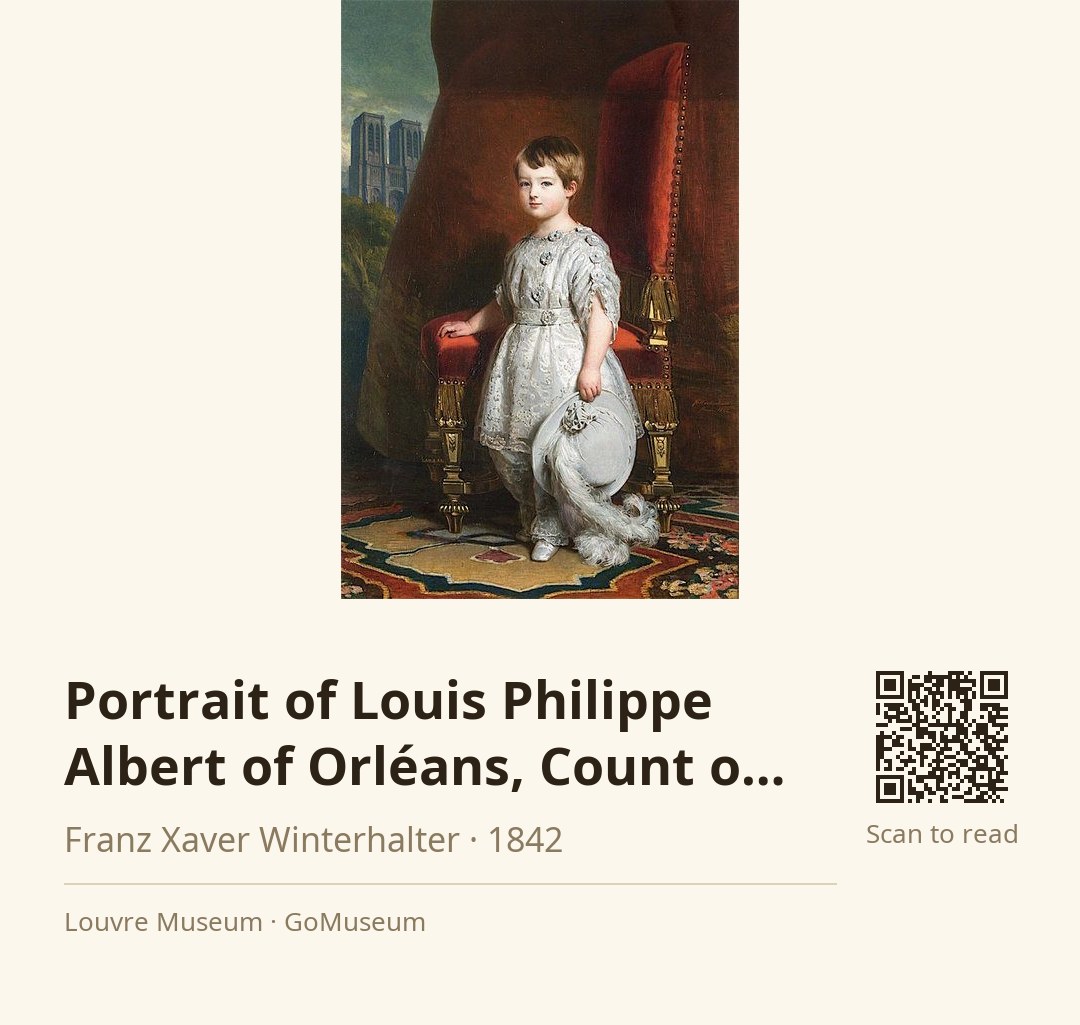
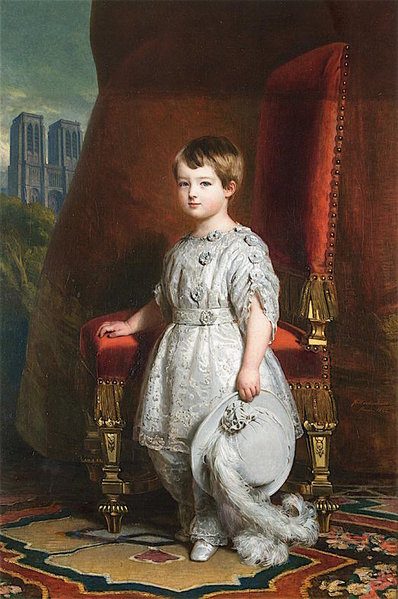
🎧 This work has audio narration — listen in the appTake a moment to really look at this portrait of Louis Philippe Albert d'Orléans, the Count of Paris. Notice how the young boy stands confidently in his baptismal gown, the delicate satin and lace almost glowing against the muted backdrop. His gaze meets yours, inviting you into a world of royal expectation.
Now, focus on the way he rests his hand on that rich, red velvet seat. It’s not just a prop; it symbolizes the future responsibilities that await him as a member of the Orléans family. This isn’t just a portrait; it’s a visual promise of his royal destiny, captured by the skilled hand of Franz Xaver Winterhalter, a painter known for his ability to flatter his subjects while maintaining their likeness.
Winterhalter painted this piece in 1842, a time when the Orléans family was at the heart of French politics.
As you stand here, think about the life that lay ahead for this young count, born into privilege yet facing the uncertainties of a changing monarchy. What do you think he felt, standing there, poised between childhood and the weight of history?
Franz Xaver Winterhalter was a prominent German painter and lithographer, born on April 20, 1805, in Menzenschwand, Germany. He became renowned for his flattering portraits of royalty and the upper class in the mid-19th century, establishing a reputation for fashionable court portraiture. His works, including "Empress Eugénie Surrounded by her Ladies in Waiting" and portraits of Empress Elisabeth of Austria, exemplify his skill in blending likeness with flattery.
Winterhalter's artistic journey began at a young age, influenced by his family and early education in drawing and engraving. He trained under notable artists and gained recognition in Germany before moving to France, where he quickly became a sought-after portraitist. Appointed court painter to Louis-Philippe of France, he executed numerous commissions for the royal family, solidifying his status in the art world. Despite facing criticism from some artistic circles, his success made him an international celebrity, with royal patrons across Europe, including Queen Victoria.
Winterhalter's legacy lies in his ability to capture the essence of his subjects while embodying the elegance of his time, making him a significant figure in the history of portrait painting. He passed away on July 8, 1873, leaving behind a rich collection of works that continue to resonate in art history.
This portrait was commissioned for the baptism of Louis Philippe Albert d'Orléans, the Count of Paris, on May 2, 1841, and completed by February 1842. It was first shown at the Paris Salon, where it was presented by the Orléans family, although they were neither the commissioners nor the payers. Following its exhibition, the painting changed hands several times, eventually being sold at a Sotheby's auction in Monaco in July 1993. It remained within the Orléans family until 1996 when it was acquired by Christopher Forbes. The painting was classified as a historical monument in 1994 and has since been deposited at the Louvre, where it is now part of the American Friends of the Louvre collection as of 2023.
Take a closer look at the way Winterhalter has expertly handled the fabric in this portrait. The delicate satin and lace of the baptismal gown are painted with a soft, almost ethereal quality, drawing your eye immediately to the figure of the young count. Notice how the light plays off the textures, creating a sense of depth and realism. The muted backdrop serves to enhance the vibrancy of the gown, while the rich red of the velvet seat contrasts beautifully, symbolizing the weight of royal expectation. The composition is carefully structured, with the Count's gaze directed towards the viewer, inviting a connection that feels both personal and regal. This vertical format adds to the sense of stature, making him appear both approachable and authoritative.
Interestingly, Winterhalter was not just a court painter in France; he also became a favorite of Queen Victoria, painting over 120 works for her and her family. This connection helped solidify his reputation across Europe, making him a sought-after artist not just in France but also in England and beyond.
In the upper left corner of the composition, you can spot the silhouette of the Notre-Dame Cathedral, subtly integrated into the muted backdrop, hinting at the historical and cultural significance of the setting.
While Winterhalter's portraits gained popularity and secured him royal commissions, critics often dismissed him as a serious artist, labeling his work as mere fashionable portraiture rather than high art, which affected his standing in artistic circles.