The Intervention of the Sabine Women
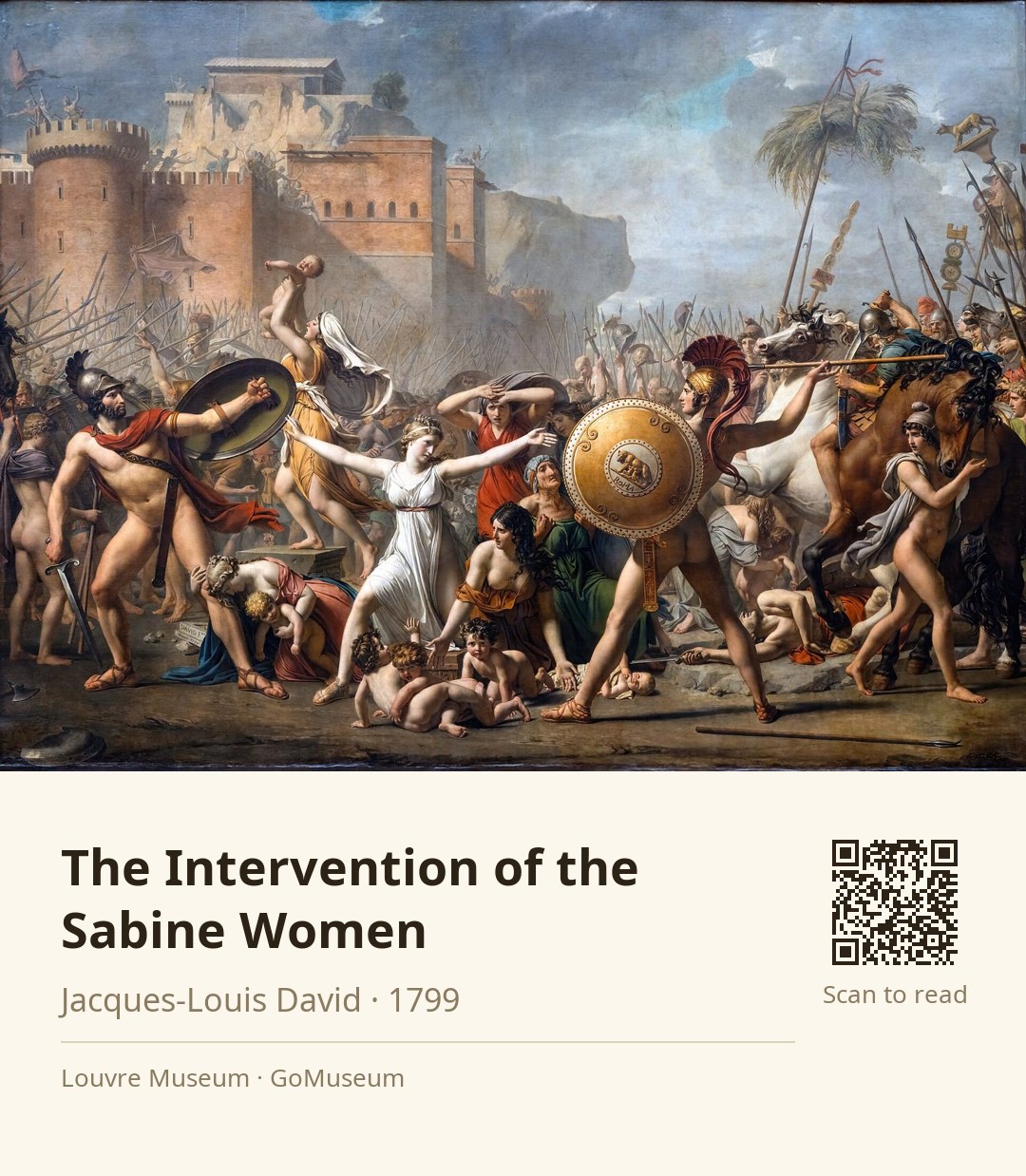
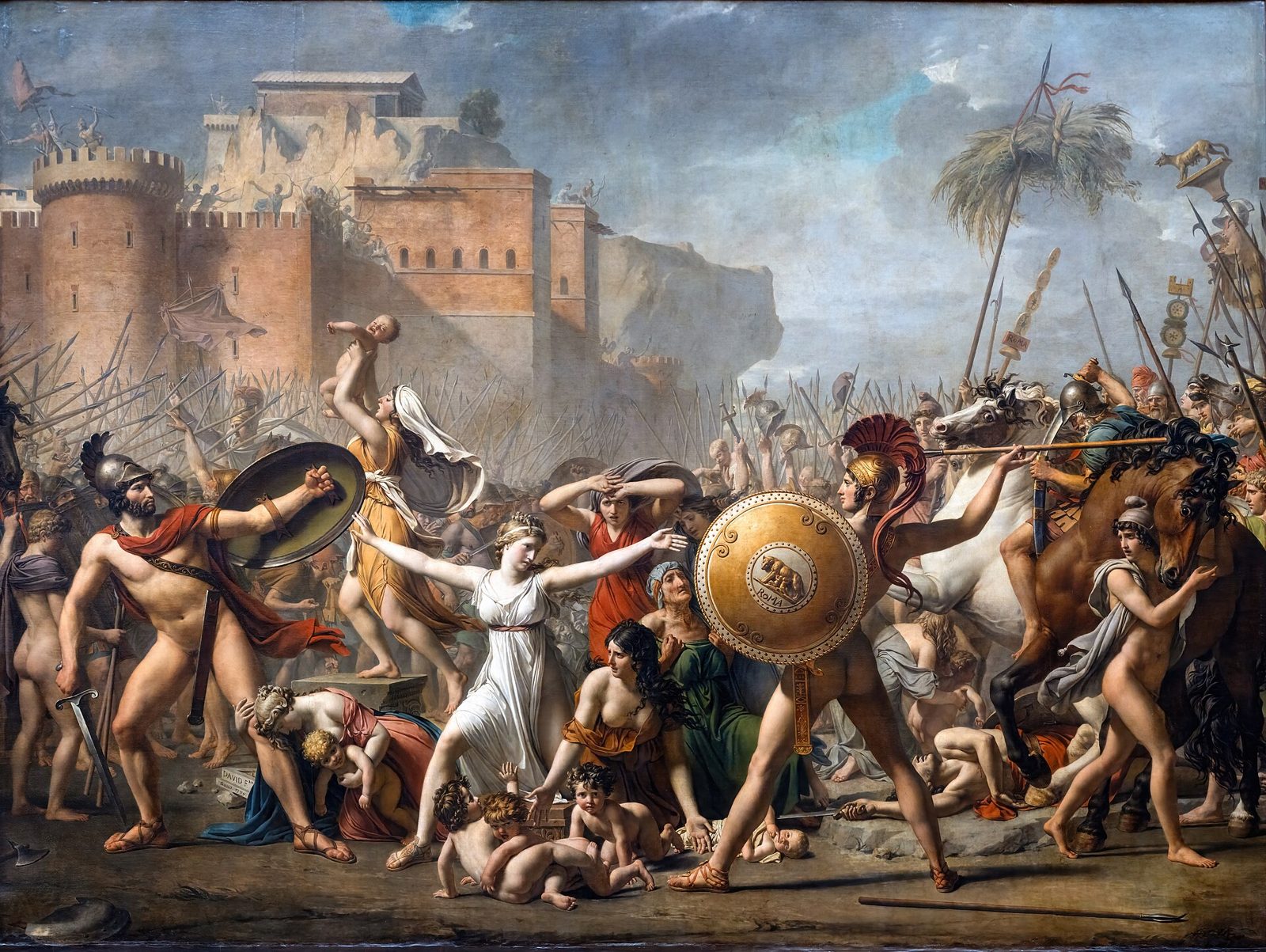
🎧 This work has audio narration — listen in the appTake a moment to really absorb the drama unfolding in Jacques-Louis David's "The Intervention of the Sabine Women." Look closely at the central figure, Hersilia, as she stands resolutely between her husband Romulus and her father Tatius, arms outstretched. Notice the tension in Romulus's posture; he’s poised to strike, yet hesitating, caught in a moment of conflict that speaks volumes about love and loyalty.
This detail is crucial because it encapsulates the painting's core message: love triumphing over violence. David painted this scene not just as a historical moment but as a plea for reconciliation in post-Revolutionary France, reflecting the turmoil of his own times. The rocky outcrop in the background, known as the Tarpeian Rock, serves as a haunting reminder of the consequences of civil strife, where betrayal led to death.
David began this work while imprisoned, inspired by a visit from his estranged wife. He wanted to convey a message of unity and protection, using the Sabine women as symbols of peace amid chaos. This painting took him nearly four years to complete, a testament to his dedication to both the craft and the message.
As you stand here, think about the sacrifices made for love and family. How does this resonate with our own struggles for unity in times of conflict?
Jacques-Louis David was a pivotal French painter born on August 30, 1748, in Paris. He emerged as the leading figure of the Neoclassical movement, marking a significant shift in artistic taste from the frivolity of Rococo to a more austere and emotionally charged classical style. His early life was marked by personal tragedy, losing his father at a young age, which shaped his character and determination to pursue art against familial expectations.
David's career flourished during the tumultuous political landscape of France, where he became an ardent supporter of the French Revolution, aligning himself with figures like Robespierre. His political engagement influenced his art, producing iconic works such as "The Death of Marat" and "The Coronation of Napoleon," which reflect both historical narratives and his personal convictions. After the fall of Napoleon, David faced exile but continued to influence generations of artists, establishing a legacy that shaped academic painting in the early 19th century. His works remain celebrated in major museums, particularly the Louvre, solidifying his status as a cornerstone of Western art history. David's life and art were inextricably linked to the evolving identity of France, embodying the spirit of revolution and the quest for artistic integrity.
Jacques-Louis David's "The Intervention of the Sabine Women" was conceived during a tumultuous period in his life. It all began in 1795 when David found himself imprisoned in the Luxembourg Palace, a victim of the political upheaval following the Reign of Terror. It was during this time that his estranged wife, Charlotte, visited him, igniting a spark of inspiration. He began the painting in 1796, aiming to depict a powerful narrative of love and reconciliation amidst conflict. The work took nearly four years to complete, and upon its unveiling in 1799 at the Louvre, it drew significant attention, despite being a paid exhibition. The painting's themes resonated deeply with a nation still reeling from revolutionary violence, and it was seen as a call for unity.
As you gaze at this monumental painting, notice the dynamic brushwork that David employs to create a sense of urgency and tension. The figures are rendered with a vigorous energy, particularly Romulus, whose poised stance suggests both aggression and hesitation. The contrasting light and shadow enhance the drama, drawing your eye to the central conflict. David's choice to isolate the main figures against a backdrop of indistinct soldiers emphasizes the personal nature of the struggle. The composition is meticulously structured; the triangular arrangement of the figures creates a visual stability that belies the chaos of the scene. The use of color is equally striking, with the reds and earth tones grounding the figures while the cooler hues in the background suggest the looming threat of violence. This careful orchestration of elements not only captures the moment's intensity but also invites you to reflect on the broader implications of love and sacrifice.
Did you know that Jacques-Louis David conceived this monumental painting while he was imprisoned? After a tumultuous period during the French Revolution, he found himself in jail, estranged from his wife. It was during this time that he decided to create 'The Intervention of the Sabine Women' as a tribute to her, symbolizing love triumphing over conflict. This personal connection adds a layer of emotional depth to the artwork, making it not just a historical narrative but also a reflection of David's own life struggles.
David was inspired to depict this moment as a sequel to Poussin's 'The Rape of the Sabine Women,' aiming to show the aftermath of the abduction and the potential for reconciliation, reflecting his own desire for unity during a time of political turmoil.
The models for the Sabine women were aristocratic sisters, Aurore and Adèle de Bellegarde, whose appearances blended with classical sculptures, creating a link between the mythological figures and the women of David's own time, thus enhancing the painting's message of reconciliation for a divided France.
The Tarpeian Rock in the background serves as a symbolic reminder of the consequences of civil conflict, referencing the historical punishment for treason, which adds a layer of urgency to the scene as it underscores the stakes of the conflict between Romulus and Tatius.