Napoleon I on his Imperial Throne
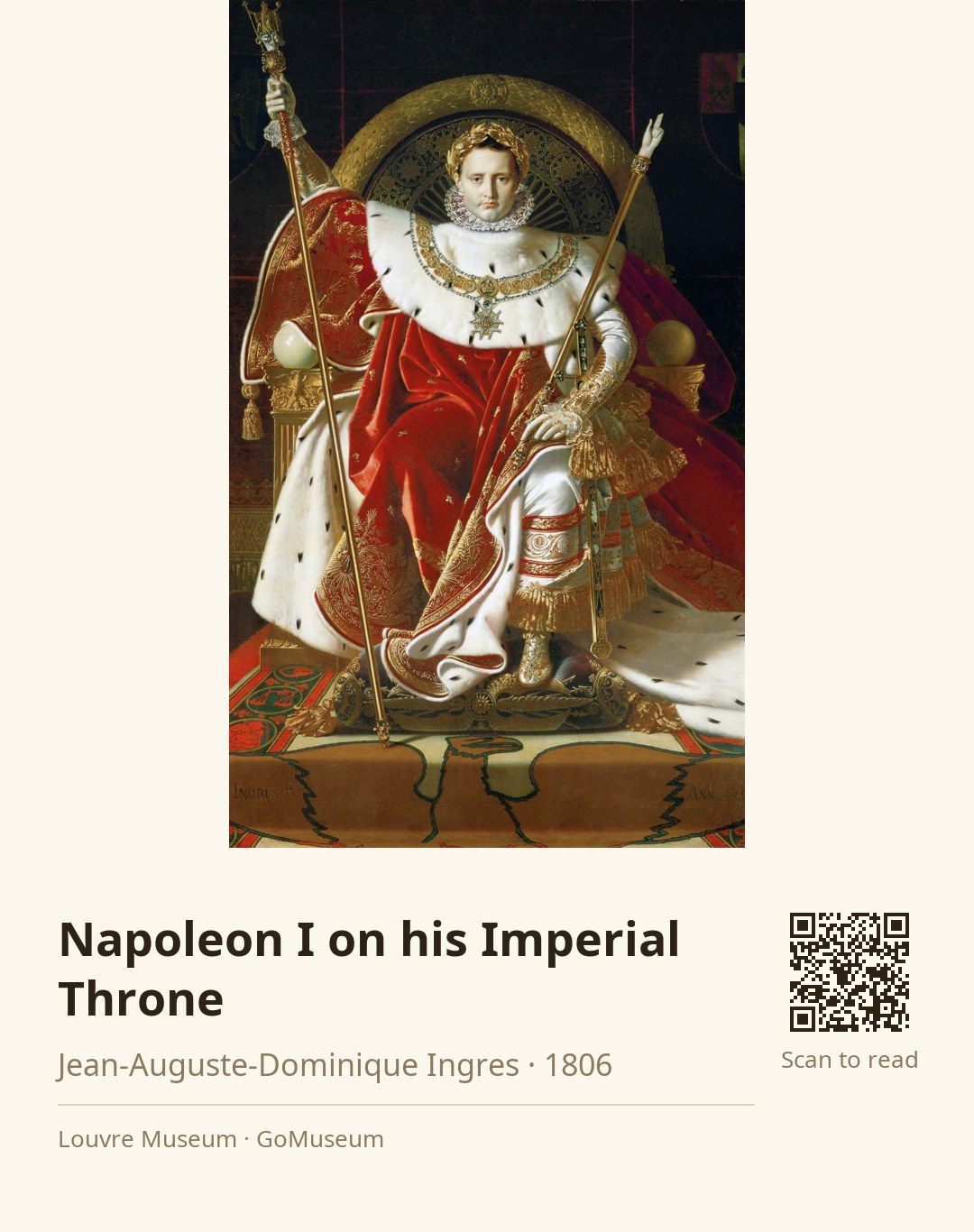
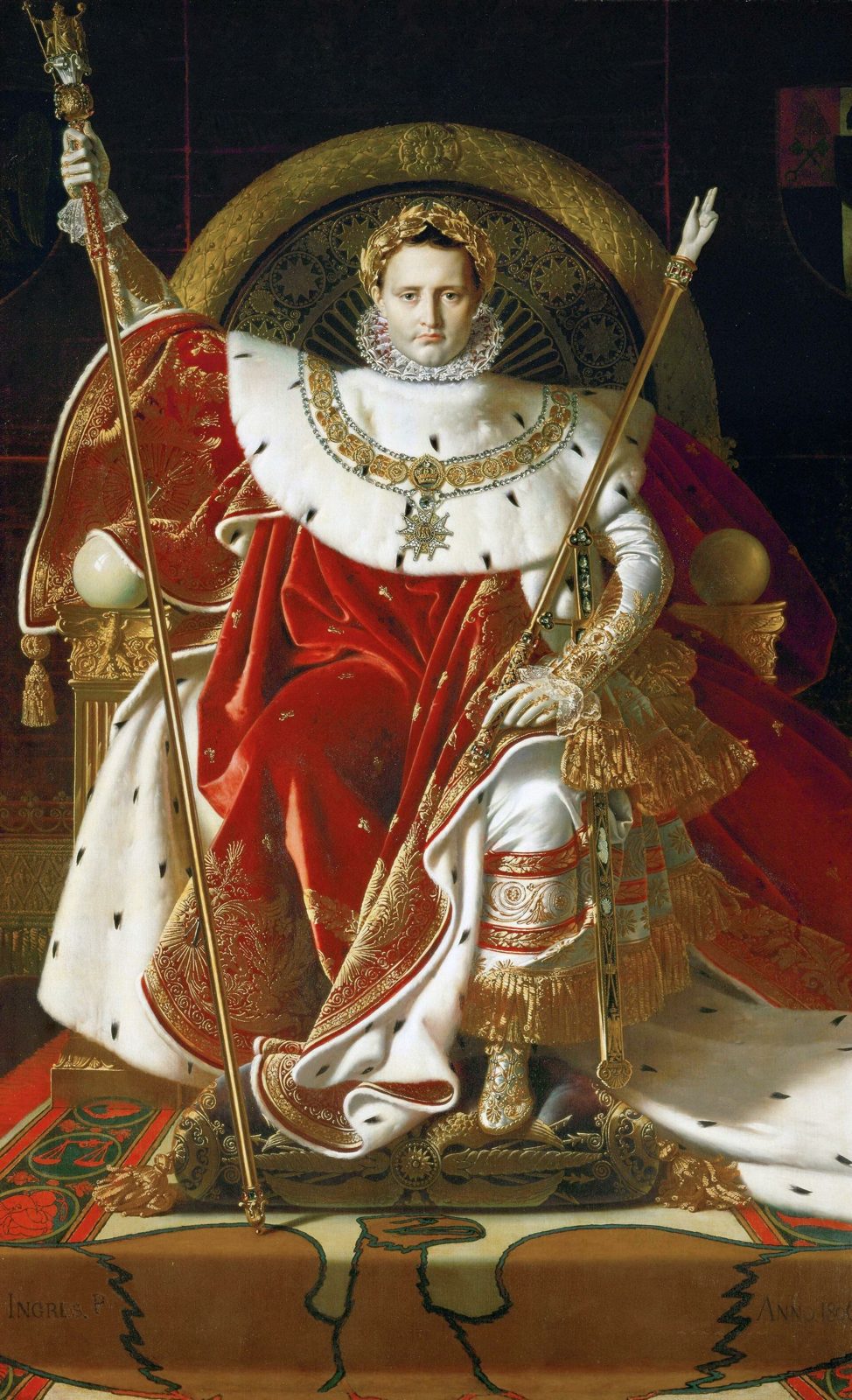
🎧 This work has audio narration — listen in the appTake a moment to really look at "Napoleon I on his Imperial Throne." Notice how Napoleon sits, regal and commanding, draped in rich fabrics that shimmer with gold embroidery. His right hand grips the scepter of Charlemagne, while the left holds the hand of justice, symbolizing his power and authority.
These details matter because they aren’t just decorative; they tell a story about Napoleon’s ambition to align himself with the great rulers of history. The laurel wreath on his head echoes Julius Caesar, linking him to the glory of ancient Rome. Ingres meticulously crafted this portrait to convey not just a likeness, but a powerful statement about imperial legitimacy and grandeur.
Painted in 1806, this work emerged during a time when Napoleon was consolidating his power, and Ingres was influenced by the classical traditions of the past. He sought to elevate portraiture to a level of historical significance, much like the grand history paintings of his time.
As you stand here, consider this: What do you think Ingres was trying to communicate about leadership and legacy through this striking image?
Jean-Auguste-Dominique Ingres was a pivotal figure in French Neoclassicism, born on August 29, 1780, in Montauban. He was the son of a versatile artist, which nurtured his early artistic inclinations. Ingres studied under Jacques-Louis David in Paris, where he developed a commitment to academic traditions, aspiring to elevate history painting above all genres. His early career was marked by struggles, as critics dismissed his style as archaic, yet he persevered, achieving recognition with works like "The Vow of Louis XIII" in 1824.
His portraits, characterized by expressive distortions, became his most celebrated contributions, influencing modern artists such as Matisse and Picasso. Ingres's time in Italy, from 1806 to 1824, was crucial; he immersed himself in the study of Renaissance masters, which shaped his distinctive style. Despite facing criticism for his meticulous approach, he remained steadfast in his vision of beauty, emphasizing drawing over color.
Later in life, he returned to Paris, where he continued to create significant works, including "The Turkish Bath." Ingres's legacy endures as a bridge between classical traditions and modern art, embodying the tension between adherence to established norms and the evolving landscape of artistic expression. He passed away on January 14, 1867, leaving behind a profound impact on the art world.
Commissioned by the Corps législatif, this painting was intended to celebrate Napoleon's imperial authority during a time of political consolidation. Initially, it was met with mixed reviews; critics were divided, some mocking its composition while others admired its meticulous detail. The painting was later transferred to the Louvre in 1815 and eventually found its home in the Musée de l'Armée. Interestingly, a shield in the upper right corner, partially visible, bears the arms of the Papal States and suggests that the original commission may have aimed to portray Napoleon as King of Italy. This innovative iconography led to its rejection by the initial patrons, resulting in its acquisition by the legislative body instead.
As you gaze at this imposing portrait, notice the way Ingres employs light and color to create a sense of grandeur. The rich golds and deep purples of Napoleon's attire shimmer against the stark white of his shoes, drawing your eye to the emperor's commanding presence. The brushwork is precise, almost clinical, which enhances the regal quality of the fabrics and the intricate details of the throne. Ingres's choice of a frontal composition mirrors classical statues, evoking a sense of timeless authority. The circular throne, with its ivory ball armrests, creates a visual anchor, emphasizing Napoleon's centrality in the painting. This careful arrangement not only showcases his royal attire but also reinforces his status as a leader, embodying the ideals of power and legitimacy.
One surprising tidbit about 'Napoleon I on his Imperial Throne' is that it was initially intended to be a representation of Napoleon as King of Italy, as indicated by the arms of the Papal States visible in the painting. However, due to its innovative iconography, it was rejected by the original commissioners, leading to its eventual acquisition by the Corps législatif instead.
Upon its debut at the Salon of 1806, the painting received mixed reviews; some critics mocked its composition while others praised its meticulous detail, highlighting the divided opinions it sparked among viewers.
Ingres' distinctive approach, particularly his expressive distortions of form and space, made him a precursor to modern art, influencing notable figures like Henri Matisse and Pablo Picasso, who drew inspiration from his techniques.
Despite his talent, Ingres struggled with insecurity stemming from a disrupted education during the French Revolution, which he felt limited his opportunities and recognition in the competitive art world.