 Image: Rama · Georgezhao · Rama
stele with the code of Hammurabi
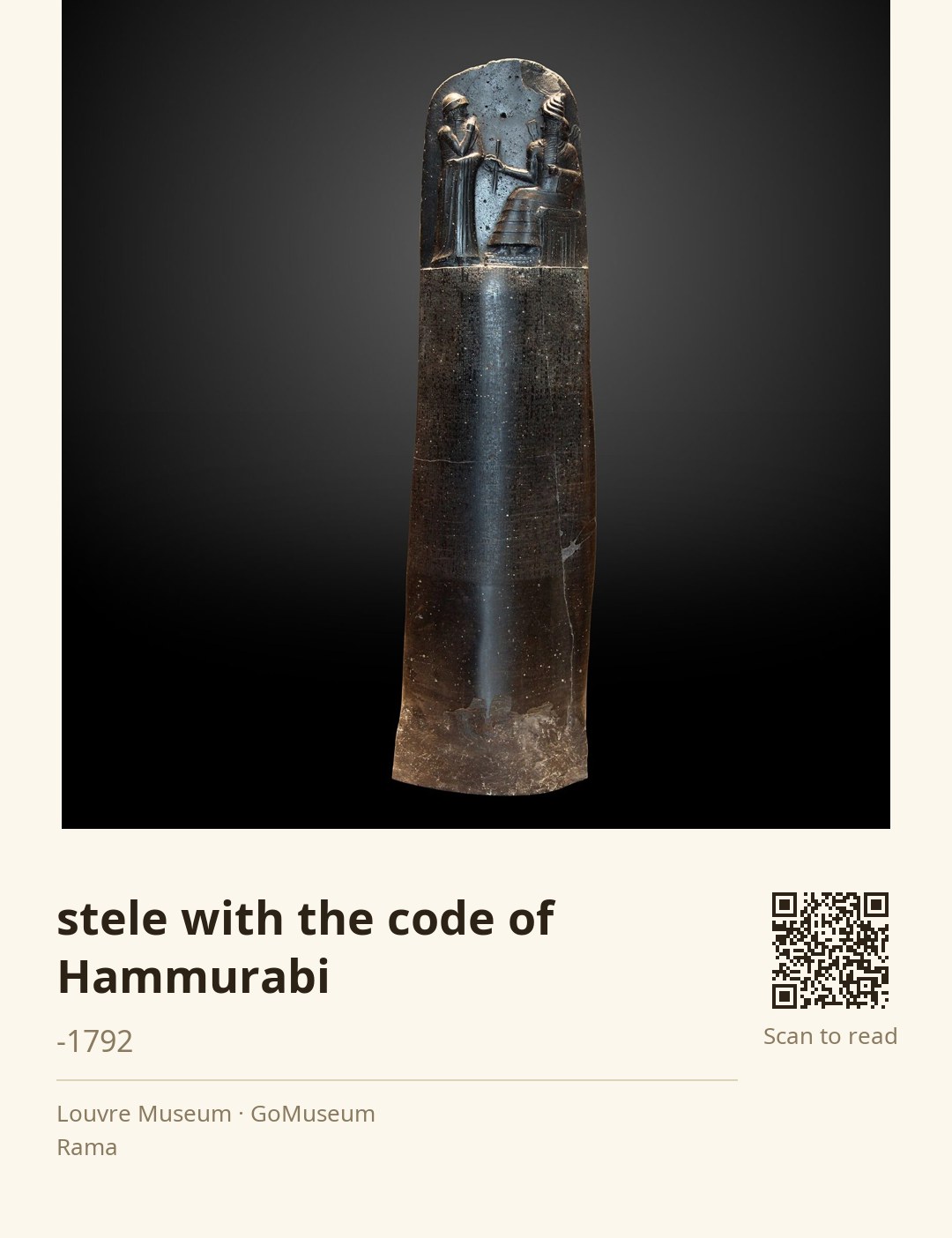
🎧 This work has audio narration — listen in the appTake a moment to really look at the stele before you, the Code of Hammurabi. Notice how the intricate carvings rise from the stone, almost as if they’re alive, telling stories of justice and order from a world over 3,700 years ago. Focus on the figure at the top—Hammurabi himself—standing tall, receiving the laws from Shamash, the sun god. His posture is commanding, and the way he holds the staff exudes authority.
These details matter because they reveal the very essence of Hammurabi’s reign. This stele isn’t just a stone slab; it’s a declaration of power and civilization. Hammurabi aimed to unify his diverse empire under a single code, emphasizing that justice should be accessible to all, not just the elite. This was revolutionary for its time, laying the groundwork for legal systems that would follow.
Hammurabi ruled Babylon during a time of great upheaval, transforming it from a minor city-state into a major power in Mesopotamia. His laws, inscribed in cuneiform, were among the first to establish the presumption of innocence and specific penalties for crimes, a concept that resonates even today.
As you stand here, think about how this ancient artifact connects to our modern understanding of law and justice. What does it mean to you that these principles have endured through millennia?
This period was marked by Hammurabi's ambitious efforts to transform Babylon from a minor city-state into a dominant power in Mesopotamia. The stele was likely displayed prominently in public spaces, serving as a constant reminder of his authority and the laws he established. Its reception was significant, as it represented a shift in governance, emphasizing a codified system of justice. After Hammurabi's death, the stele became a symbol of his legacy, revered by subsequent rulers who sought to emulate his model of governance. Rediscovered in the late 19th century, it has since been a crucial artifact for understanding early legal systems and the history of law itself.
Hammurabi, the king of Babylon, didn't just rule; he laid down a code that emphasized justice and order, marking a shift from retribution to a more structured legal system. This code, inscribed in cuneiform on black basalt, became a template for future legal systems, influencing not only Babylon but also later civilizations, including the Romans and even modern legal frameworks. Imagine a world where laws were not arbitrary but codified, where the presumption of innocence began to take root. This stele is not just a stone; it's a testament to humanity's quest for justice and the rule of law, echoing through the ages.
One fascinating detail about the Code of Hammurabi is that it was inscribed in cuneiform on a large stone stele, which stood nearly eight feet tall. This monumental display was not just for decoration; it was a public declaration meant to be seen by all, ensuring that the laws were accessible to the people of Babylon. The stele was also topped with a relief of Hammurabi receiving the laws from Shamash, the sun god, reinforcing the divine authority behind these legal principles.
The stele was strategically placed in public spaces, making the laws visible to all citizens, which reinforced the idea that justice was a communal responsibility and not just a royal decree.
After Hammurabi's death, the stele became a revered artifact, with later rulers adopting its legal principles and even claiming descent from Hammurabi to legitimize their own authority.