The Coronation of Napoleon
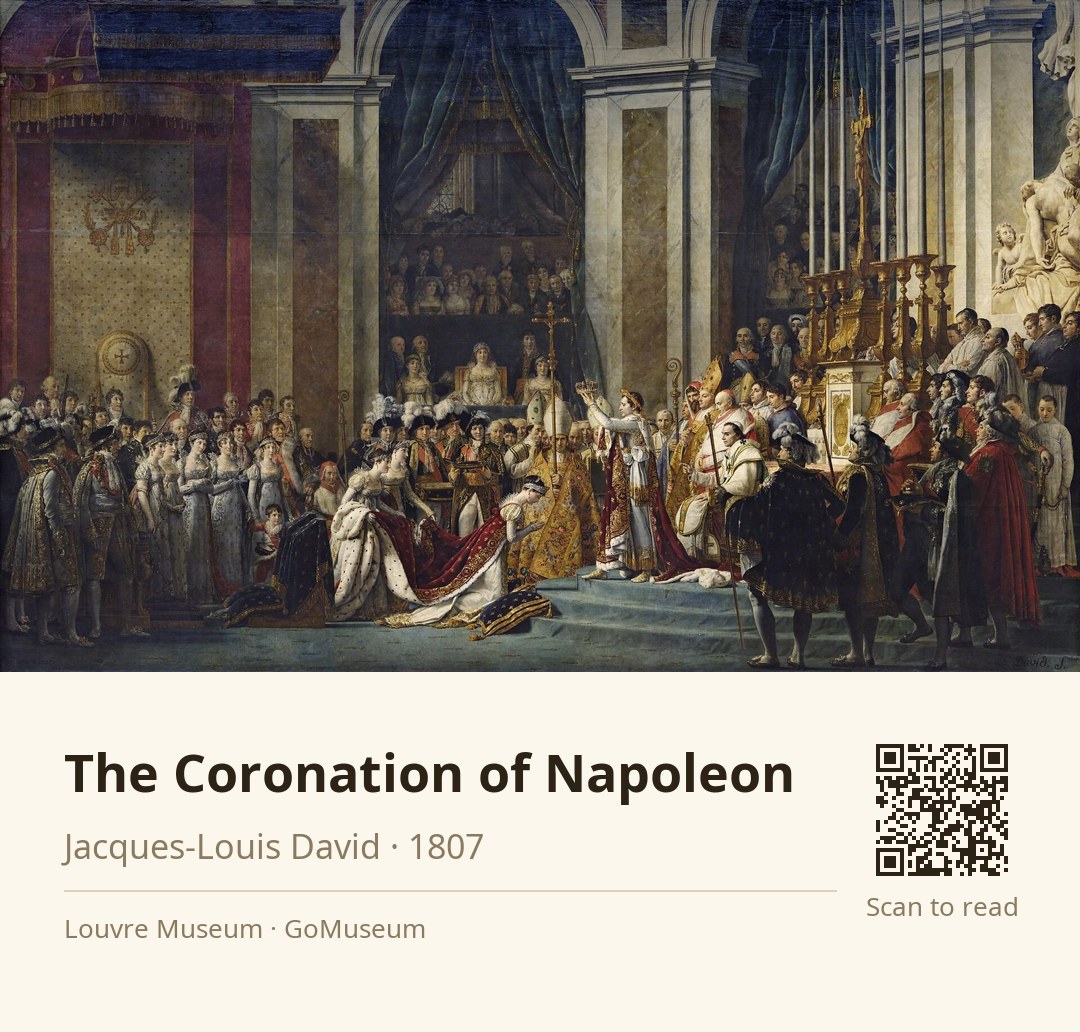
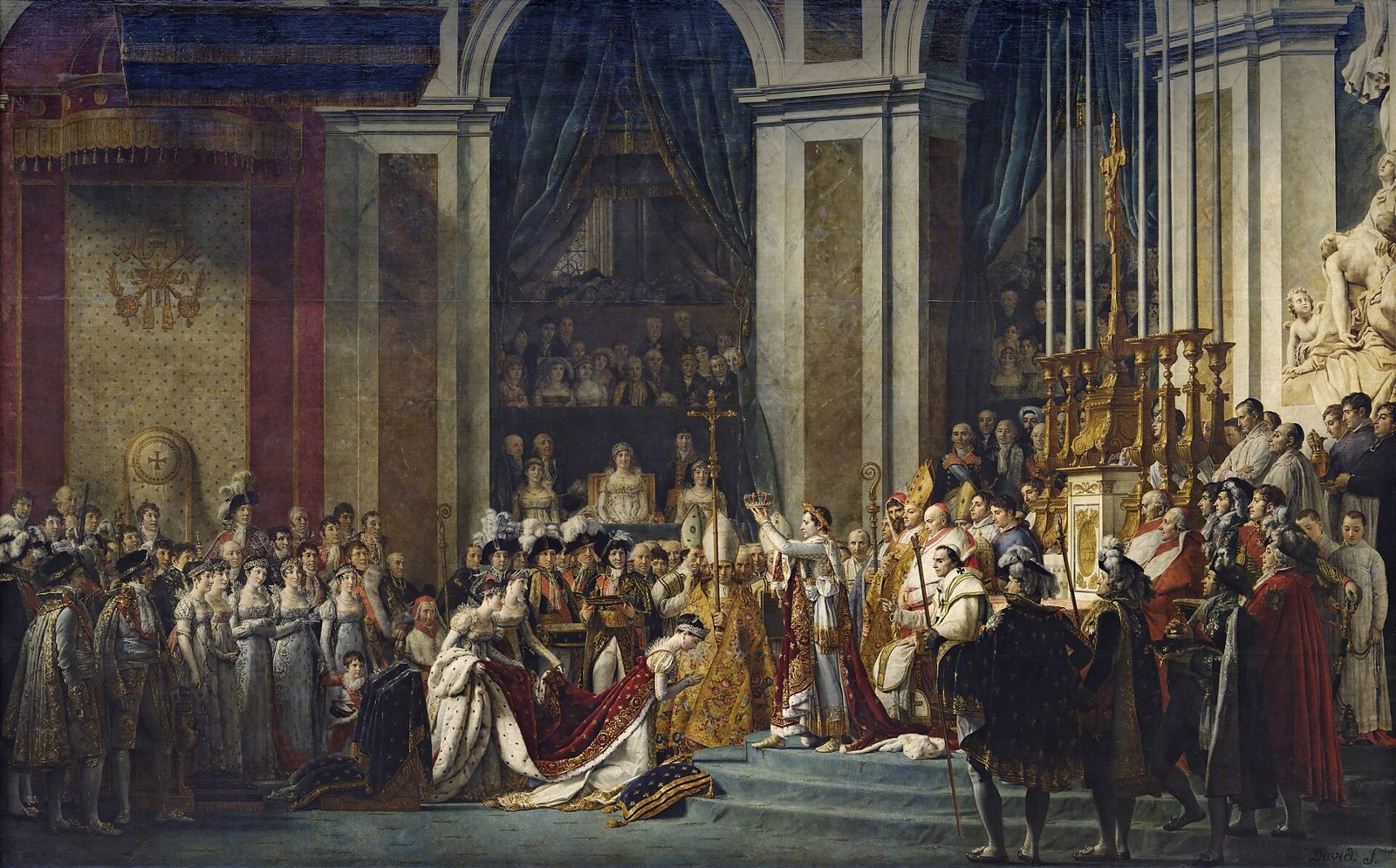
🎧 This work has audio narration — listen in the appAs you stand before Jacques-Louis David's monumental "The Coronation of Napoleon," take a moment to let the sheer scale of this painting wash over you. Almost ten meters wide, it’s not just a visual feast but a carefully crafted narrative of power and ceremony. Notice how all eyes in the scene are drawn to Napoleon himself, standing tall in his imperial robes, a striking figure at the center of this grand tableau.
Look closely at the way David has positioned Joséphine, kneeling before him, receiving the crown directly from her husband rather than the Pope.
Commissioned in 1804, this painting was David's way of immortalizing the moment when Napoleon crowned himself Emperor in Notre-Dame de Paris. It’s a pivotal event that not only reshaped France but also echoed throughout Europe, as it signaled the rise of a new kind of ruler.
As you take in the scene, consider the implications of this act of self-crowning. What does it say about ambition, power, and the lengths one might go to secure their legacy? Let this moment linger in your mind as you reflect on the audacity of Napoleon’s reign and the artistry of David that captured it so vividly.
Jacques-Louis David was a pivotal French painter born on August 30, 1748, in Paris. He emerged as the leading figure of the Neoclassical movement, marking a significant shift in artistic taste from the frivolity of Rococo to a more austere and emotionally charged classical style. His early life was marked by personal tragedy, losing his father at a young age, which shaped his character and determination to pursue art against familial expectations.
David's career flourished during the tumultuous political landscape of France, where he became an ardent supporter of the French Revolution, aligning himself with figures like Robespierre. His political engagement influenced his art, producing iconic works such as "The Death of Marat" and "The Coronation of Napoleon," which reflect both historical narratives and his personal convictions. After the fall of Napoleon, David faced exile but continued to influence generations of artists, establishing a legacy that shaped academic painting in the early 19th century. His works remain celebrated in major museums, particularly the Louvre, solidifying his status as a cornerstone of Western art history. David's life and art were inextricably linked to the evolving identity of France, embodying the spirit of revolution and the quest for artistic integrity.
Jacques-Louis David's 'The Coronation of Napoleon' was commissioned orally by Napoleon himself in September 1804, marking a significant moment in the artist's career as he became the official painter of the Emperor. David began working on the painting on December 21, 1805, in a workshop set up in the former chapel of the College of Cluny, near the Sorbonne. He was assisted by his student Georges Rouget and completed the work in January 1808. The painting was first exhibited at the Salon of 1808, where it drew considerable attention and was celebrated for its grandeur and historical significance. Following its exhibition, it was presented at the Salon decennial prize competition in 1810. Initially, the painting remained with David until 1819 when it was transferred to the Royal Museums. It was stored away until 1837, after which it was displayed in the Chamber Sacre of the Palace of Versailles. In 1889, it found its permanent home at the Louvre Museum in Paris. Interestingly, David was commissioned by American entrepreneurs to create a full-size replica in 1808, which he painted from memory during his exile in Brussels, completing it only in 1822. This replica was returned to France in 1947, further intertwining the painting's legacy with the history of its creation and reception.
As you gaze at 'The Coronation of Napoleon,' take a moment to appreciate the meticulous craftsmanship that Jacques-Louis David employed. The painting is a masterclass in neoclassical composition, structured around several axes that guide the viewer's eye. Notice how all the figures are oriented towards Napoleon, who stands at the center, dressed in robes reminiscent of Roman emperors. The vertical axis created by the cross above him emphasizes his divine right to rule, while a diagonal line connects the Pope to Joséphine, creating a dynamic tension in the scene. The brushwork is precise, with David's use of light and shadow enhancing the three-dimensionality of the figures. The rich colors, particularly the deep reds and golds, evoke a sense of opulence and power. The architecture of Notre-Dame, with its towering columns and elaborate decor, frames the ceremony, drawing your focus to the central act of crowning. David's choice to depict the moment of self-crowning, where Napoleon takes the crown from the altar, is a bold statement of his authority and independence, effectively breaking from the traditional monarchy. This painting is not just a visual representation; it is a carefully orchestrated narrative that captures the essence of a pivotal moment in history.
Completed in 1807, this monumental work not only captured the essence of Napoleon's self-crowning but also marked a shift in the artistic narrative of power and authority. David, as Napoleon's official painter, utilized neoclassical principles to elevate the emperor's image, blending grandeur with a sense of personal agency. This painting influenced a generation of artists who sought to convey political narratives through visual art, establishing a precedent for the use of art as a tool for propaganda. It resonates with themes of legitimacy and sovereignty, reflecting the tumultuous political landscape of the time. Remember this: David didn't just paint a scene; he crafted an enduring symbol of ambition and self-assertion that would echo through the ages, shaping how leaders and their legacies are portrayed in art.
Napoleon initially commissioned Jacques-Louis David to paint this monumental piece in 1804, but it wasn't just a straightforward artistic endeavor. David faced significant challenges, including the pressure of capturing a pivotal moment in history while also adhering to Napoleon's vision of grandeur. Interestingly, during the painting process, David originally depicted Napoleon placing the crown on his own head, symbolizing his self-made authority. However, under Napoleon's direction, this was altered to show Joséphine receiving the crown from him, emphasizing the traditional royal ceremony.
For the coronation, the cathedral was dramatically altered with decorative elements to enhance its solemnity, including draped curtains and faux marble to mask its Gothic style, creating a more grandiose setting for the event.
David's alignment with various political regimes, from the French Revolution to Napoleon's empire, shaped his work significantly; he transitioned from revolutionary themes to imperial grandeur, reflecting the changing tides of French politics in his art.