Bonaparte Crossing the Alps
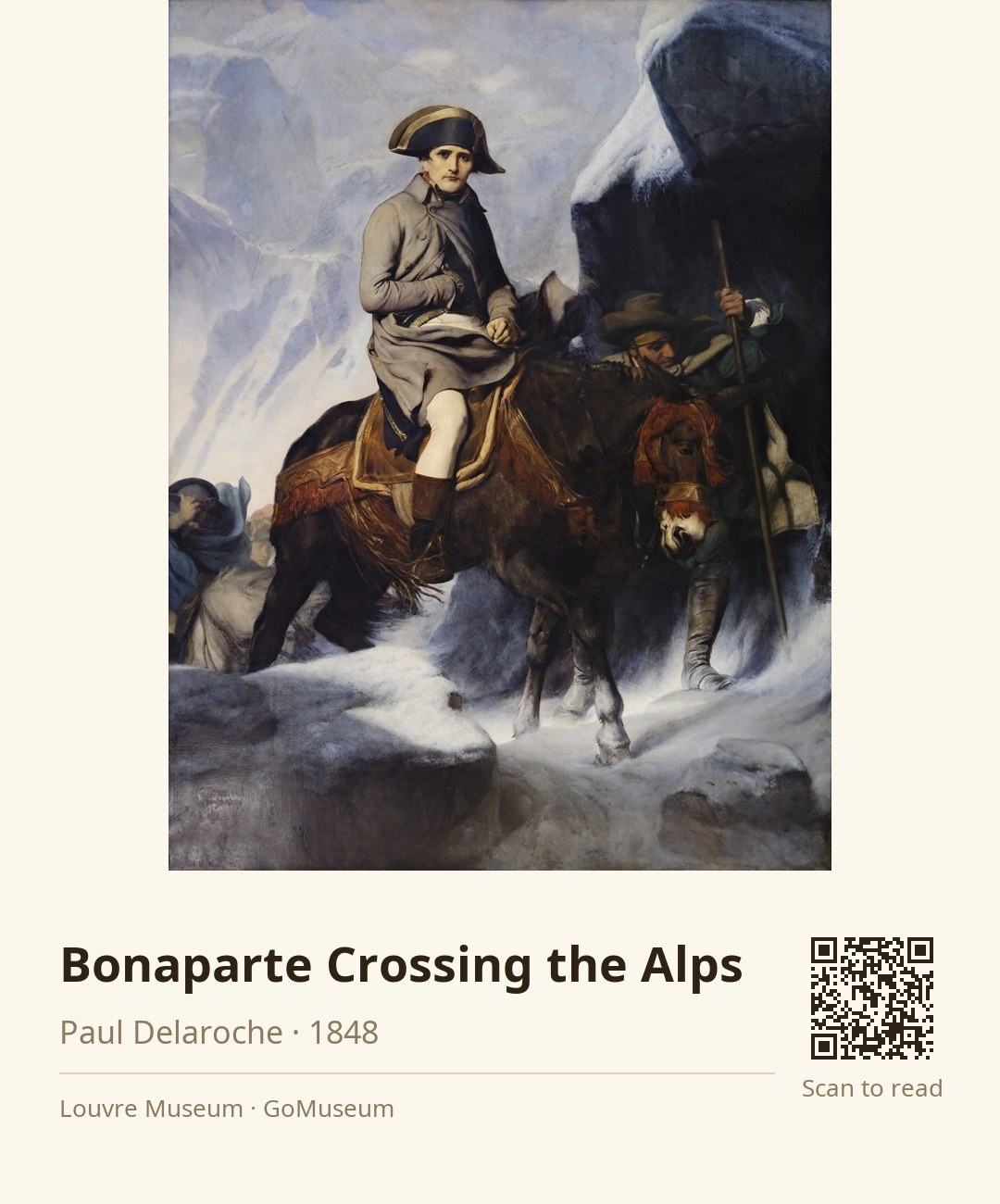
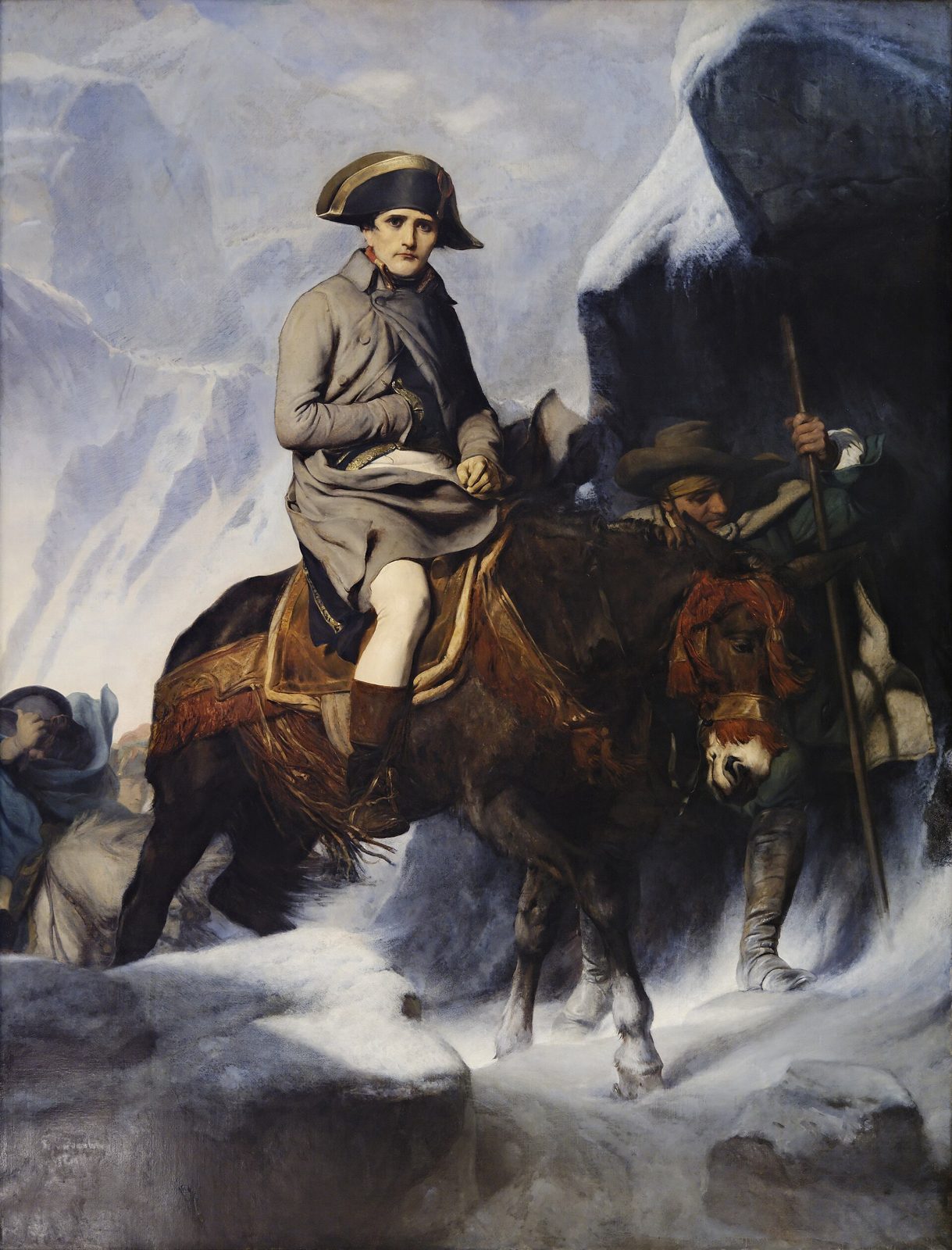
🎧 This work has audio narration — listen in the appTake a moment to look closely at "Bonaparte Crossing the Alps" by Paul Delaroche. Notice how Napoleon is depicted not on a majestic steed, but rather on a humble mule, his expression stoic as he leads his troops through the treacherous mountain pass. This choice of animal is striking, isn’t it? It conveys a sense of realism and vulnerability, contrasting sharply with the heroic portrayals of Napoleon by other artists, like Jacques-Louis David.
Delaroche’s decision to show Napoleon in this way matters because it strips away the glorified image of the military leader, presenting him as a man facing the harsh realities of war and nature. It’s a nod to the Romantic movement’s emphasis on emotion and realism, inviting viewers to connect with the human experience behind the legend.
Painted in 1848, this work emerged during a time when Napoleon's legacy was being reexamined, nearly four decades after his fall from power. Delaroche aimed to capture not just the grandeur of history, but its gritty truth, reflecting a shift in how artists approached historical figures.
As you stand here, consider what this portrayal says about leadership and the burdens that come with it. How does this image of a weary leader resonate with your own understanding of power and responsibility?
Hippolyte-Paul Delaroche was a prominent French painter born on July 17, 1797, in Paris, where he spent most of his life until his death on November 4, 1856. Known for his historical scenes, Delaroche's work straddled the lines between Romanticism, Academicism, and Neoclassicism, reflecting the emotional depth of Romantic ideals while adhering to the meticulous detail favored by Academics. His pragmatic realism allowed him to portray historical figures, such as Marie Antoinette and Napoleon Bonaparte, with a sense of equality, devoid of glorification.
Delaroche emerged as a significant figure in the art world during a time of stylistic conflict between Romanticism and Classicism. His early works, particularly "The Execution of Lady Jane Grey," garnered acclaim and established him as a leading historical painter. He was a student of Antoine-Jean Gros and later mentored notable artists like Jean-Léon Gérôme and Jean-François Millet. Despite his success, Delaroche faced criticism for his later religious works, leading him to withdraw from public exhibitions after 1837.
His artistic journey began at L'École des Beaux-Arts, where he initially focused on landscapes but soon shifted to history painting under Gros's influence. Delaroche's legacy includes a rich body of work that resonated with the public and influenced future generations, making him a key figure in 19th-century art history. His marriage to Louise Vernet and the subsequent loss of her in 1845 deeply affected him, yet his contributions to the art world remain significant. Delaroche's paintings continue to be celebrated for their narrative quality and emotional resonance, solidifying his place in the annals of art history.
Paul Delaroche's 'Bonaparte Crossing the Alps' was painted between 1848 and 1850, commissioned by Arthur George, the Third Earl of Onslow. After a visit to the Louvre, where they saw Jacques-Louis David's glorified version of Napoleon, George sought a more realistic portrayal. Delaroche's painting was inspired by Napoleon's actual crossing in 1800, a strategic surprise against the Austrians. The work was initially met with mixed reviews; while some praised its fidelity to detail, others criticized Delaroche for failing to capture Napoleon's genius. The painting has several versions, with the original housed in the Louvre and another in the Walker Art Gallery in Liverpool, acquired by Onslow in 1893.
Delaroche's technique in 'Bonaparte Crossing the Alps' is strikingly meticulous. The brushwork is both precise and expressive, capturing the ruggedness of the Alpine landscape and the weariness of the figures. Notice how the light plays across the snow, creating a stark contrast that enhances the drama of the scene. The composition is carefully structured; Napoleon is centrally positioned, drawing your eye immediately. The use of a mule instead of a horse adds a layer of humility, while the muted color palette—grays and whites—evokes the harshness of the environment. Delaroche's choice to depict Napoleon with a stoic expression, hand tucked under his uniform, suggests a man burdened by the weight of leadership, inviting you to ponder the emotional toll of such a journey.
Unlike the glorified depictions by Jacques-Louis David, Delaroche's painting presents Napoleon in a more human light, riding a mule rather than a majestic horse. This shift towards realism influenced a generation of artists who began to prioritize authenticity over idealization. Delaroche's approach marked a significant departure from the prevailing neoclassical style, paving the way for the romantic realism that would dominate the 19th century. His work invites viewers to reconsider the narratives surrounding historical events, emphasizing the struggles and vulnerabilities of its subjects. Remember, this painting isn't just about a military leader; it's about the very human experience of overcoming obstacles.
One interesting tidbit about 'Bonaparte Crossing the Alps' is that during the actual crossing in 1800, Napoleon's army consumed an astonishing 22,000 bottles of wine, along with over a ton of cheese and 800 kilograms of meat! This detail highlights not just the logistical challenges of the campaign but also the human side of the military endeavor, contrasting sharply with the heroic image often associated with Napoleon.
Upon its exhibition in England in 1850, critics praised the painting's detail and realism but criticized Delaroche for not capturing Napoleon's genius, indicating a divide between the expectations of historical representation and the artist's intentions.
During the crossing in 1800, Napoleon's army faced significant logistical challenges, consuming an astonishing 22,000 bottles of wine, over a ton of cheese, and 800 kilograms of meat, which highlights the human aspect of military campaigns often overlooked in heroic narratives.