The Lacemaker
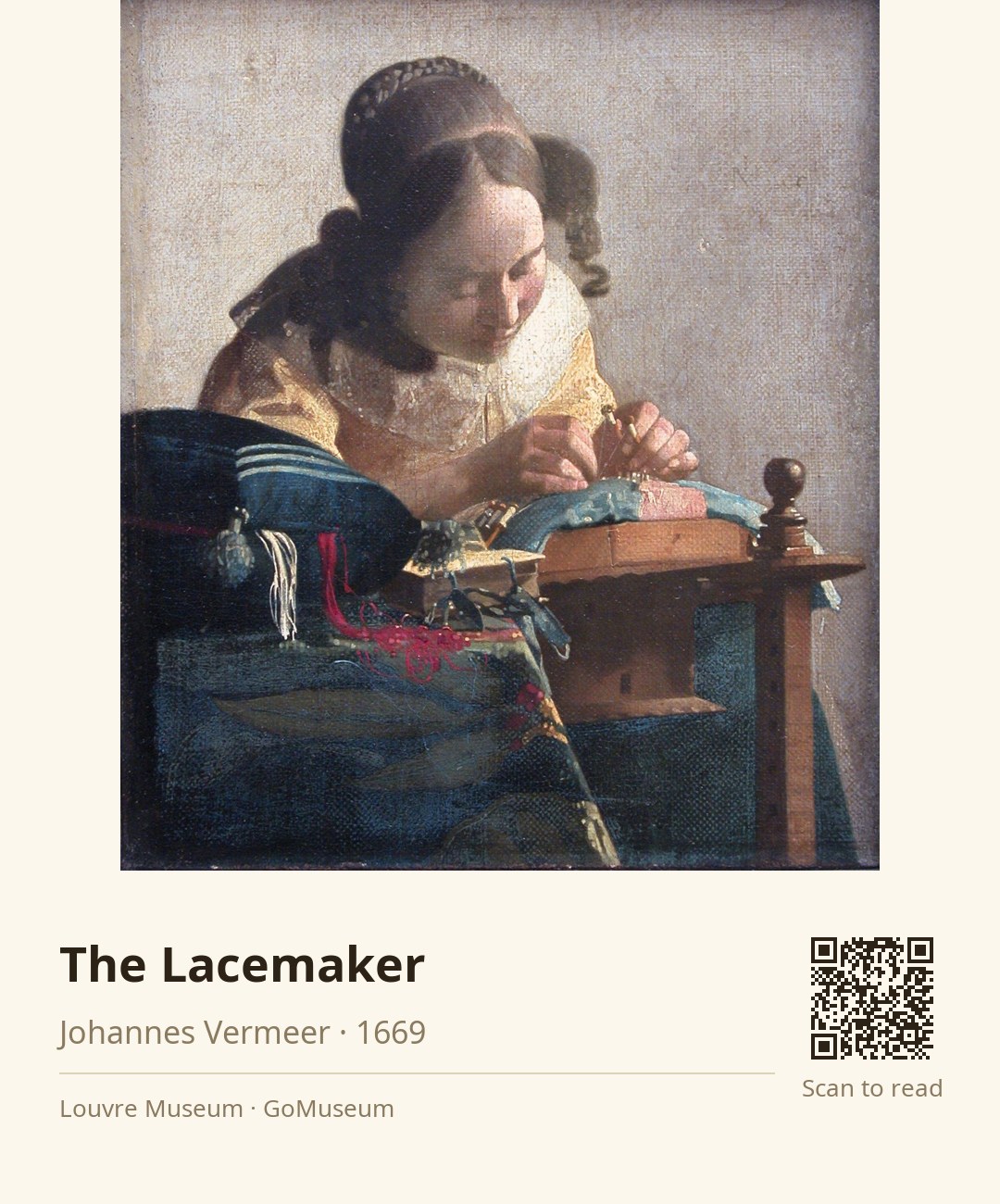
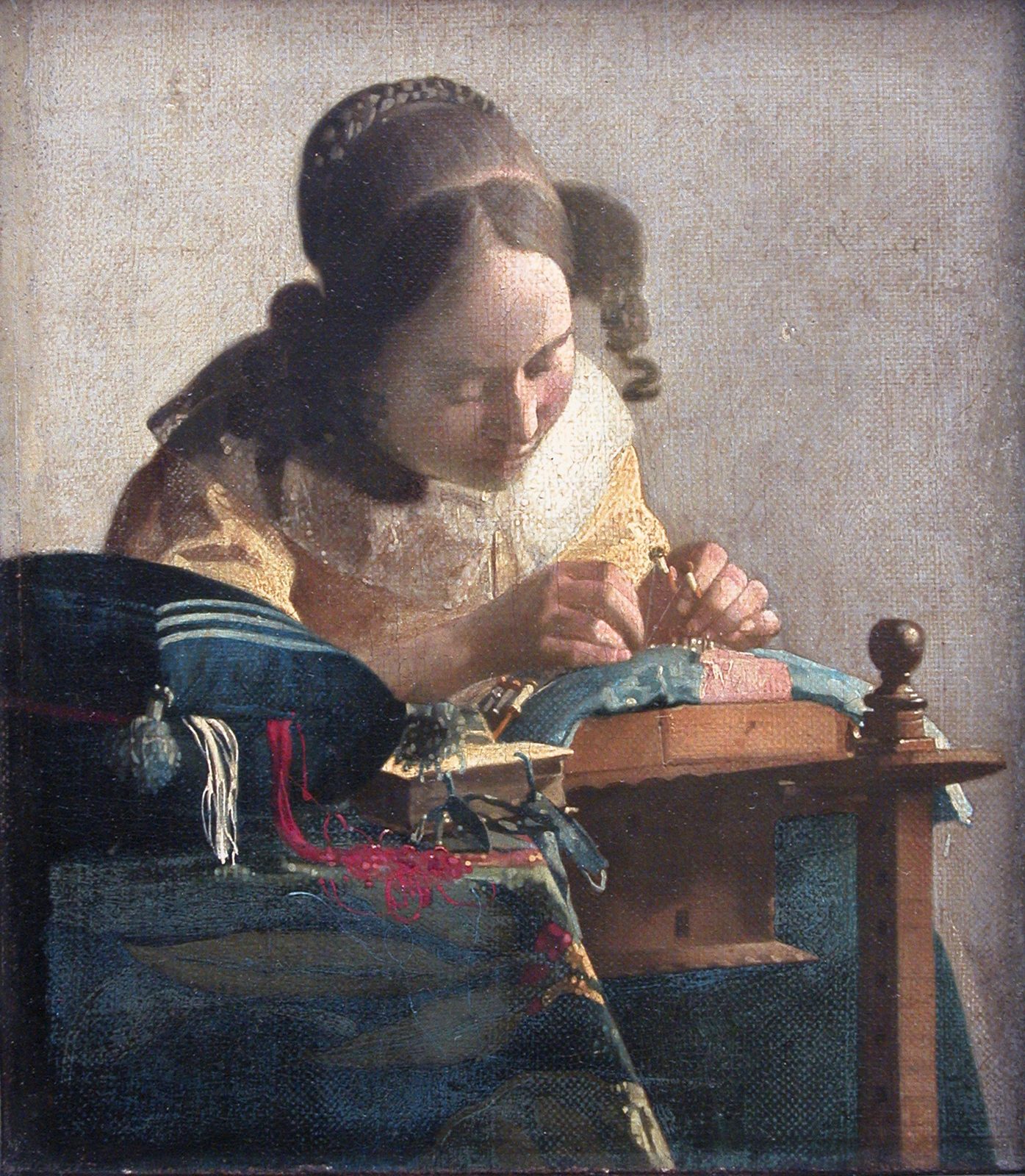
🎧 This work has audio narration — listen in the appTake a moment to really look at "The Lacemaker" by Vermeer. Notice how the young woman, dressed in a vibrant yellow bodice, is completely absorbed in her intricate task. Her delicate fingers are poised with bobbins, while she carefully places a pin into the lace pillow. This moment of concentration is beautifully captured, don’t you think?
Now, focus on the way the lace spills from the cushion, almost flowing like liquid. This contrast between the soft, blurred threads and the sharp precision of the lace she’s crafting creates a captivating tension in the painting. It’s as if Vermeer is inviting you to pause and appreciate the beauty in the mundane, the artistry in everyday life.
As you stand here, think about the quiet intimacy of this moment. What stories do you think this young woman holds in her mind as she creates? What dreams or aspirations might she be weaving into her lace?
Johannes Vermeer, born in Delft in 1632, was a Dutch painter renowned for his intimate domestic scenes that capture the essence of middle-class life. His meticulous approach and masterful use of light set him apart during the Dutch Golden Age, yet he remained relatively obscure during his lifetime, primarily recognized in his local circles. Vermeer produced only about 34 paintings, often depicting the same interiors and figures, predominantly women, which contributed to his unique style that blends familiarity with mystery.
Despite his artistic talent, Vermeer struggled financially, operating an art dealership and leaving his family in debt upon his death in 1675. His work fell into obscurity until the 19th century when critics like Théophile Thoré-Bürger rediscovered him, leading to a resurgence of interest. Today, Vermeer is celebrated alongside masters like Rembrandt and Hals, with iconic works such as "Girl with a Pearl Earring" and "The Milkmaid" solidifying his place in art history. His paintings continue to captivate audiences, showcasing a harmonious blend of color, light, and composition that reflects a world more perfect than his own.
Vermeer's 'The Lacemaker' was painted around 1669-1670, during a time when the artist was gaining recognition in Delft and The Hague, though he remained relatively obscure outside these circles. This painting, now held in the Louvre, was first mentioned in a 1696 auction in Amsterdam, where it sold for 28 florins—about a month's salary for a laborer. It eventually made its way to the Louvre in 1870 for 7,500 francs, a significant sum reflecting its growing value. Interestingly, it was only in the 19th century that Vermeer was rediscovered, thanks to the efforts of art historians like Théophile Thoré-Burger, who helped elevate his status in the art world.
In 'The Lacemaker', Vermeer employs a meticulous technique that showcases his mastery of light and texture. The painting is notably small, measuring just 24.5 cm by 21 cm, yet it packs a powerful visual punch. Notice how the young woman's figure is set against a blank wall, a deliberate choice by Vermeer to eliminate distractions and focus your attention entirely on her delicate work. The brushwork is incredibly precise, especially in the depiction of the lace, which contrasts with the soft, almost fluid representation of the threads spilling from the cushion. This interplay creates a tension that draws you in, inviting you to appreciate the intricate process of lace-making.
Vermeer's 'The Lacemaker' has left a lasting legacy in the art world, influencing generations of artists who admire his unique approach to light and domestic scenes. Salvador Dalí, for instance, was inspired enough to create his own version of this work in 1955, demonstrating Vermeer's enduring impact. The painting is often regarded as one of the most abstract and unusual of Vermeer’s oeuvre, challenging traditional representations of genre painting. Its intimate portrayal of a solitary moment has resonated with viewers and artists alike, cementing Vermeer’s place as a master of the Dutch Golden Age and ensuring that his work continues to be celebrated and studied.
Did you know that 'The Lacemaker' is actually the smallest painting by Vermeer? At just 24.5 cm by 21 cm, it’s a tiny masterpiece that packs a big punch! This intimate scale draws you in, making you feel like you're peering into a private moment of creation.
The canvas for 'The Lacemaker' was cut from the same bolt as that used for another of Vermeer's works, 'A Young Woman Seated at the Virginals', suggesting a deliberate connection between these two paintings.
Contrary to some interpretations, the young woman is not portrayed as a working-class lace maker but is believed to come from a wealthier background, reflecting a more intimate and contemplative moment rather than a depiction of labor.