Coronation of the Virgin
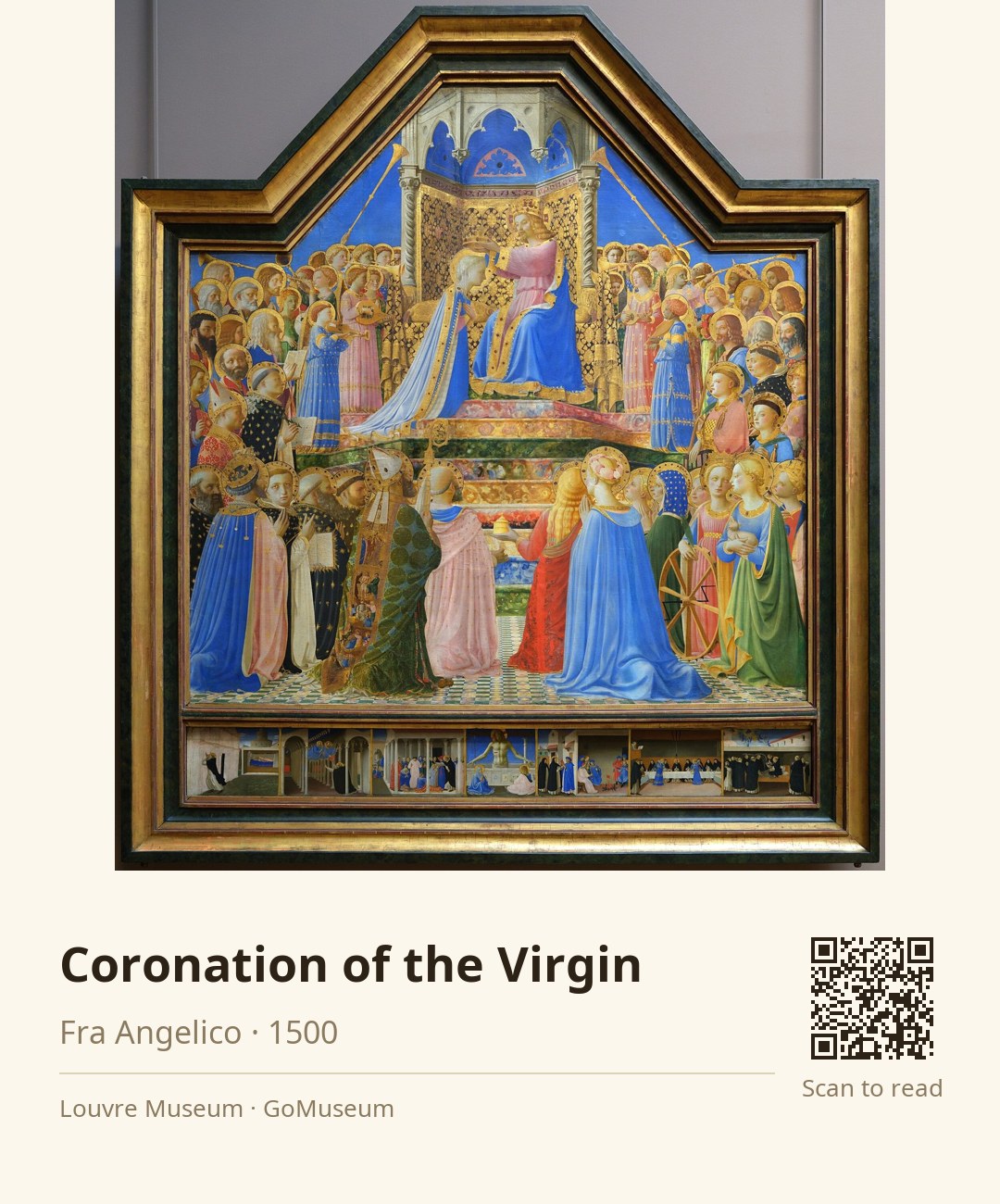
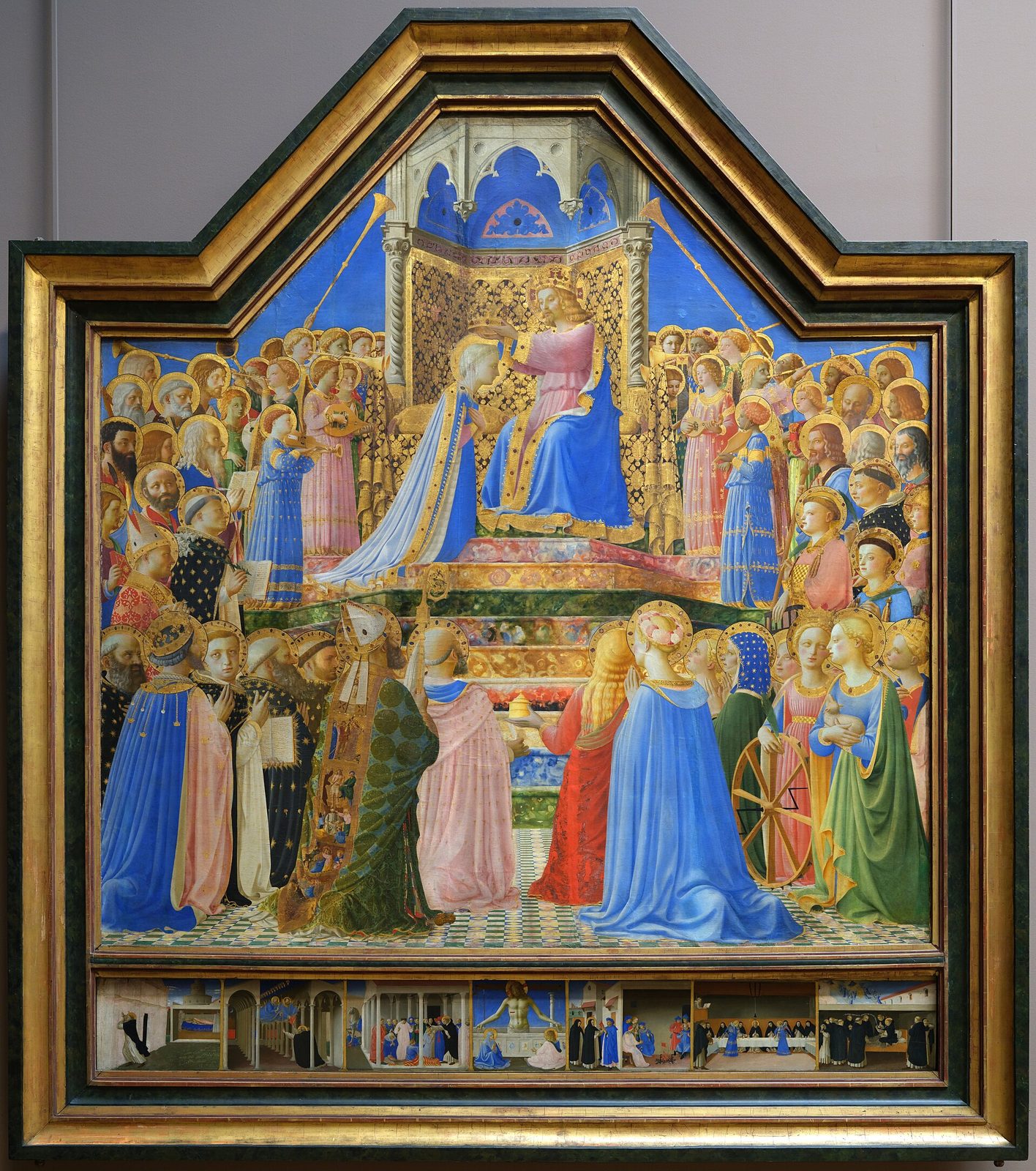
🎧 This work has audio narration — listen in the appTake a moment to really soak in the beauty of "Coronation of the Virgin" by Fra Angelico. Look closely at the vibrant blue sky that envelops the scene. Notice how it contrasts with the intricate, polychrome marble steps leading up to the throne. This isn’t just a backdrop; it’s a deliberate choice by Angelico to create a sense of depth and realism, moving away from the flat gilded backgrounds typical of earlier works.
He was not just painting a religious scene; he was inviting you into a heavenly moment, making the divine feel accessible. The twisted columns and the geometric tiles on the floor draw your eye upward, guiding you to the central act of Christ crowning the Virgin Mary, surrounded by a celestial audience of saints and angels.
Fra Angelico, a Dominican friar, painted this masterpiece around 1434 for the convent of San Domenico in Fiesole, where he lived and worked. His art was deeply spiritual, merging his faith with the burgeoning artistic innovations of his time.
As you stand here, think about the emotions this scene evokes. What do you feel when you see the Virgin crowned? Does it inspire a sense of peace or wonder? Let that feeling linger as you continue your journey through the museum.
Fra Giovanni da Fiesole, known posthumously as Fra Angelico, was an Italian Dominican friar and painter born around 1395 in Mugello, Tuscany. His early life was marked by a deep commitment to his faith, which he expressed through his art. Joining the Dominican Order, he adopted the name Fra Giovanni and dedicated his career to creating religious works. His most notable contributions include frescoes for the convent of San Marco in Florence, commissioned by Cosimo de' Medici, and masterpieces like the San Marco Altarpiece and the Deposition of Christ.
Angelico's artistry was characterized by a pioneering use of linear perspective and a profound attention to light and form, setting him apart from the late Medieval styles. His works were imbued with a mystical quality, reflecting his personal humility and spirituality. He completed significant commissions in Rome under papal patronage, further solidifying his place in art history.
Beatified by Pope John Paul II in 1982, Fra Angelico is celebrated as the patron of Catholic artists. His legacy endures as a bridge between Medieval traditions and the emerging Renaissance, embodying the spiritual and artistic aspirations of his time.
The 'Coronation of the Virgin' was commissioned for the convent of San Domenico in Fiesole, where Fra Angelico lived as a Dominican friar. While it is generally dated to around 1434, some art historians suggest it may have been created during Angelico's later visit to Rome around 1450. After the Napoleonic Wars, the painting was taken to France and now resides in the Musée du Louvre.
As you gaze at the 'Coronation of the Virgin,' pay attention to the brushwork that feels both meticulous and lively, almost as if the figures are caught in a moment of divine celebration. The use of a light blue sky instead of a gilded background invites a sense of realism and depth, a significant departure from earlier styles. Notice how the polychrome marble steps lead your eye upward, creating a pyramidal composition that draws you into the scene. The figures are arranged in a way that feels both intimate and grand, with some shown from behind, adding layers to the narrative. The geometric tiles on the floor enhance the perspective, making the viewer feel as though they are part of this celestial moment. This careful attention to light and structure showcases Angelico's mastery of early Renaissance techniques.
Interestingly, while Fra Angelico is celebrated for his serene and spiritual works, he often worked with assistants. In fact, some parts of the 'Coronation of the Virgin' were painted by his students, particularly on the right side of the composition, where the details are less refined. This collaborative approach was not uncommon during the Renaissance, as artists often had workshops that produced multiple works simultaneously.
The painting shows influences from Masaccio's innovations, particularly in its advanced composition and use of linear perspective, which marked a significant evolution in Renaissance art. Additionally, the twisted columns and architectural elements echo styles found in the frescoes of the Niccoline Chapel in Rome.
The painting was taken to France during the Napoleonic Wars as part of the looting of artworks, and due to its large size, it was not returned after the conflict, remaining in the Musée du Louvre.
Fra Angelico worked collaboratively with his assistants on the 'Coronation of the Virgin,' particularly on the right side of the composition, where some details are less refined, showcasing a common practice among Renaissance artists who often relied on workshops to complete large commissions.