The Women of Algiers
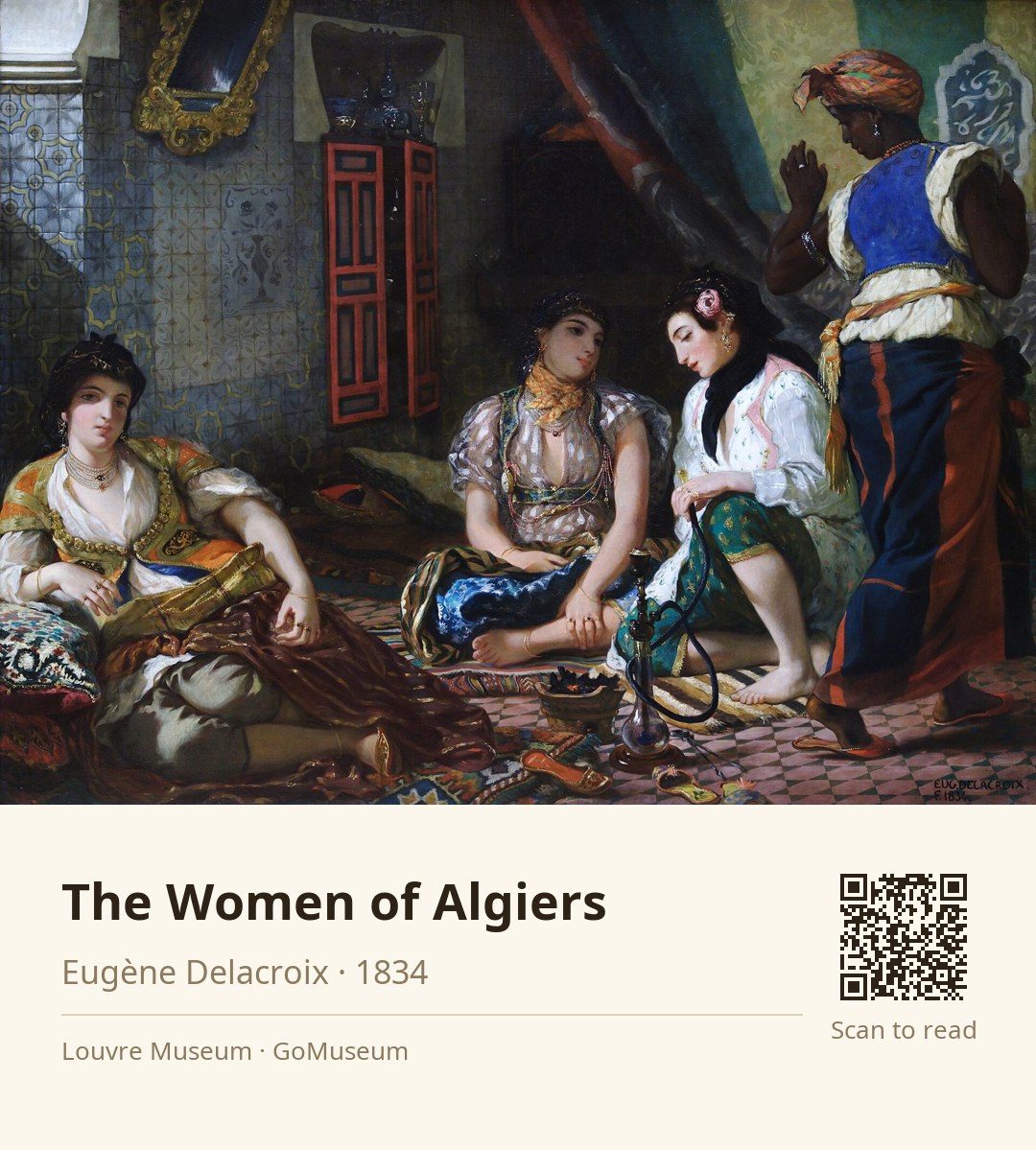
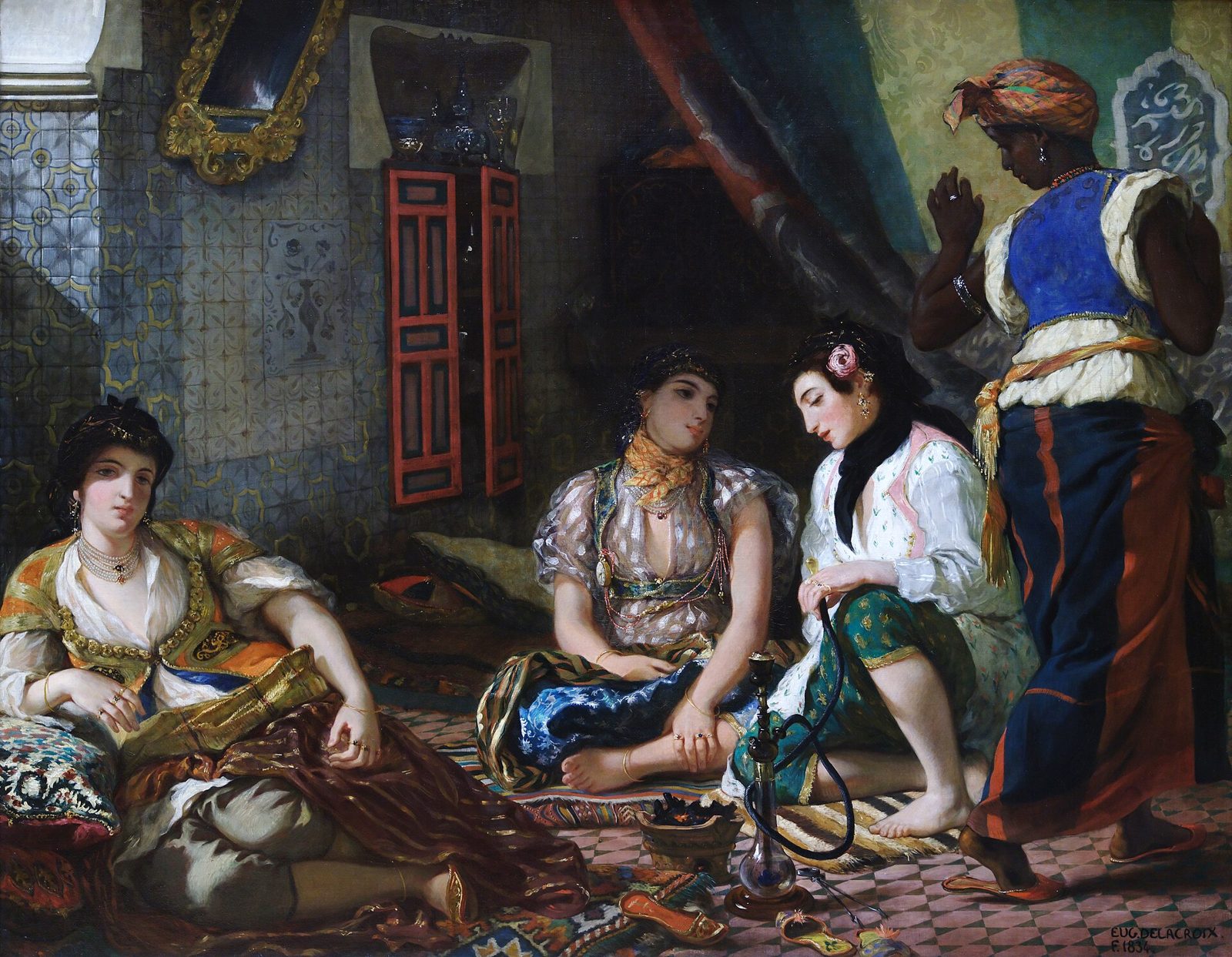
🎧 This work has audio narration — listen in the appTake a moment to really absorb the scene before you in Eugène Delacroix's "The Women of Algiers." Notice how the light filters through the window, casting a warm glow on the richly adorned garments of the women. Look closely at the intricate details of their clothing—the flowing fabrics and the delicate gold jewelry that shimmer against the opulent backdrop of their surroundings.
These details matter because they transport you to a world that Delacroix sought to capture, one that reflects both the allure and the complexity of the harem experience. Unlike many of his contemporaries, who often depicted women in a purely eroticized manner, Delacroix's portrayal is layered with a sense of intimacy and separation. The women are together yet isolated, their expressions hinting at a guardedness that invites curiosity but also maintains a boundary.
Created in 1834, this painting was inspired by Delacroix's travels to North Africa, where he was captivated by the culture and beauty he encountered.
As you take in this rich tapestry of color and form, consider what stories these women might tell if they could speak. What thoughts and emotions lie behind their gazes?
Eugène Delacroix, born on April 26, 1798, in Charenton-Saint-Maurice, emerged as a pivotal figure in the French Romantic movement. He diverged from the Neoclassical ideals of his contemporaries, such as Ingres, drawing inspiration from the vibrant colors and dynamic forms of Rubens and the Venetian Renaissance. His works, characterized by dramatic themes and a passion for the exotic, often reflected his travels in North Africa and his fascination with the sublime forces of nature, influenced by literary figures like Lord Byron.
Delacroix's career was marked by both acclaim and controversy; his early painting, "The Barque of Dante," stirred public debate but was ultimately recognized by the state. His later masterpieces, including "Liberty Leading the People," showcased his ability to blend historical and contemporary narratives, solidifying his status as a master of expressive brushwork and color theory. His innovative techniques laid the groundwork for Impressionism and inspired the Symbolist movement.
Despite personal struggles, including early orphanhood and financial hardships, Delacroix's legacy endures. He is celebrated not only for his paintings but also for his lithographs and writings, which reveal his artistic philosophy. As one of the last old masters, his influence resonates through art history, marking him as a cornerstone of Romanticism and a precursor to modern artistic movements. Delacroix passed away on August 13, 1863, leaving a profound impact on the art world.
Eugène Delacroix's "The Women of Algiers" was first unveiled at the Salon of 1834 in Paris, where it stirred a mix of admiration and critique. Art critic Gustave Plance praised it for its audacity and fresh spirit, while others were less impressed. The painting was quickly acquired by King Louis Philippe and became part of the Musée du Luxembourg before moving to the Louvre in 1874, where it remains today. Interestingly, Delacroix created a second version of this scene between 1847 and 1849, which is housed at the Musée Fabre in Montpellier. This later work shifts the mood, inviting viewers into a more intimate space. The painting's reception reflected the tensions of its time, as it navigated the complex dynamics of Orientalism and the Western gaze on the harem. Delacroix's journey to North Africa in 1832, where he sketched the women he encountered, laid the groundwork for this evocative piece, blending his experiences with his artistic vision.
As you gaze at "The Women of Algiers," notice the way Delacroix's brushwork dances across the canvas. His technique is a vibrant interplay of light and shadow, creating a soft glow that bathes the women in warmth. The flowing fabrics of their garments are rendered with meticulous detail, showcasing Delacroix's skill in capturing texture—each fold and drape feels alive. The composition is carefully structured, with the women arranged in a semi-circle that draws your eye inward, yet their expressions convey a sense of separation. The use of color is particularly striking; the rich hues of their clothing contrast beautifully against the opulent background, enhancing the exotic allure of the scene. Delacroix's choice to depict the women in a moment of stillness, rather than action, invites contemplation, allowing you to ponder their thoughts and emotions. This painting is not just a visual feast; it’s a complex emotional landscape, inviting you to explore the nuances of intimacy and distance.
However, despite his interest in authenticity, the final painting reflects a blend of his experiences and European fantasies about the harem, illustrating the tension between reality and artistic interpretation. This duality adds layers to the work, making it a rich subject for discussion on how art can both reflect and distort cultural realities.
Delacroix's journey to North Africa not only inspired 'The Women of Algiers' but also shaped his fascination with exotic themes, leading him to explore similar subjects in subsequent paintings, which often depicted the complexities of Eastern cultures through a Western lens.
The painting received mixed reviews at the Salon of 1834, with some critics praising its audacity and fresh spirit, while others were less impressed, reflecting the polarized views on Orientalism and the representation of women in art during that era.