 Image: Pierre-Yves Beaudouin
The Three Graces
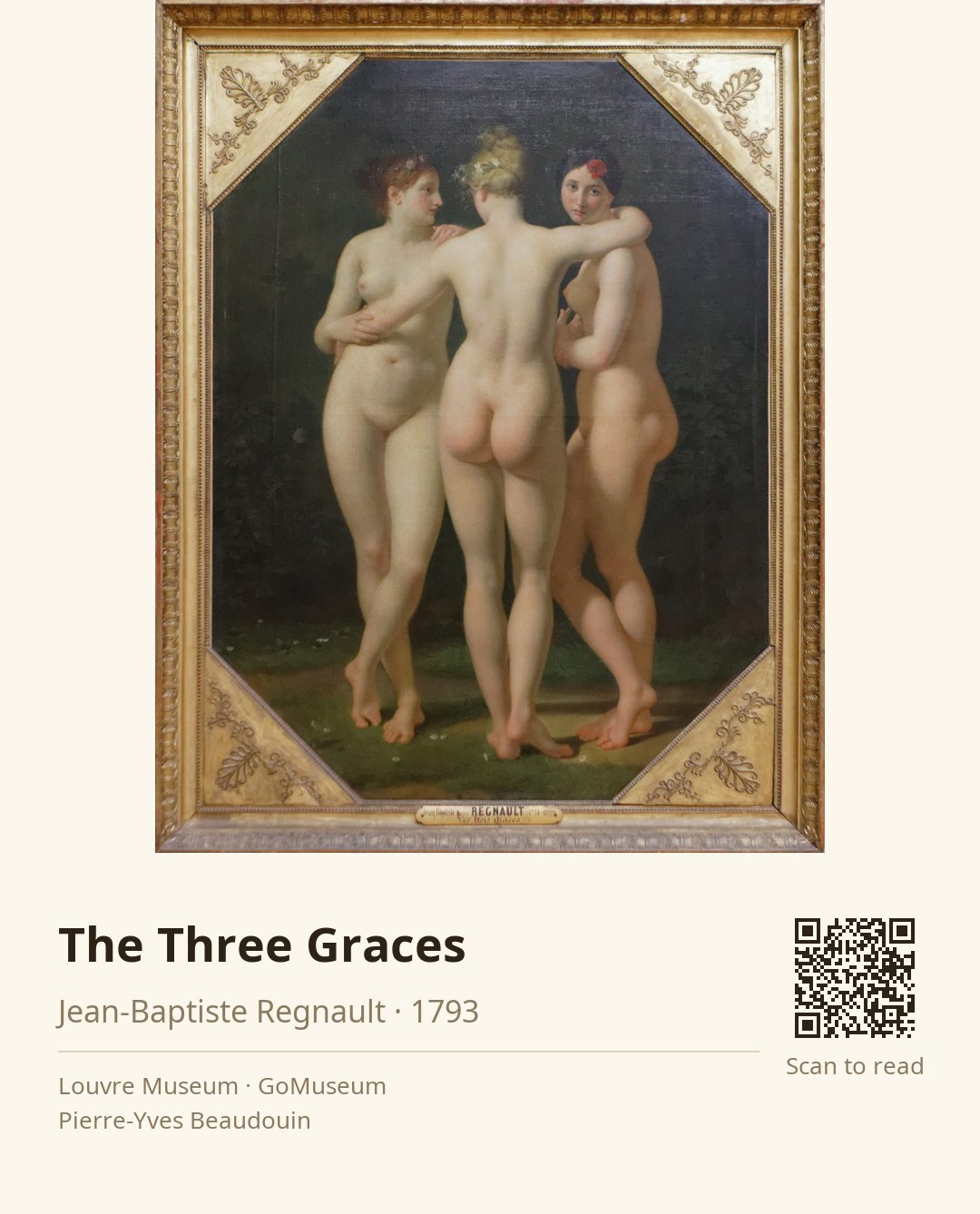
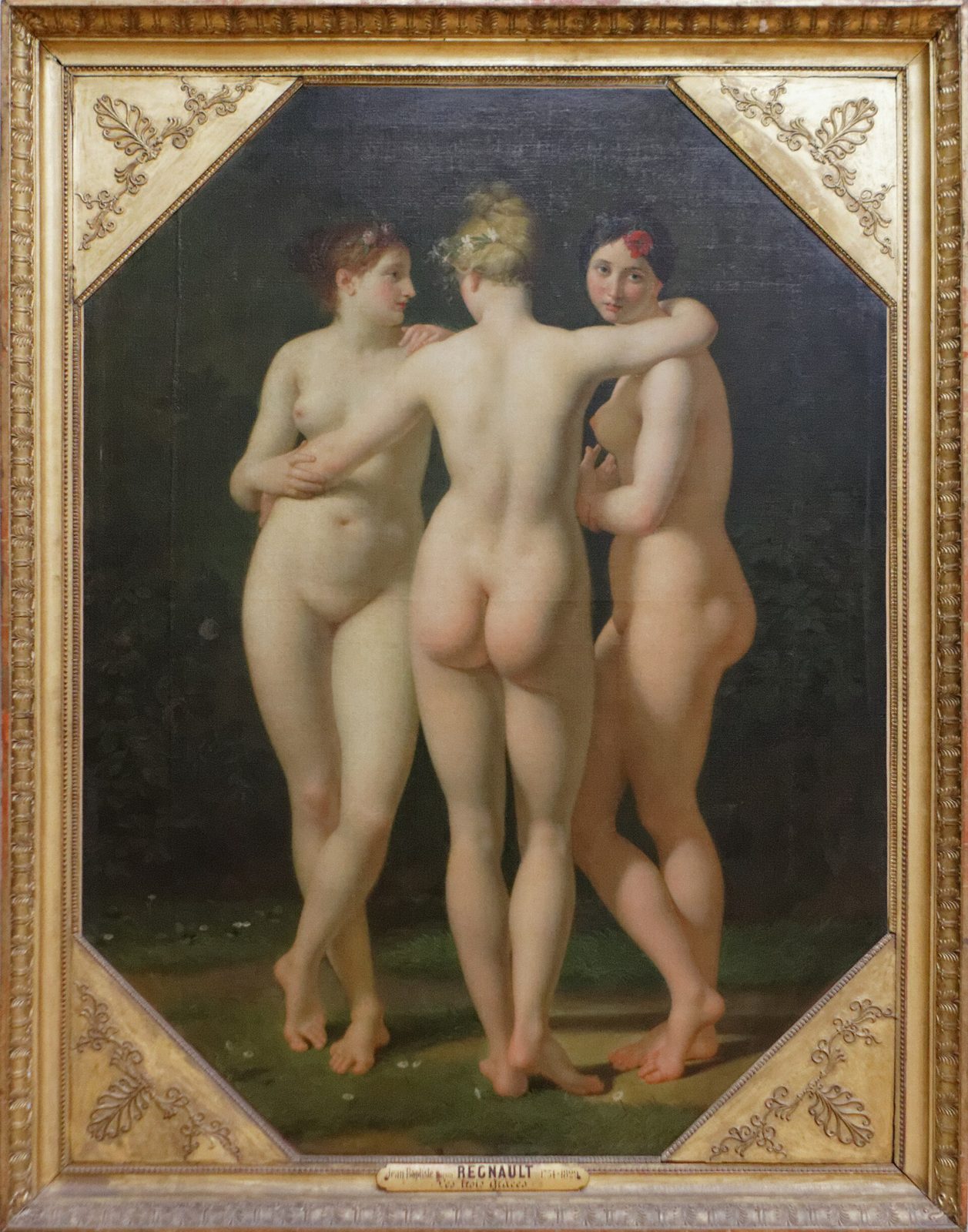
🎧 This work has audio narration — listen in the appThree nude women, known as the Graces, stand together in a serene yet intimate pose, embodying beauty and harmony. The central figure, with her back turned, embraces the other two, one adorned with flowers gazing at her, while the other looks directly at you, inviting a connection. This arrangement emphasizes their unity and the celebration of femininity, a theme deeply rooted in neoclassical ideals.
The soft, natural palette enhances the figures' delicate skin tones, rendered with smooth brushwork that suggests both tenderness and vitality. The indistinct dark landscape behind them hints at a lush garden or forest, creating a tranquil backdrop that allows the figures to take center stage. Regnault's choice of nudity here is not merely for allure; it reflects a classical reverence for the human form, echoing the ideals of beauty and virtue from antiquity.
Created in 1793, "The Three Graces" showcases Regnault's mastery of oil on canvas, a medium that allowed him to explore texture and depth.
Jean-Baptiste Regnault was a prominent French painter born in Paris on October 9, 1754. Initially, he worked at sea before his artistic talent was recognized at the age of fifteen, leading to his studies in Italy under Jean Bardin. Regnault gained acclaim for his historical and allegorical paintings, winning the Prix de Rome in 1776 with "Alexandre and Diogène." His notable works, including "The Education of Achilles by Chiron" and "The Three Graces," are housed in prestigious institutions like the Louvre and Versailles.
Elected to the Académie des Beaux-Arts in 1783, Regnault became a significant figure in the neoclassical movement, often compared to his contemporary Jacques-Louis David. He taught many influential artists, fostering a school that rivaled David's in impact. His works reflect a blend of classical themes with a more sensual approach, particularly evident in his later pieces during the Empire and Restoration periods.
Regnault's life was marked by personal challenges, including two marriages and the loss of his mother at a young age. He passed away on November 12, 1829, in Paris and is buried in Père-Lachaise Cemetery. His legacy endures through his contributions to neoclassical art and the many artists he inspired.
Jean-Baptiste Regnault's 'The Three Graces' was created in 1793 and later exhibited at the Louvre from 1799 to 1804. Regnault, who had already made a name for himself with his historical and allegorical works, was celebrated for his delicate treatment of color and form. Upon its unveiling, the painting was well-received, aligning with the neoclassical ideals of beauty and harmony that were gaining traction in France at the time.
Regnault's technique in 'The Three Graces' showcases his mastery of oil paint on canvas, allowing for a rich texture and depth. The brushwork is smooth and deliberate, creating a soft, almost ethereal quality to the figures' skin tones. The choice of a natural palette not only enhances the lifelike appearance of the women but also evokes a sense of tranquility. The composition is carefully balanced, with the figures forming a triangular arrangement that draws the viewer's eye across the canvas, emphasizing their unity. The indistinct dark background serves to elevate the figures, making them the focal point while hinting at a lush, idyllic setting. This choice of backdrop allows the viewer to feel enveloped in the serene atmosphere, enhancing the intimate connection between the figures and the audience.
Regnault started his life at sea, working on a merchant vessel before pursuing a career in art.
Regnault taught several prominent artists, including Pierre-Narcisse Guérin, and his school was a significant rival to that of Jacques-Louis David.