The Young Mother
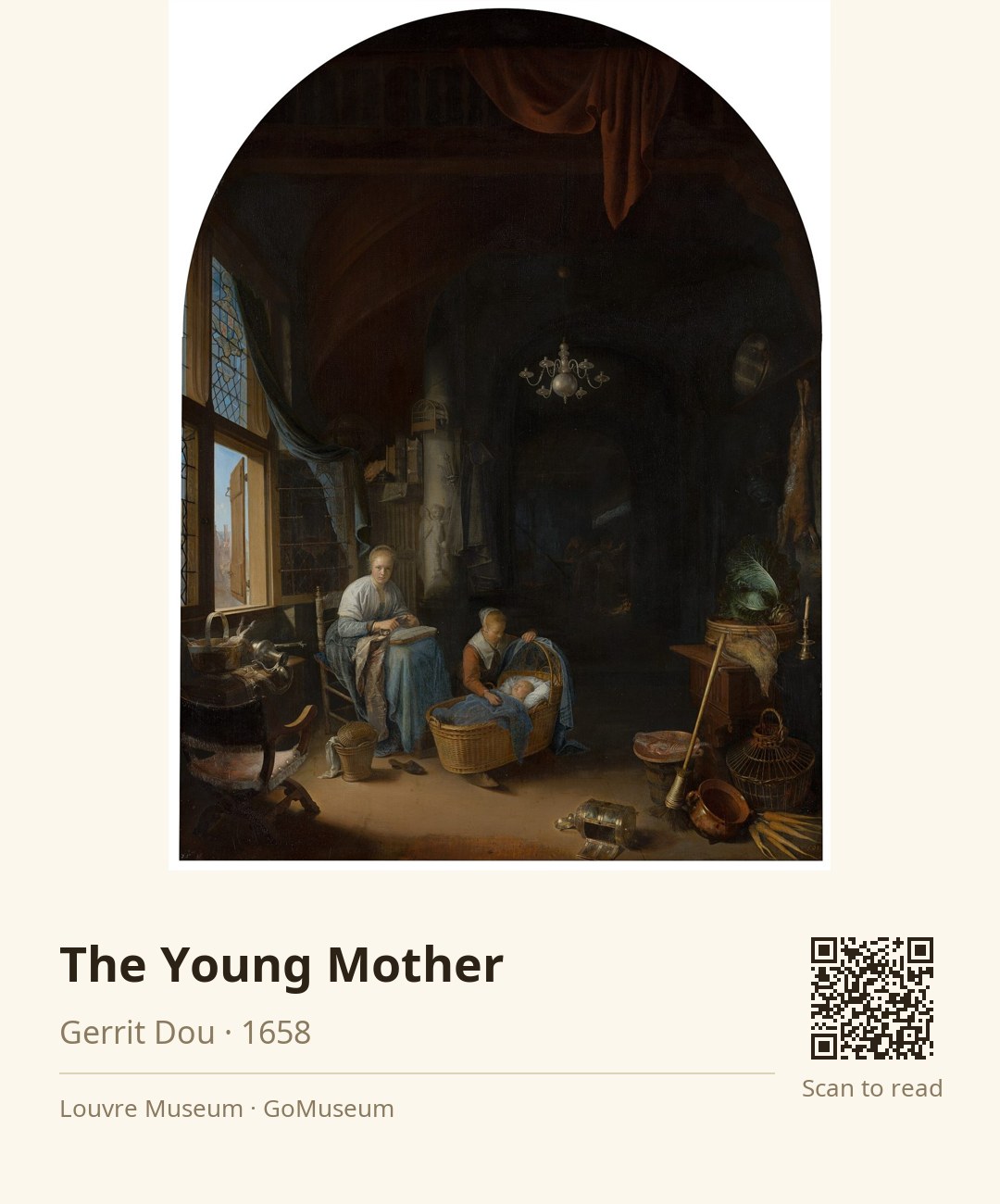
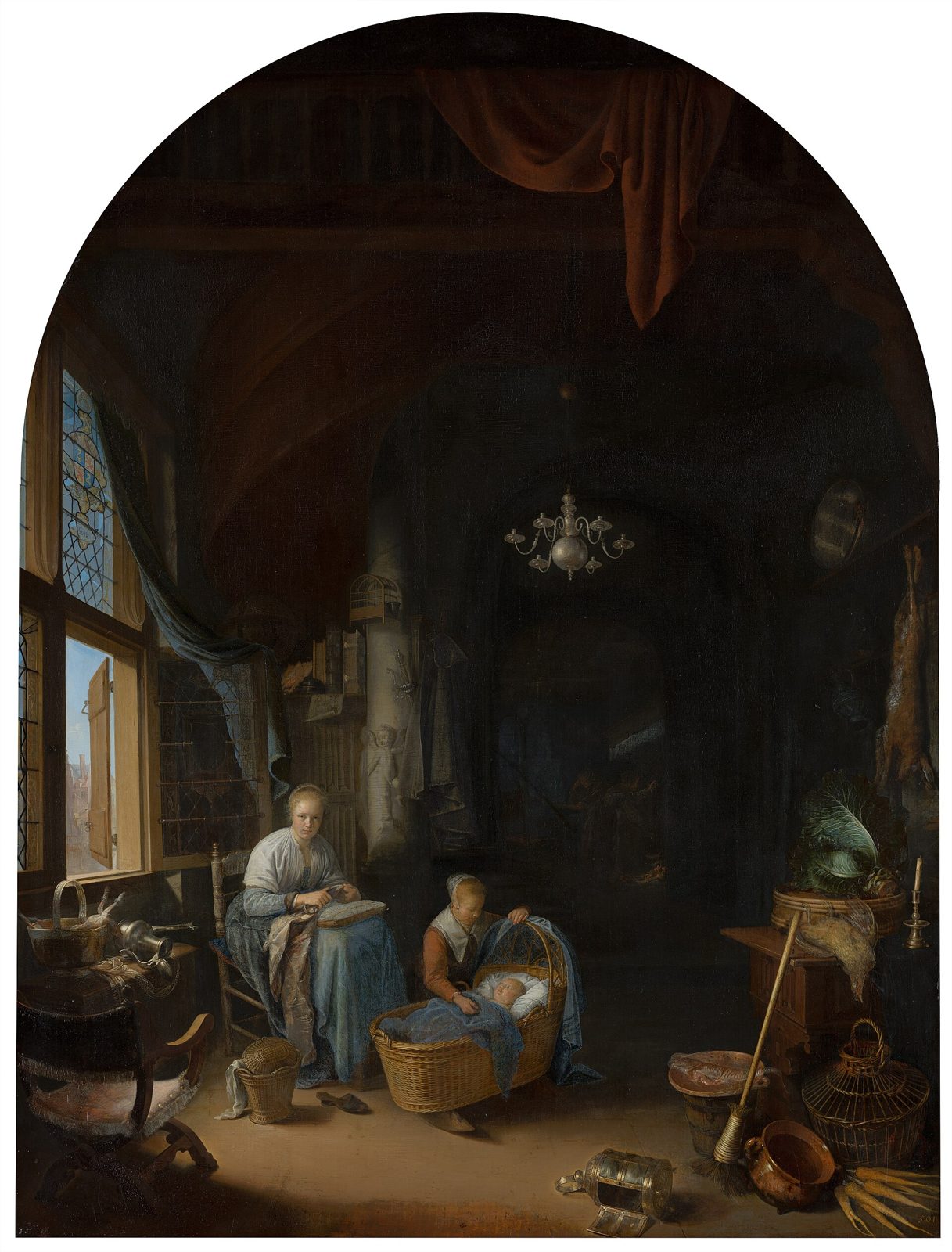
🎧 This work has audio narration — listen in the appTake a moment to really look at "The Young Mother" by Gerrit Dou. Notice how the light streams through the window, illuminating the young mother as she glances up from her needlework. That soft glow highlights not just her face, but also the delicate details of her surroundings, like the wicker crib beside her and the clutter of everyday objects scattered around the room.
These details matter because they weave a rich narrative of domestic life in the 17th century. The young mother’s handiwork symbolizes virtue and care, while the fallen objects—a lantern, a broom, even a dead bird—hint at the chaos of life.
Created in 1658, this piece is part of a collection known as the Dutch Gift, presented to King Charles II of England. Dou, a pupil of Rembrandt, developed a unique style that diverged from his mentor, focusing on meticulous detail and realism, which you can see in the textures of the fabrics and the expressions of the figures.
As you stand here, think about what this scene might tell us about the role of women in that era. What stories do you think the young mother could share, and how do those stories resonate with our lives today?
Gerrit Dou, born on April 7, 1613, in Leiden, was a prominent Dutch painter of the Golden Age, recognized for his meticulous genre scenes and mastery of chiaroscuro. A student of Rembrandt, Dou developed a unique style that diverged from his mentor's, favoring small, highly detailed works that often depicted candlelit interiors and everyday life. His dedication to precision was legendary; he crafted his own brushes and employed optical aids to enhance his painting technique.
Dou's career flourished in Leiden, where he became a leading figure in the fijnschilders movement, emphasizing fine detail akin to miniature painting. His works, including "The Dropsical Woman" and "The Evening School," showcase his exceptional ability to create lifelike representations and intricate textures. Despite his success, he declined offers to work abroad, choosing to remain in his hometown, where he established a guild for fine painters.
His influence extended through his students, including Frans van Mieris and Gabriël Metsu, and his paintings garnered high prices, attracting patrons like Queen Christina of Sweden. Dou's legacy endures in art history, celebrated for his contributions to the paragone debate and his innovative approach to light and detail, solidifying his place among the masters of Dutch painting. He passed away on February 9, 1675, in Leiden, leaving behind a rich body of work that continues to captivate audiences.
Gerrit Dou's "The Young Mother" was created in 1658 and is part of a fascinating history tied to the political landscape of its time. Commissioned as part of the Dutch Gift, a collection of artworks presented to King Charles II of England to curry favor after his restoration to the throne, this painting was meant to symbolize the virtues of motherhood and domestic life. Interestingly, Dou's work was so well-received that Charles II attempted to lure him to England, but Dou declined the invitation, choosing instead to remain in the Netherlands. Over the years, the painting has traveled extensively, hanging in royal palaces before finding a permanent home in the Mauritshuis in The Hague since 1822. Its journey reflects the shifting tides of art and politics, showcasing how a single piece can traverse borders and eras, embodying the essence of its time.
In "The Young Mother," Dou's meticulous technique shines through, showcasing his mastery of light and detail. Notice how the sunlight streams through the window, casting a warm glow that not only illuminates the young mother but also brings life to the surrounding objects. Dou's brushwork is incredibly fine, allowing for a rich texture that gives depth to the fabrics and the wicker crib. The composition is carefully structured, with the mother positioned centrally, drawing your eye immediately to her. The clutter of everyday items—like the fallen lantern and the dead bird—creates a sense of realism and chaos, contrasting with the serene figure of the mother. This juxtaposition invites you to ponder the complexities of domestic life, while the use of color is both vibrant and soft, enhancing the emotional resonance of the scene. Dou's ability to capture both the beauty and the disorder of life is what makes this painting so compelling.
Here's a fascinating tidbit: The Young Mother was part of a grand diplomatic gesture known as the Dutch Gift, where the Netherlands presented around 25 paintings to King Charles II of England to curry favor. Imagine the political weight behind this artwork! Dou's painting was not just a pretty picture; it was a strategic move in a game of international relations. Charles II was so taken with Dou's work that he invited the artist to England, but Dou, valuing his roots and reputation in the Netherlands, declined.
Dou developed a highly polished and meticulous style that focused on minute details and realism, contrasting with Rembrandt's more expressive and loose brushwork, which allowed Dou to create intricate textures and lifelike representations.