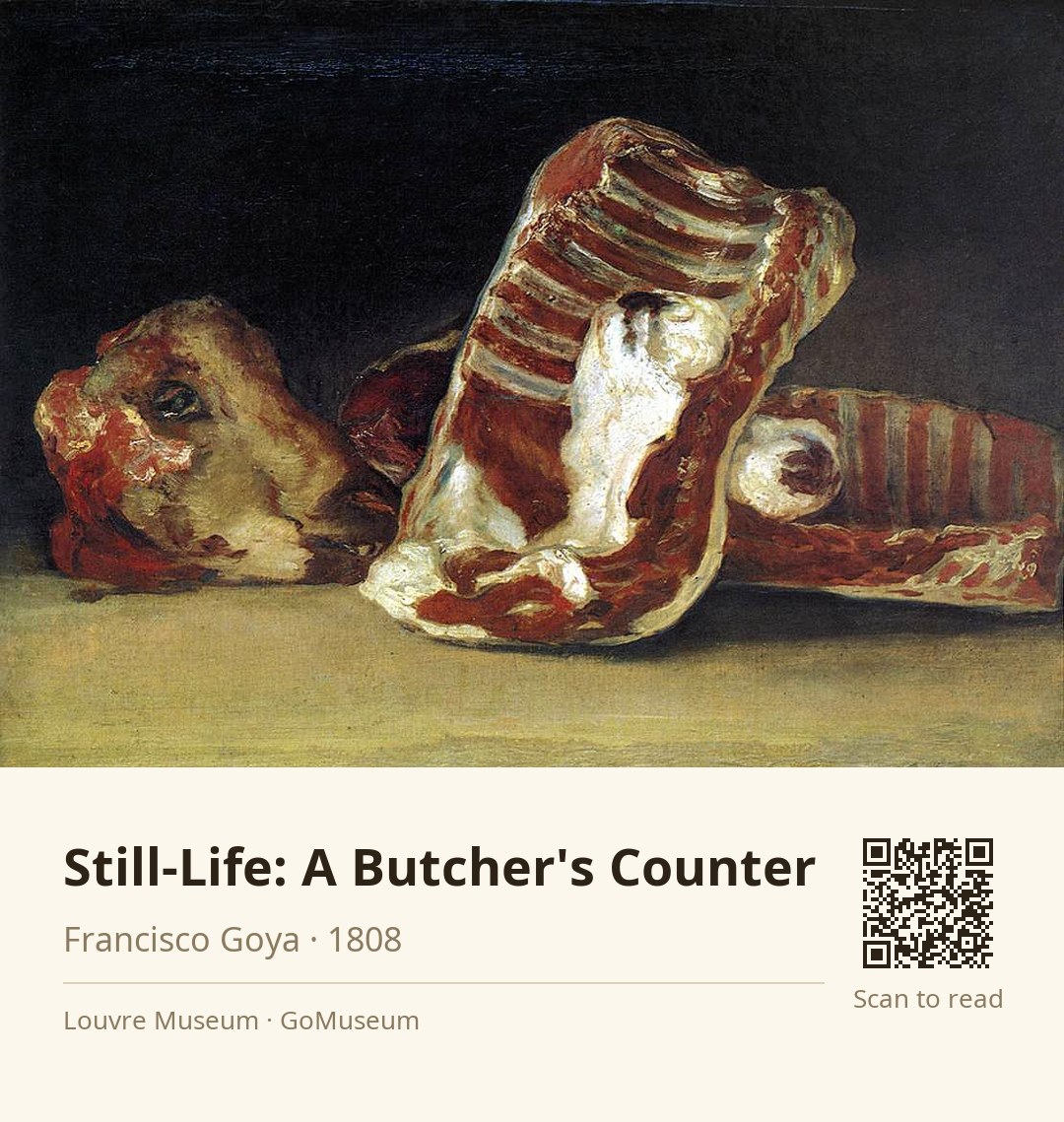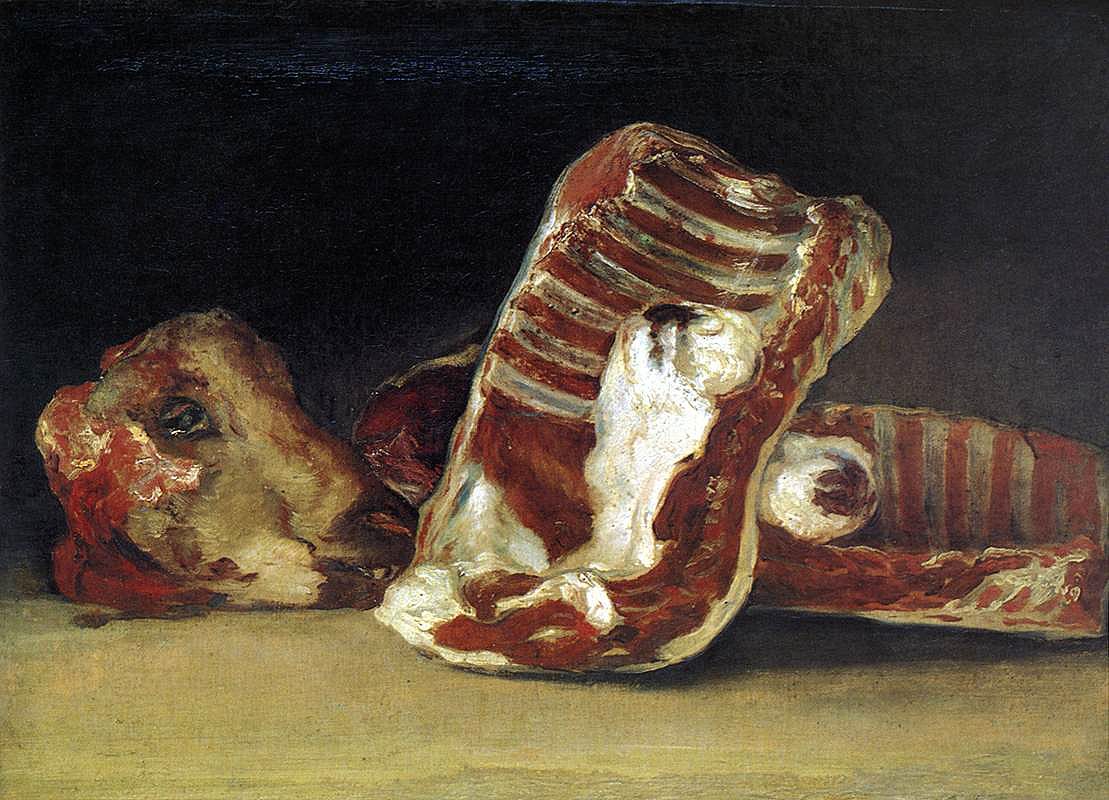
Still-Life: A Butcher's Counter
🎧 This work has audio narration — listen in the appTake a moment to really look at Goya's "Still-Life: A Butcher's Counter." Notice how the stark contrast between the dark background and the vivid, raw meat draws your eye. The head of the lamb, with Goya’s signature subtly inscribed, seems to stare back at you, a haunting reminder of life lost.
These details matter because they shift the focus from a simple still life to a powerful commentary on mortality and the violence of the era. Painted around 1808, during Spain's tumultuous war with Napoleon, this piece reflects the brutality and despair that Goya witnessed. Unlike traditional still lifes that celebrate abundance, Goya’s work confronts us with death, urging us to acknowledge the cost of conflict.
This painting is part of a series that starkly contrasts with his more glamorous court portraits, revealing a darker, more introspective side of his genius.
As you stand here, consider: what emotions does this raw imagery evoke in you? How does it change your perception of still life as a genre?
Francisco José de Goya y Lucientes, born on March 30, 1746, in Fuendetodos, Spain, emerged as a pivotal figure in the transition from the Old Masters to modern art. Goya's early life was marked by a middle-class upbringing, and he began his artistic education at the age of 14. His career flourished as he became a court painter, producing portraits of Spanish nobility and engaging with Rococo styles. However, a severe illness in 1793 left him deaf, profoundly impacting his artistic vision, leading to darker themes in his work.
Goya's later pieces, including the haunting "Disasters of War" series and the "Black Paintings," reflect his disillusionment with society and the tumult of his times, particularly during the Napoleonic Wars. His art often explored themes of madness, corruption, and the human condition, positioning him as a precursor to modern artistic movements. Goya's legacy endures as he is celebrated for his innovative techniques and profound emotional depth, influencing generations of artists and earning his place as a cornerstone of Western art history. He passed away in Bordeaux on April 16, 1828, leaving behind a body of work that continues to resonate.
Goya's "Still-Life: A Butcher's Counter" was painted around 1808, a turbulent time during Spain's war with Napoleon. This piece is part of a series of twelve still lifes featuring butchered animals, created as a stark contrast to the more celebratory works of his contemporaries. The painting has been housed in the Louvre since 1909, but its journey began with Goya's son, Javier, who inherited it and passed it down to his grandson. Eventually, these works were sold off to settle debts, leading to their scattering across various collections. This painting, like the others in the series, serves as a haunting reminder of the brutality of war, evoking the suffering of both the animals and the people of Spain during this dark period.
As you gaze at the painting, notice Goya's bold brushwork and limited palette. The thick strokes create a sense of texture that makes the raw meat almost palpable, while the dark background enhances the vividness of the lamb's head and flanks. Goya's choice to focus on the carcasses rather than any culinary aspect emphasizes mortality, stripping away any romanticism associated with still lifes. The stark contrast between the bright reds and the deep shadows not only draws your eye but also evokes a visceral reaction. The composition is straightforward yet powerful, with the lamb's head almost confronting the viewer, inviting a reflection on the themes of life and death. This technique, reminiscent of Rembrandt, marks a departure from traditional still lifes, transforming the genre into a commentary on the human condition amidst the horrors of war.
Francisco Goya's 'Still-Life: A Butcher's Counter' is a striking departure from the traditional still-life genre, emerging during a tumultuous period in Spanish history. Painted around 1808, it reflects the violence and despair of the Peninsular War. Instead, Goya imbues them with a raw, unsettling reality, using butchered animals as a metaphor for the casualties of war. His bold brushwork and limited palette evoke a sense of urgency and mortality, paving the way for modern art movements that would grapple with similar themes of human suffering and existential dread.
Did you know that Goya's 'Still-Life: A Butcher's Counter' is part of a series of twelve still lifes he painted during a time of great upheaval in Spain? While most artists of his era focused on more traditional subjects, Goya turned to the stark imagery of butchered animals, reflecting the violence and chaos of the Napoleonic Wars. This series was created around the same time as his powerful 'Disasters of War' prints, showcasing a shift in his work towards themes of death and suffering. It's a fascinating glimpse into how personal and national trauma can shape an artist's vision.
Goya's use of thick brushstrokes creates a tactile quality that makes the raw meat appear almost lifelike, enhancing the visceral impact of the work. This technique marks a departure from the more polished styles of his contemporaries, emphasizing the rawness of the subject matter.
Goya's deafness, which he suffered from after a severe illness in 1793, led him to explore darker themes in his art, reflecting a more introspective and somber perspective on life and death. This personal struggle likely contributed to the haunting quality of 'Still-Life: A Butcher's Counter'.
After Goya's death, the painting was inherited by his son Javier, who later passed it down to his grandson Mariano. To settle debts, Mariano sold the painting to the Count of Yumuri, and after the count's death, it was dispersed among various collections before being acquired by the Louvre in 1909.