 Image: Shonagon · Tangopaso · Tangopaso · Tangopaso
Mary Magdalene
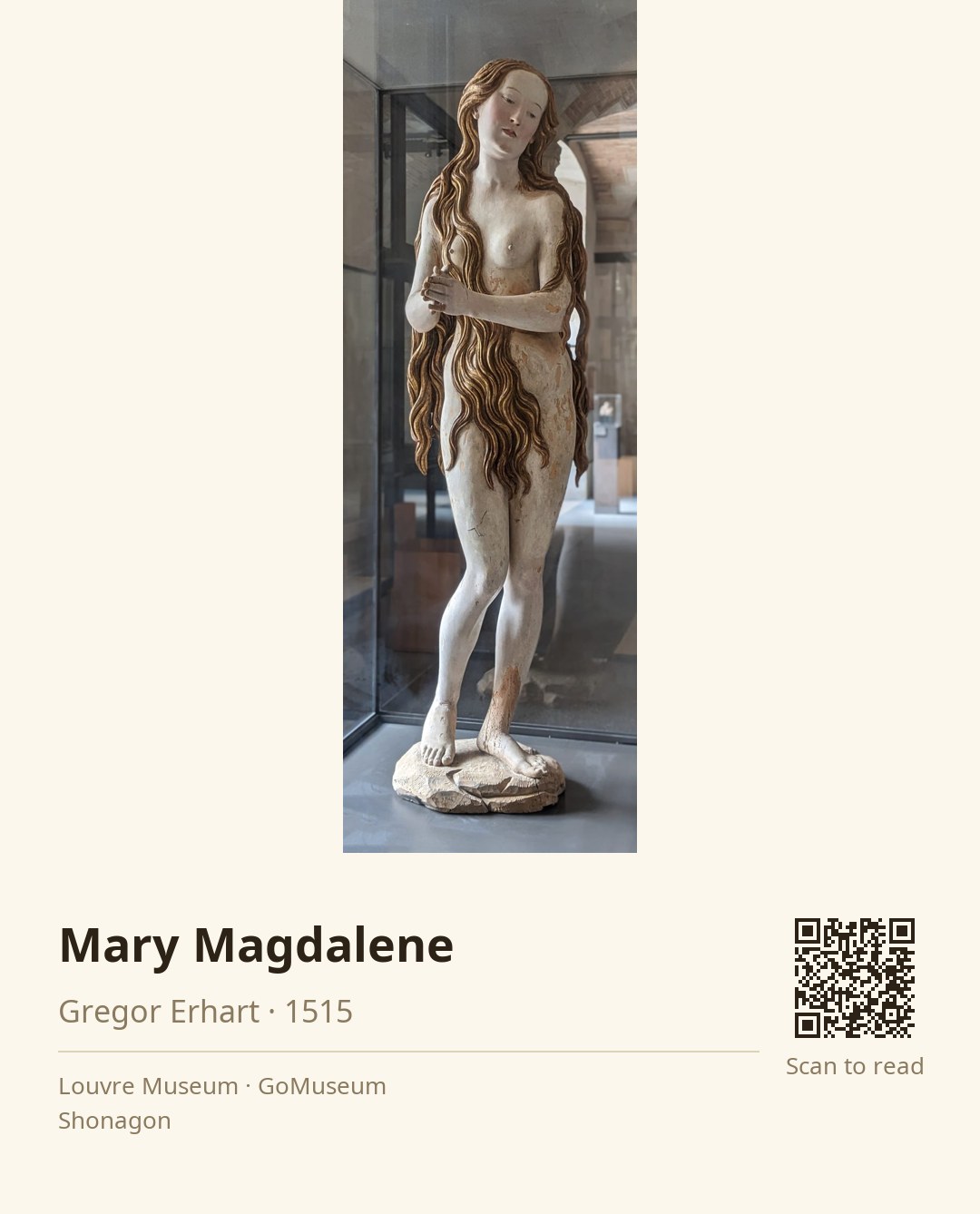
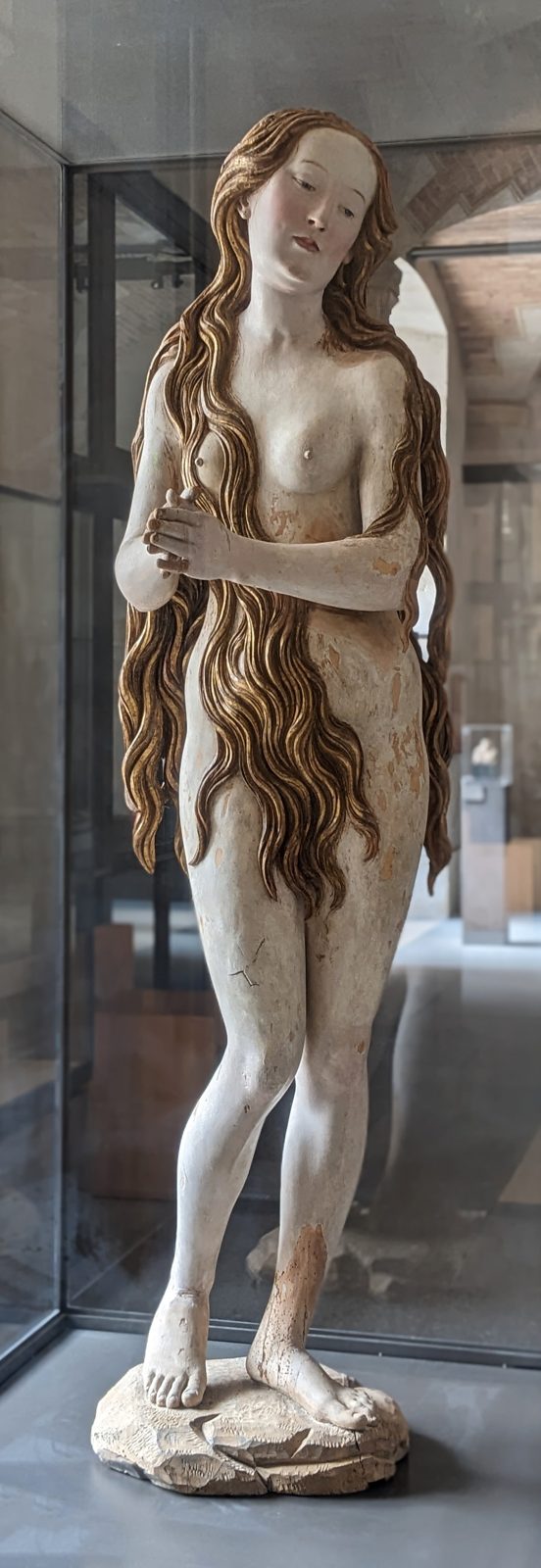
🎧 This work has audio narration — listen in the appMary Magdalene stands before you, her long, flowing hair cascading down her body, partially concealing her form. The gentle bend of her leg and the serene expression on her face suggest a moment of quiet contemplation, inviting you to reflect on her story. The intricate wavy lines of her hair add texture, while the muted palette emphasizes the softness of her features, creating a striking balance between modesty and sensuality.
This depiction aligns with the hagiographical accounts of Mary Magdalene, particularly from Jacobus de Voragine's Golden Legend, which recounts her life as a penitent hermit in Provence. The narrative portrays her as a figure of both sin and redemption, often depicted in art as a woman clothed only in her hair, symbolizing her humility and spiritual awakening. Gregor Erhart's sculpture, created in 1515, merges Gothic and Renaissance styles, showcasing a remarkable evolution in sculptural autonomy. The work was originally intended for the Dominican Church of St. Magdalene in Augsburg, where it was suspended from the vault, embodying the blend of sacred and sensual that characterized the era.
After its removal from the church in the early 19th century, the statue passed through various private collections before being acquired by the Louvre in 1902.
Gregor Erhart was a German sculptor born around 1470 in Ulm, the son of the sculptor Michel Erhart. He established his career in Augsburg, where he became a master in 1496 and remained until his death around 1540. His work is characterized by a blend of Late Gothic and early Renaissance styles, reflecting the transitional period in which he lived.
Erhart's artistic journey began in his father's workshop, and he gained recognition for his exquisite sculptures, particularly of the Virgin Mary and Child, which showcase his skill in capturing emotion and elegance. Notable works include the Virgin at the Benedictine Abbey of Blaubeuren and the Virgin of Saint-Ulrich, both celebrated for their intricate detail and expressive forms.
His legacy includes not only religious sculptures but also tombs and epitaphs, contributing to the funerary art of the time. Although many of his works were lost during World War II, Erhart's influence endures in the context of German Renaissance sculpture, marking him as a significant figure in the evolution of artistic expression in the region.
This sculpture is carved from light-colored limewood, a choice that allows for intricate detailing. Look closely at the wavy lines of Mary Magdalene's hair; they create a sense of movement and texture that draws you in. The craftsmanship is exceptional, showcasing Erhart's skill in polychrome wood carving. You can see some signs of wear, hinting at its long history, and the base mimics a rocky surface, grounding the figure in a naturalistic setting. Each curve and contour speaks to the artist's meticulous attention to form and the delicate balance between sensuality and modesty.
Commissioned in 1515 for the Dominican Church of St. Magdalene in Augsburg, this sculpture was originally suspended from the church's vault, supported by angels. It was part of a rich tradition of devotional art, intended to inspire contemplation among the faithful. After the church's deconsecration in the early 19th century, the statue changed hands several times, passing through private collections before being acquired by the Louvre in 1902. Its journey didn't end there; during World War II, it was coveted by Hermann Göring, who traded for it in 1943, believing it represented German cultural heritage. The Allies recovered it in 1945, returning it to the Louvre, where it remains today.
One intriguing detail about this sculpture is its nickname, 'La Belle Allemande,' or 'The Beautiful German Woman.' This title reflects not only its aesthetic appeal but also how it was perceived in the context of German cultural identity during the Nazi era. Göring's obsession with the statue was so intense that he believed it embodied the ideal of Aryan beauty, showcasing how art can become entangled in political narratives.
The sculpture has undergone various alterations, such as filling voids from its original suspension points and modifications made in the 17th or 18th century.