 Image: Tangopaso
Esther and Assuerus
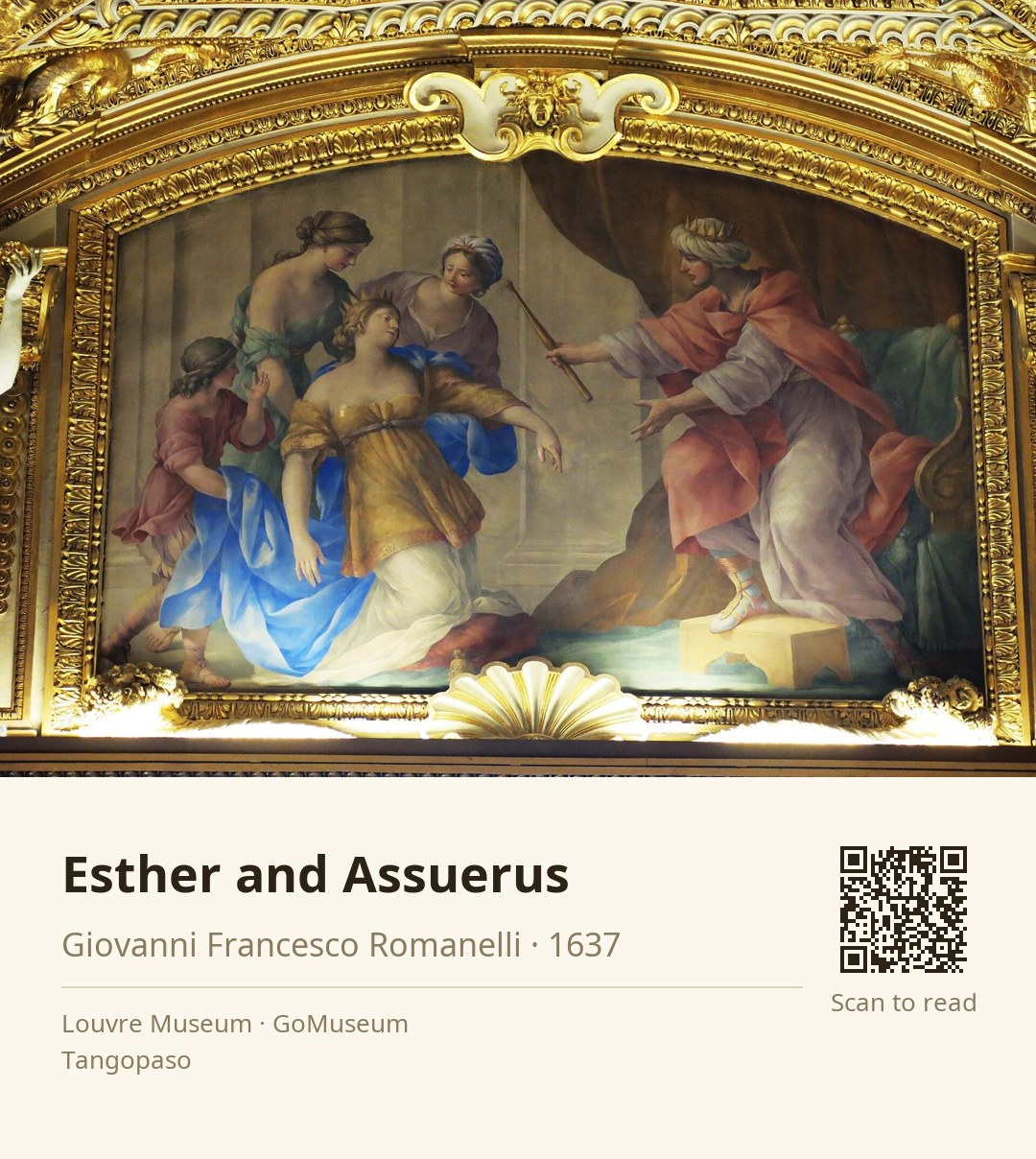
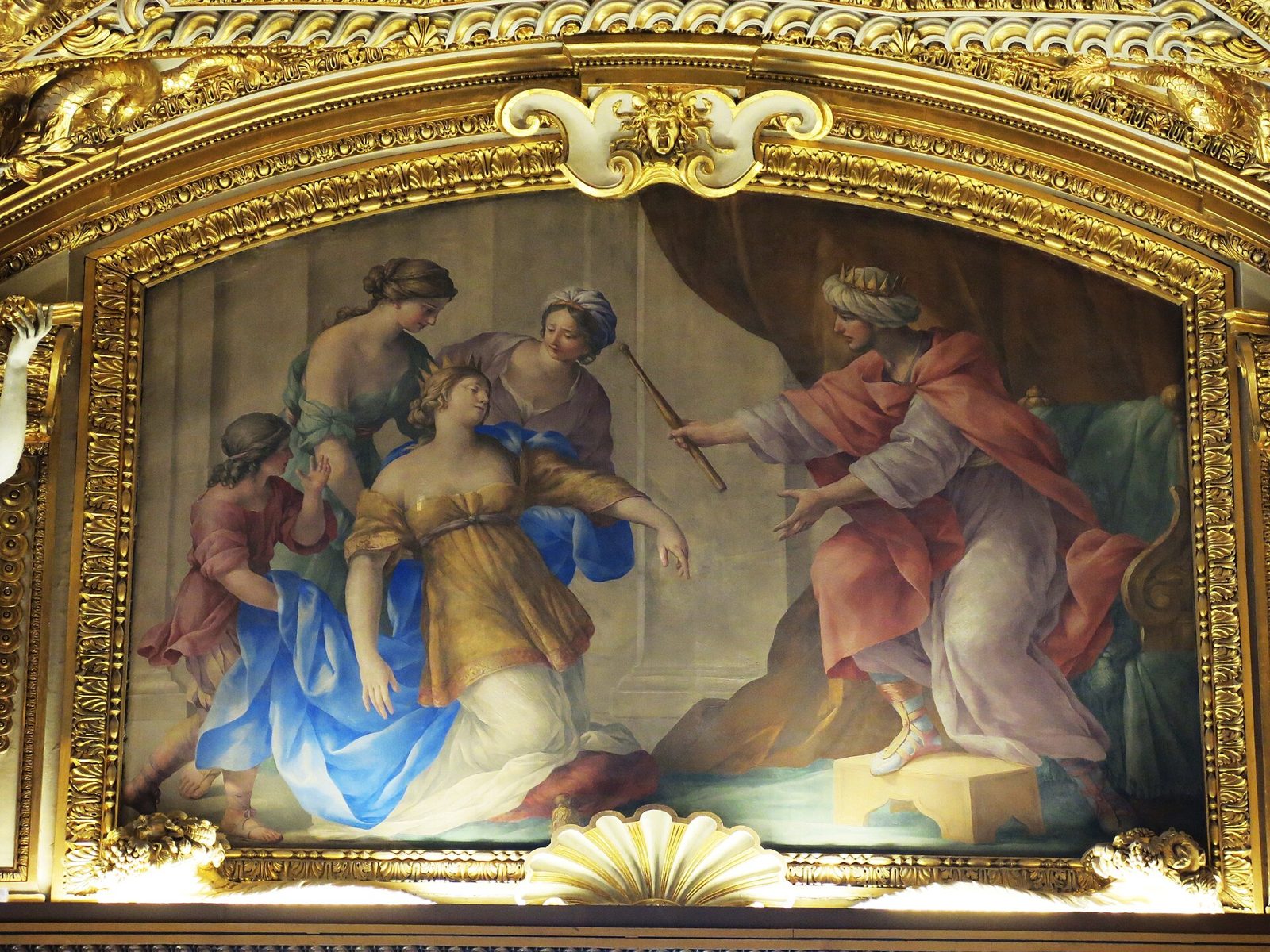
🎧 This work has audio narration — listen in the appThe figure in the turban, adorned in flowing pink and white robes, commands attention as he gestures with a staff, standing on a small platform. Opposite him, a seated woman in a golden dress with a blue sash leans back, her arm extended, surrounded by three attendants in vibrant shades of pink, green, and blue, who seem to offer her support. This striking contrast between the figures emphasizes a moment of tension and drama, inviting you to ponder the narrative unfolding before you.
Romanelli's choice of rich warm tones and soft pastels enhances the elegance of the scene, creating a visual harmony that draws the viewer in. The ornate gold detailing framing the composition adds a layer of opulence, characteristic of the Baroque style, which Romanelli mastered during his career. The simplicity of the draped background allows the figures to take center stage, highlighting their emotional expressions and interactions. This focus on human experience reflects the artist's ability to convey complex narratives through visual art.
Giovanni Francesco Romanelli, born in Viterbo in 1610, became a prominent figure in the Baroque movement, known for his vibrant colors and clarity of detail. By 1637, when he created "Esther and Assuerus," he was already recognized for his contributions to significant commissions in Rome, including frescoes for the Vatican and altarpieces for St. Peter's Basilica.
Giovanni Francesco Romanelli was an influential Italian Baroque painter born in Viterbo in 1610. He moved to Rome at 14, where he studied under Pietro da Cortona, contributing to significant projects like the Palazzo Barberini's frescoes. Romanelli's early works showcased his mastery of color and detail, leading to commissions from the Barberini family, including a notable fresco in St. Peter's Basilica. His style evolved from Cortona's Venetian influences to a more refined classicism, evident in pieces like his altarpiece for Santa Maria degli Angeli.
In 1646, Romanelli relocated to Paris, invited by Cardinal Mazarin, where he adapted his style to French tastes, creating grand ceiling decorations that influenced future artists like Charles Le Brun. He returned to Rome in 1648 but continued to work in France, decorating royal residences. Romanelli's contributions to art were recognized with his knighthood in the Order of St. Michael by Louis XIV. He passed away in 1662, leaving a legacy marked by vibrant works displayed in prestigious collections, including the Louvre, solidifying his place in art history.
Romanelli's technique in 'Esther and Assuerus' showcases his mastery of color and composition. The brushwork is fluid, allowing the soft pastels and warm tones to blend seamlessly, creating an inviting atmosphere. The figures are rendered with a clarity that emphasizes their emotional expressions, drawing the viewer into the scene's drama. The use of gold detailing not only frames the composition but also enhances the opulence typical of Baroque art. The arrangement of the figures, with the central woman leaning back and extending her arm, creates a dynamic tension that compels the eye to move across the canvas. This careful orchestration of elements results in a striking visual narrative that speaks to the viewer's imagination.
An intriguing tidbit about Romanelli is that he was initially a pupil of Pietro da Cortona, one of the leading Baroque painters of his time. However, their relationship soured, leading Romanelli to leave Cortona's studio.
Giovanni Francesco Romanelli was initially a pupil of Pietro da Cortona, a prominent Baroque painter.
While in France, Romanelli was made a knight of the Order of St. Michael by King Louis XIV.