The Soul Breaking the Links Holding it to the Earth
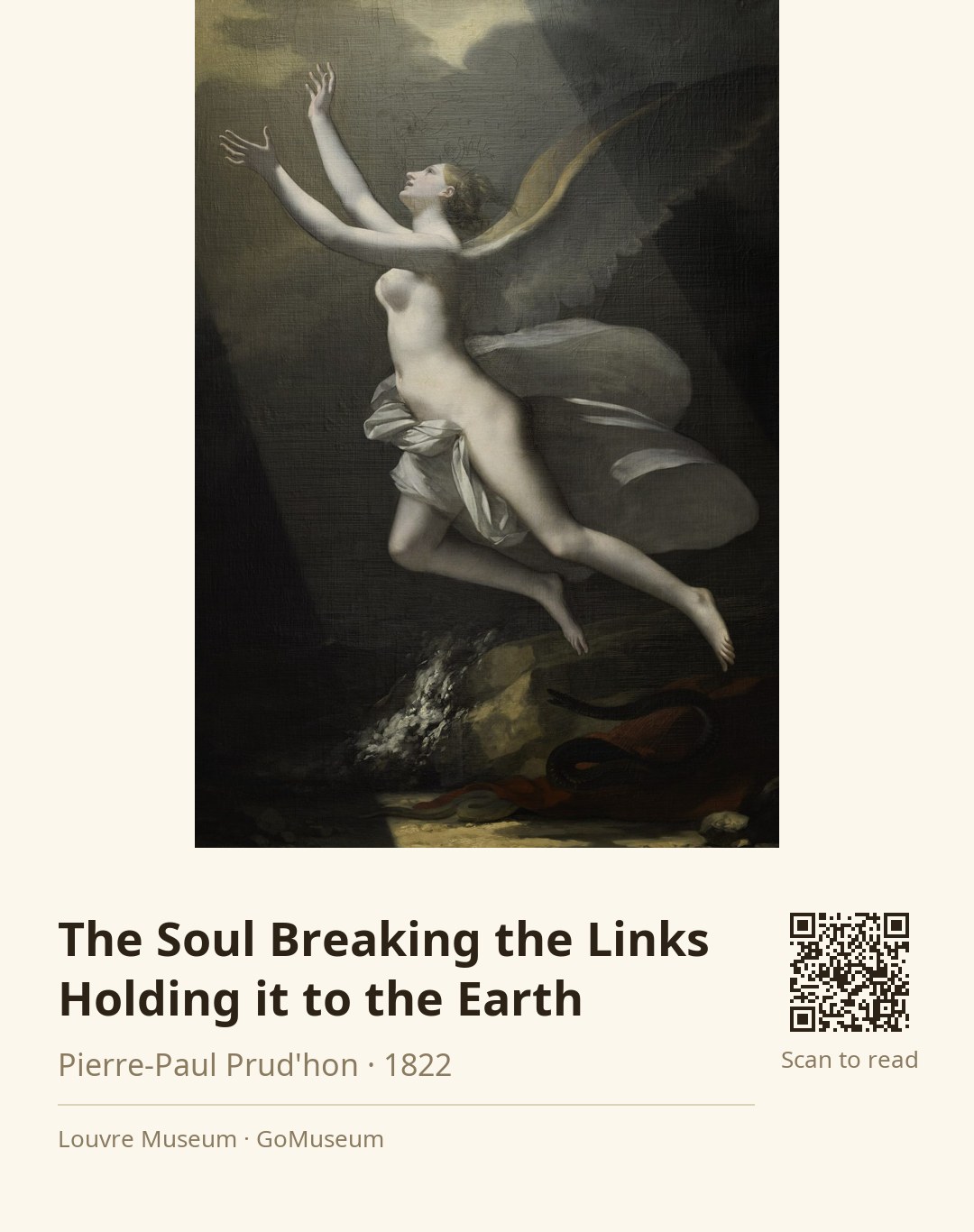
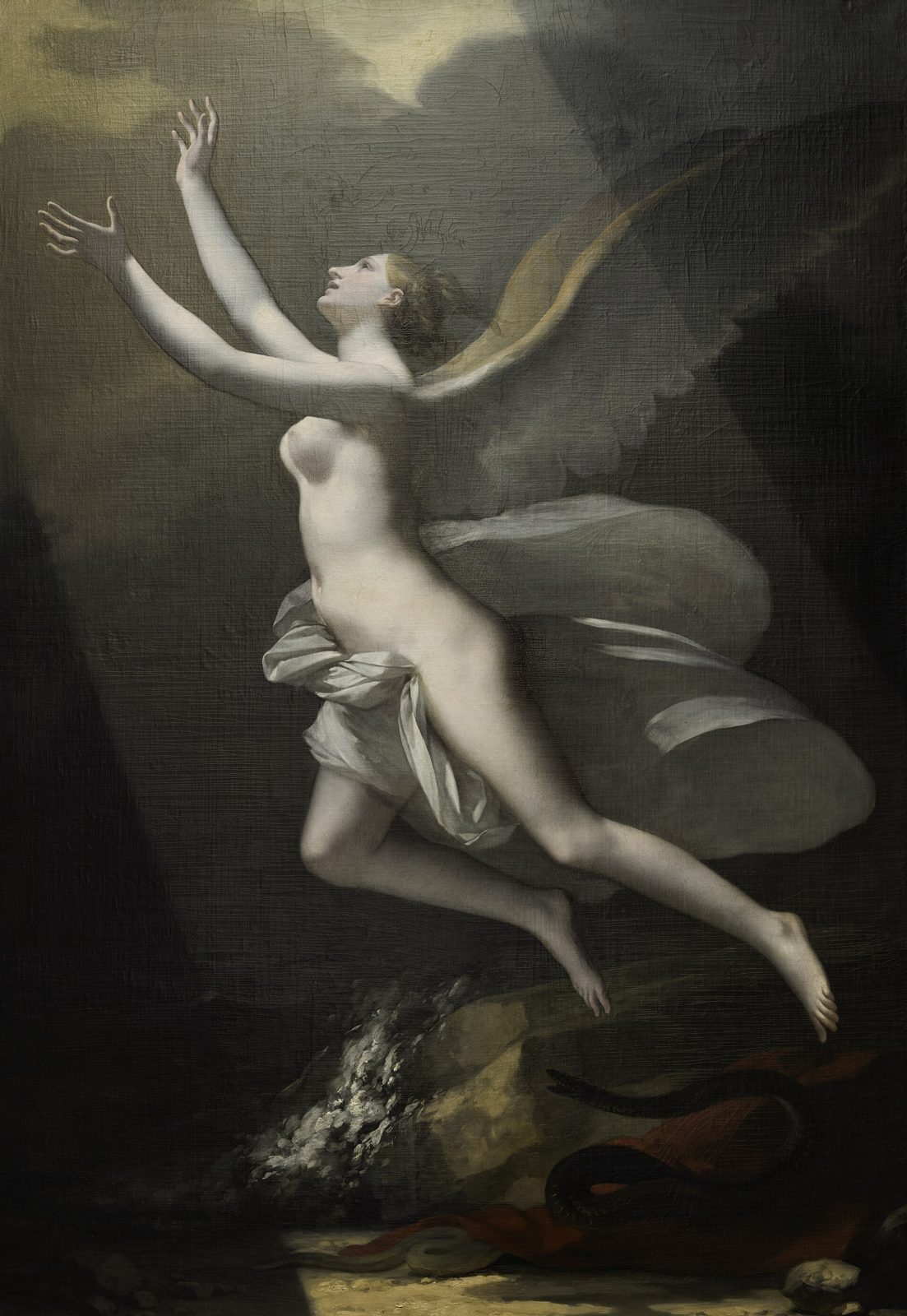
🎧 This work has audio narration — listen in the appThe nude female figure in "The Soul Breaking the Links Holding it to the Earth" soars upward, her outstretched arms and flowing white cloth suggesting both freedom and transcendence. With large wings unfurling from her back, she embodies the soul's ascent, illuminated against a dark, atmospheric background that enhances her ethereal presence. Below her, serpents coil ominously around rocks, introducing an element of danger that contrasts sharply with her serene flight.
This juxtaposition of the angelic figure and the serpents reflects the tension between the soul's liberation and the earthly ties that bind it. The muted palette of grays, whites, and earth tones emphasizes the light focused on her, creating a striking visual impact that draws the viewer into the allegorical narrative of ascension and struggle. Prud'hon's smooth brushwork captures the softness of her skin and the delicate folds of her fabric, enhancing the sense of movement as she breaks free from the constraints of the earth.
Created in 1822, this oil painting was left incomplete at Prud'hon's death in 1823.
Pierre-Paul Prud'hon was a prominent French Neo-classical painter and draughtsman, born on April 4, 1758, in Cluny, France. His artistic journey began in the provinces, where he honed his skills before moving to Paris and immersing himself in the revolutionary fervor of the time. Known for his allegorical paintings and portraits, Prud'hon gained recognition for works like the portrait of Empress Josephine, showcasing his mastery of chiaroscuro and realism.
Throughout his life, Prud'hon faced personal challenges, including a troubled marriage and the mental illness of his wife. His collaboration with artist Constance Mayer became a significant aspect of his later career, as they worked closely on various projects, often blurring the lines of authorship. Prud'hon's influence extended to future artists, notably Théodore Géricault, who admired his dramatic compositions.
Despite periods of hardship, Prud'hon's talent flourished, earning him respect among contemporaries like Stendhal and Delacroix. His work, characterized by emotional depth and technical precision, secured his place in art history, with notable pieces like "Justice and Divine Vengeance Pursuing Crime" anticipating the themes of later Romanticism. Prud'hon passed away on February 16, 1823, leaving behind a legacy that continues to inspire.
Pierre-Paul Prud'hon began painting 'The Soul Breaking the Links Holding it to the Earth' in 1821, but tragically left it unfinished when he passed away in 1823. After his death, the painting found its way into the collection of the Louvre, where it remains today. In a significant turn of events, it was declared a national treasure of France on May 19, 2018, and officially transferred to the Louvre in November 2019, marking a renewed appreciation for Prud'hon's contributions to art.
Interestingly, Prud'hon had a close working relationship with Constance Mayer, an accomplished artist herself. They collaborated on many projects, and their partnership was so intertwined that it often became difficult to distinguish where one artist's contribution ended and the other's began.
Prud'hon and Constance Mayer had a close working relationship, collaborating on many projects and often blending their contributions to the artwork.