 Image: 三猎 · VladoubidoOo
Jean de la Fontaine
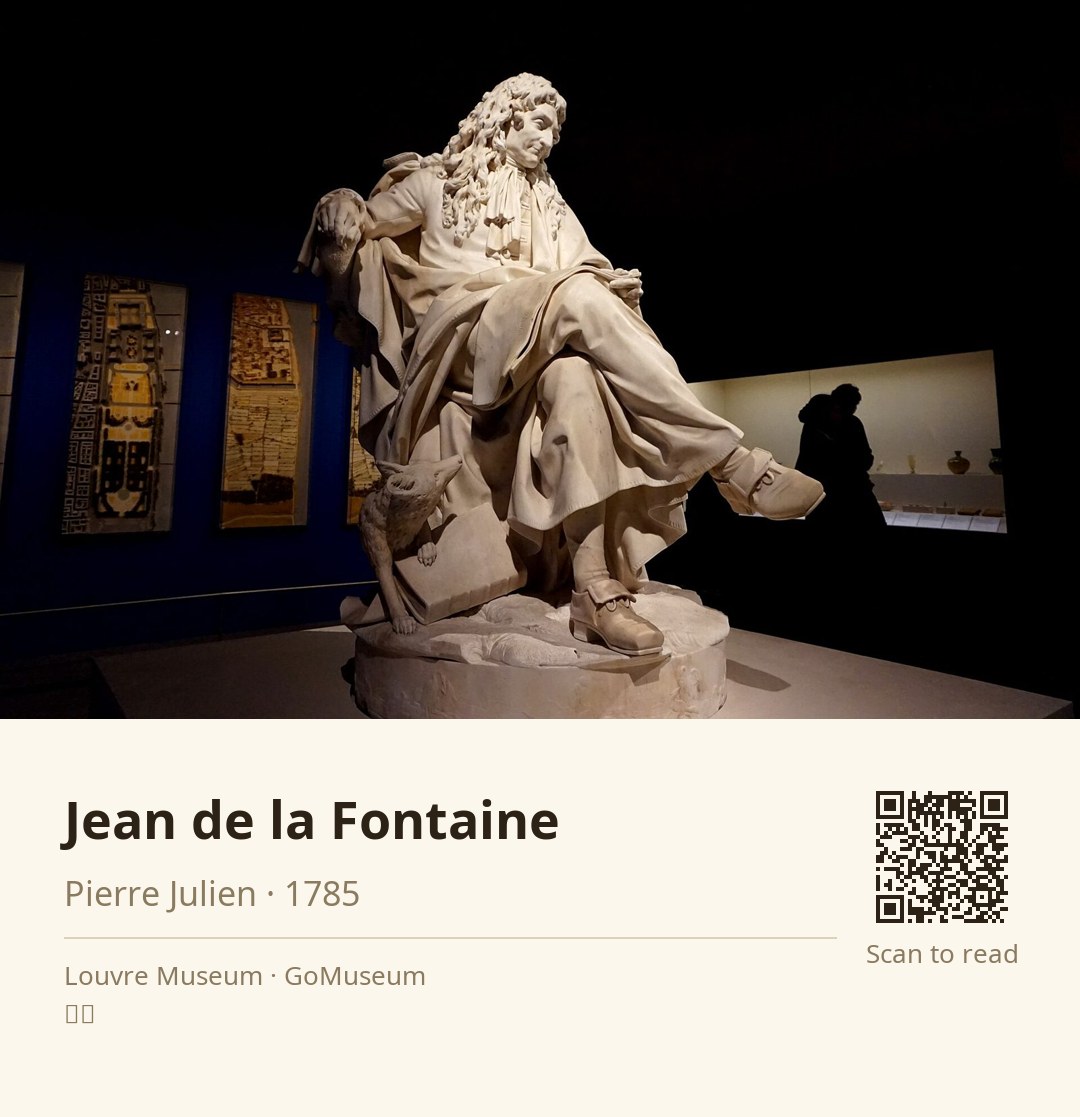
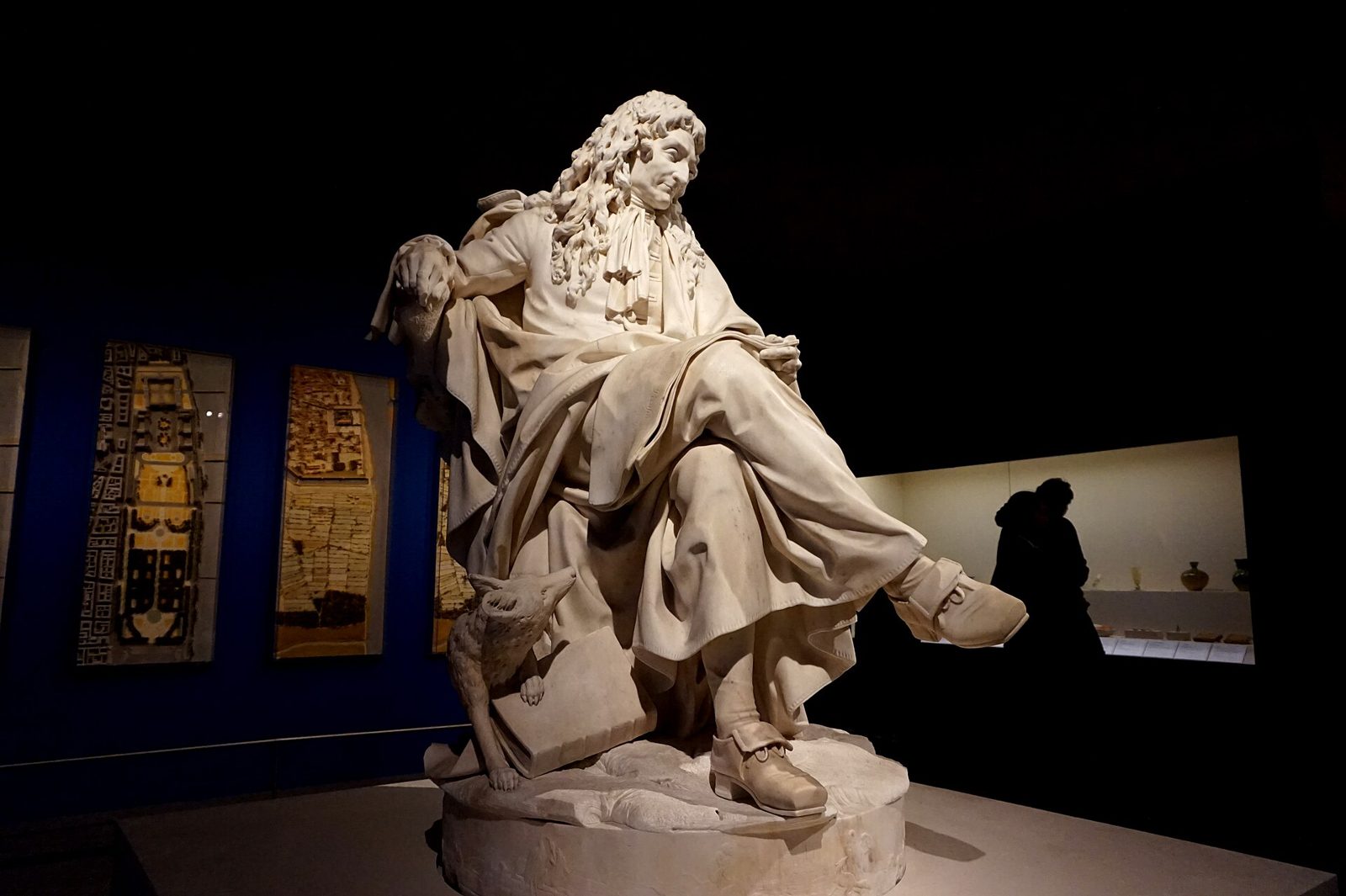
🎧 This work has audio narration — listen in the appThe seated figure in this sculpture, with its long, curly hair and flowing garments, embodies a moment of serene contemplation. One hand rests on a book, while the other casually drapes over the armrest, suggesting a connection to knowledge and introspection. At the figure's feet, a small fox gazes up, perhaps symbolizing curiosity or companionship, enhancing the narrative of this tranquil scene.
Crafted from light-colored marble, the intricate details in the folds of the clothing and the texture of the hair showcase Pierre Julien's exceptional skill as a sculptor. This work, created in 1785, reflects the neoclassical style that Julien mastered, emphasizing both elegance and naturalism. The dark background contrasts sharply with the figure, drawing attention to its delicate features and the thoughtful expression captured in the marble. Julien's ability to convey emotion through stone speaks to his training under prominent artists and his own artistic journey, which included a Prix de Rome and significant commissions from the French nobility.
Julien's work for the dairy at Rambouillet, commissioned by Marie-Antoinette, highlights his role in the decorative arts of the late 18th century, where he merged classical themes with the intimate settings of royal life.
Pierre Julien was a prominent French neoclassical sculptor born on June 20, 1731, in Saint-Paulien. His artistic journey began under the mentorship of Gabriel Samuel, leading him to study at the École de dessin in Lyon and later in Paris with Guillaume Coustou the Younger. In 1765, he won the prestigious Prix de Rome, which allowed him to immerse himself in the neoclassical movement during his time at the French Academy in Rome.
Julien's return to Paris marked the beginning of a successful career, highlighted by significant commissions from Charles Claude Flahaut, Count of Angiviller. Notable works include life-size sculptures of Jean de La Fontaine and Nicolas Poussin, as well as the decorative scheme for Marie-Antoinette's dairy at Rambouillet, featuring the celebrated figure of Amalthea. His Dying Gladiator, exhibited in 1779, garnered acclaim and solidified his reputation, although he faced initial setbacks in gaining admission to the Académie royale de peinture et de sculpture.
Throughout his life, Julien was characterized by a dedication to classical ideals and a pursuit of artistic excellence. He became a professor at the École des Beaux-Arts and was elected to the Institut de France in 1795, receiving the Légion d'Honneur shortly before his death on December 17, 1804. His works remain significant in the context of 18th-century French sculpture, with many housed in the Louvre, reflecting his lasting impact on the art world.
The intricate details are captivating; you can almost feel the soft drape of the flowing garments and the delicate curls of the hair. Julien's technique involved careful carving that brings out the texture of the fabric and the lifelike quality of the figure's expression. Each fold in the clothing seems to tell a story, while the smoothness of the marble contrasts with the detailed work, showcasing his exceptional skill as a neoclassical sculptor.
Interestingly, Julien's career was marked by a significant turning point when he initially failed to gain admission to the Académie royale de peinture et de sculpture in 1776. This setback led him to consider retirement, but he persevered and ultimately gained entry two years later with his acclaimed work, the Dying Gladiator.
During his time at the French Academy in Rome from 1768 to 1773, Julien was influenced by the neoclassical movement, which shaped his artistic style and approach.
Julien created the decorative scheme for a dairy at Rambouillet, which included various sculptures and was designed specifically for Marie-Antoinette.