Death of Sardanapalus
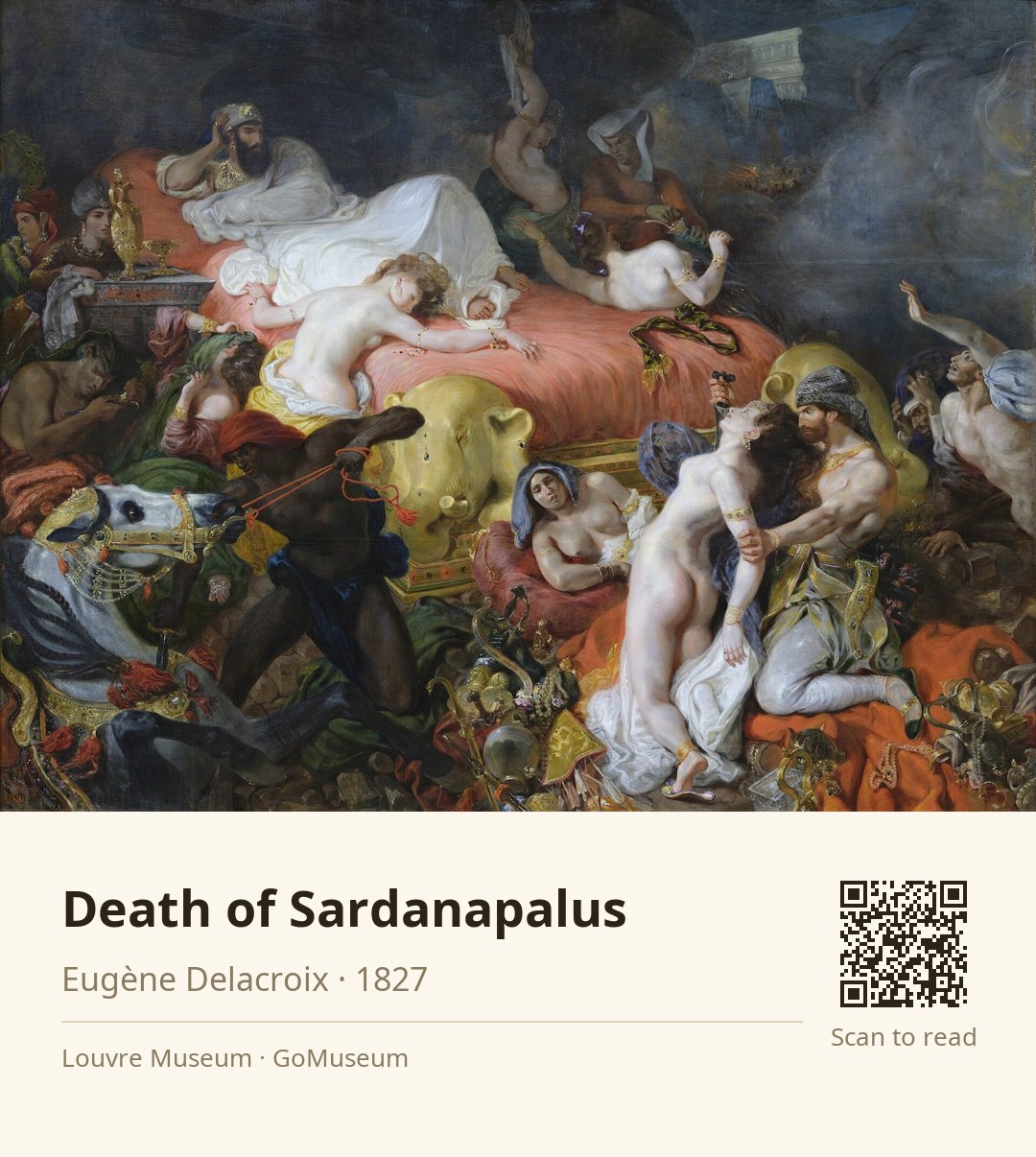
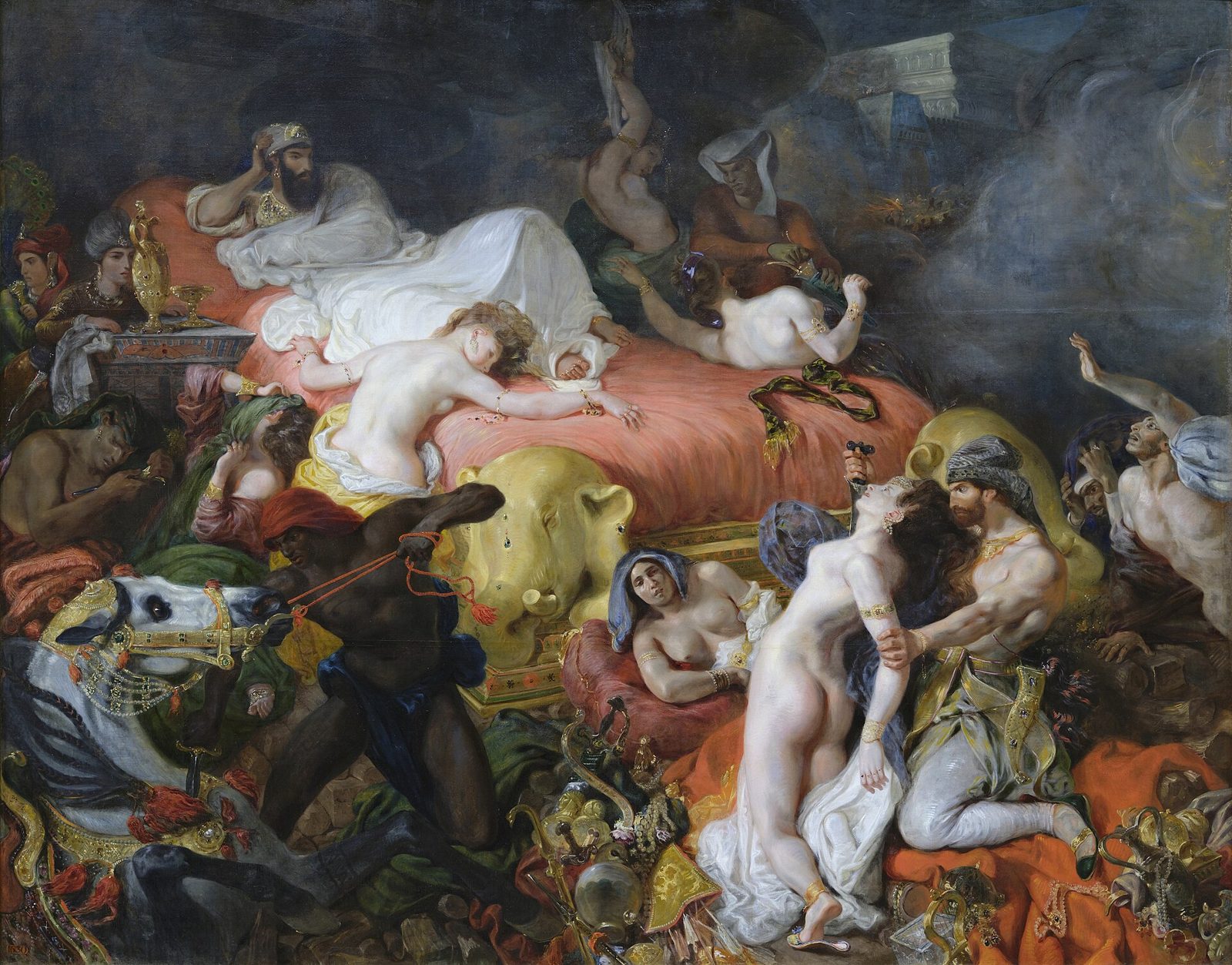
🎧 This work has audio narration — listen in the appAs you stand before Eugène Delacroix's "Death of Sardanapalus," let your eyes be drawn to the vibrant chaos unfolding on the canvas. Notice the striking red of the bed, draped luxuriously, contrasting sharply with the dark background. This isn’t just a color choice; it symbolizes both passion and violence, pulling you into the heart of the scene.
Now, take a closer look at the figure of Sardanapalus himself. He reclines on that opulent bed, dressed in flowing white, seemingly detached from the carnage around him. This disinterest is crucial—it highlights the king's apathy in the face of his own demise and the destruction of everything he holds dear. Delacroix captures a moment of tragic excess, where the king chooses to end his life amidst a whirlwind of death and despair.
Created in 1827, this painting was inspired by the dramatic tale of Sardanapalus, a king who, faced with defeat, decides to take his own life along with his treasures and loved ones. Delacroix’s work was a bold departure from the neoclassical ideals of his time, embracing the emotional and the tumultuous, which shocked audiences at its debut. Critics called it "the fanaticism of ugliness," yet it paved the way for a new artistic expression.
As you absorb this scene, consider the emotions it evokes. What does it say about power, loss, and the extremes of human experience? Delacroix invites you to reflect on the chaos of life and death, leaving you to ponder: in the face of inevitable destruction, what would you choose?
Eugène Delacroix, born on April 26, 1798, in Charenton-Saint-Maurice, emerged as a pivotal figure in the French Romantic movement. He diverged from the Neoclassical ideals of his contemporaries, such as Ingres, drawing inspiration from the vibrant colors and dynamic forms of Rubens and the Venetian Renaissance. His works, characterized by dramatic themes and a passion for the exotic, often reflected his travels in North Africa and his fascination with the sublime forces of nature, influenced by literary figures like Lord Byron.
Delacroix's career was marked by both acclaim and controversy; his early painting, "The Barque of Dante," stirred public debate but was ultimately recognized by the state. His later masterpieces, including "Liberty Leading the People," showcased his ability to blend historical and contemporary narratives, solidifying his status as a master of expressive brushwork and color theory. His innovative techniques laid the groundwork for Impressionism and inspired the Symbolist movement.
Despite personal struggles, including early orphanhood and financial hardships, Delacroix's legacy endures. He is celebrated not only for his paintings but also for his lithographs and writings, which reveal his artistic philosophy. As one of the last old masters, his influence resonates through art history, marking him as a cornerstone of Romanticism and a precursor to modern artistic movements. Delacroix passed away on August 13, 1863, leaving a profound impact on the art world.
Eugène Delacroix's 'Death of Sardanapalus' was unveiled in 1827 at the Paris Salon, a pivotal moment that would ignite both admiration and outrage. Commissioned as a bold statement against the prevailing neoclassical ideals, the painting drew inspiration from Lord Byron's 1821 play, which recounts the tragic end of the Assyrian king Sardanapalus. The work's dramatic portrayal of chaos and excess was a stark departure from the restrained aesthetics of the time. Critics were quick to pounce, with one famously dubbing it 'the fanaticism of ugliness.' Despite the controversy, the painting found its home in the Musée du Louvre, where it has remained a cornerstone of Romantic art.
As you gaze at 'Death of Sardanapalus,' notice how Delacroix's brushwork breathes life into the chaos. The painterly strokes create a sense of movement, pulling your eye across the canvas, from the vibrant red of the bed to the stark white of Sardanapalus's robe. The asymmetrical composition, while seemingly chaotic, maintains a balance that draws you into the tumult. Delacroix's use of rich, warm colors—especially the striking reds and golds—contrasts sharply with the darker background, enhancing the emotional intensity of the scene. The figures are rendered with a sense of realism, their expressions and postures conveying the urgency and despair of their plight. The way light dances across the bodies and the opulent objects scattered throughout the scene creates a visual rhythm that mirrors the unfolding drama. This isn’t just a painting; it’s a visceral experience, inviting you to feel the weight of the moment as Sardanapalus contemplates his fate amidst the carnage.
This painting boldly defies the Neoclassical ideals of order and restraint, instead plunging the viewer into a whirlwind of color and violence. Its influence rippled through the art world, inspiring not just painters but also composers like Hector Berlioz and Franz Liszt, who found in Delacroix's dramatic scenes a muse for their own works. The painting's audacious portrayal of a king's self-immolation, surrounded by the carnage of his court, challenges the viewer's sensibilities and invites a visceral reaction. Delacroix's expressive brushwork and vivid palette paved the way for the Impressionists, who would later embrace the emotional power of color and movement. Remember this: Delacroix didn't just paint a scene; he ignited a revolution in how art could express the tumult of human experience.
One intriguing anecdote about 'Death of Sardanapalus' is that its dramatic and chaotic composition was so polarizing that it led to a heated debate among critics and audiences alike. Some viewed it as a disturbing portrayal of violence and excess, while others hailed it as a groundbreaking work that broke free from traditional constraints. This division in opinion was so pronounced that it sparked discussions about the role of art in society and the responsibilities of artists, making Delacroix's work not just a visual spectacle, but a catalyst for broader conversations about morality and aesthetics in art.
Delacroix was influenced by the vibrant color palettes of the Venetian Renaissance and the expressive brushwork of Rubens, which he sought to emulate in his own work, allowing him to convey intense emotions and movement.
The painting's bold departure from neoclassical norms and its emotional intensity had a profound impact on the Impressionists and Symbolists, who admired Delacroix's emphasis on color and movement.
The painting sparked a heated debate at the 1827 Paris Salon, with critics divided; some condemned it as a disturbing display of violence while others praised it as a revolutionary work that challenged traditional artistic conventions.