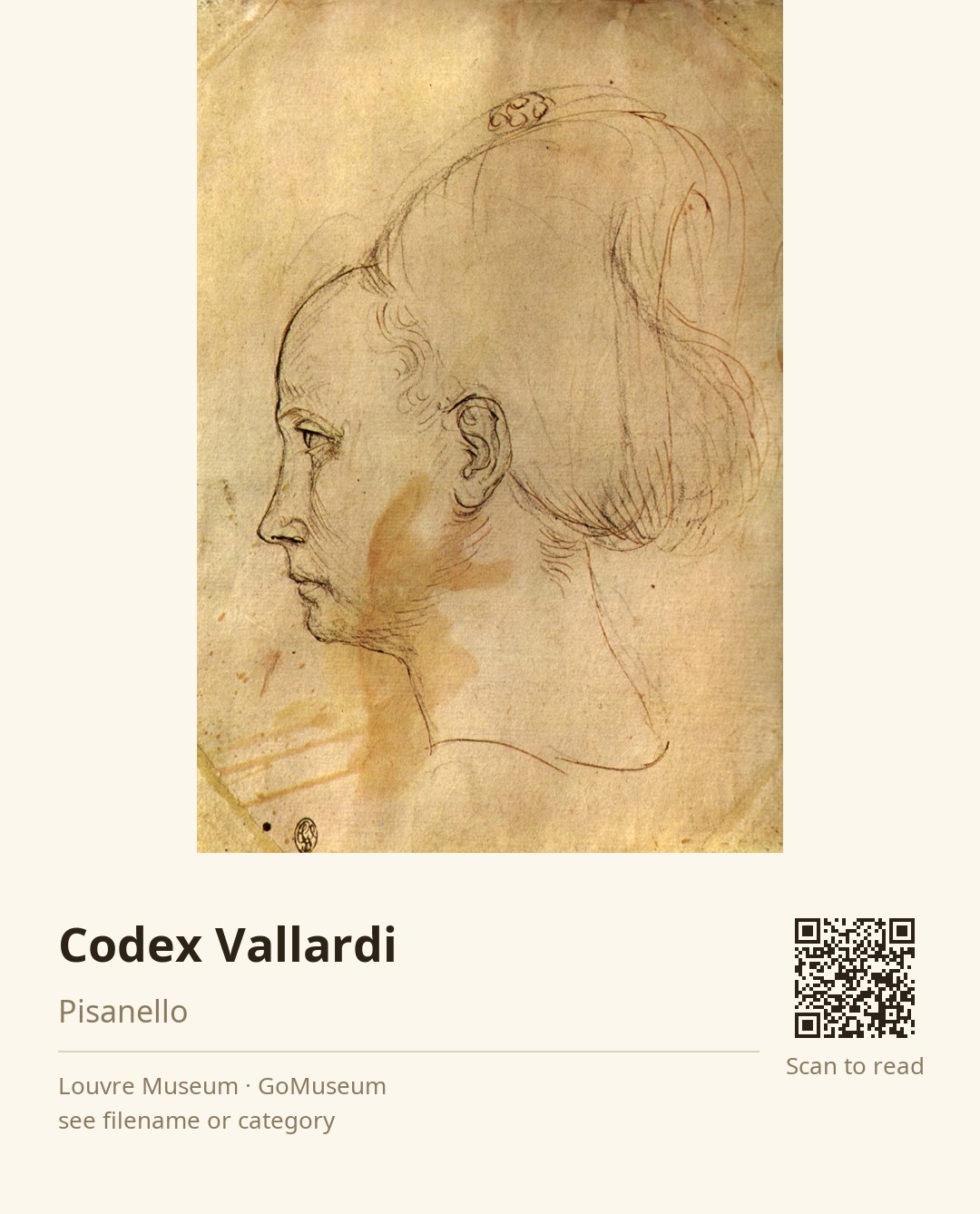
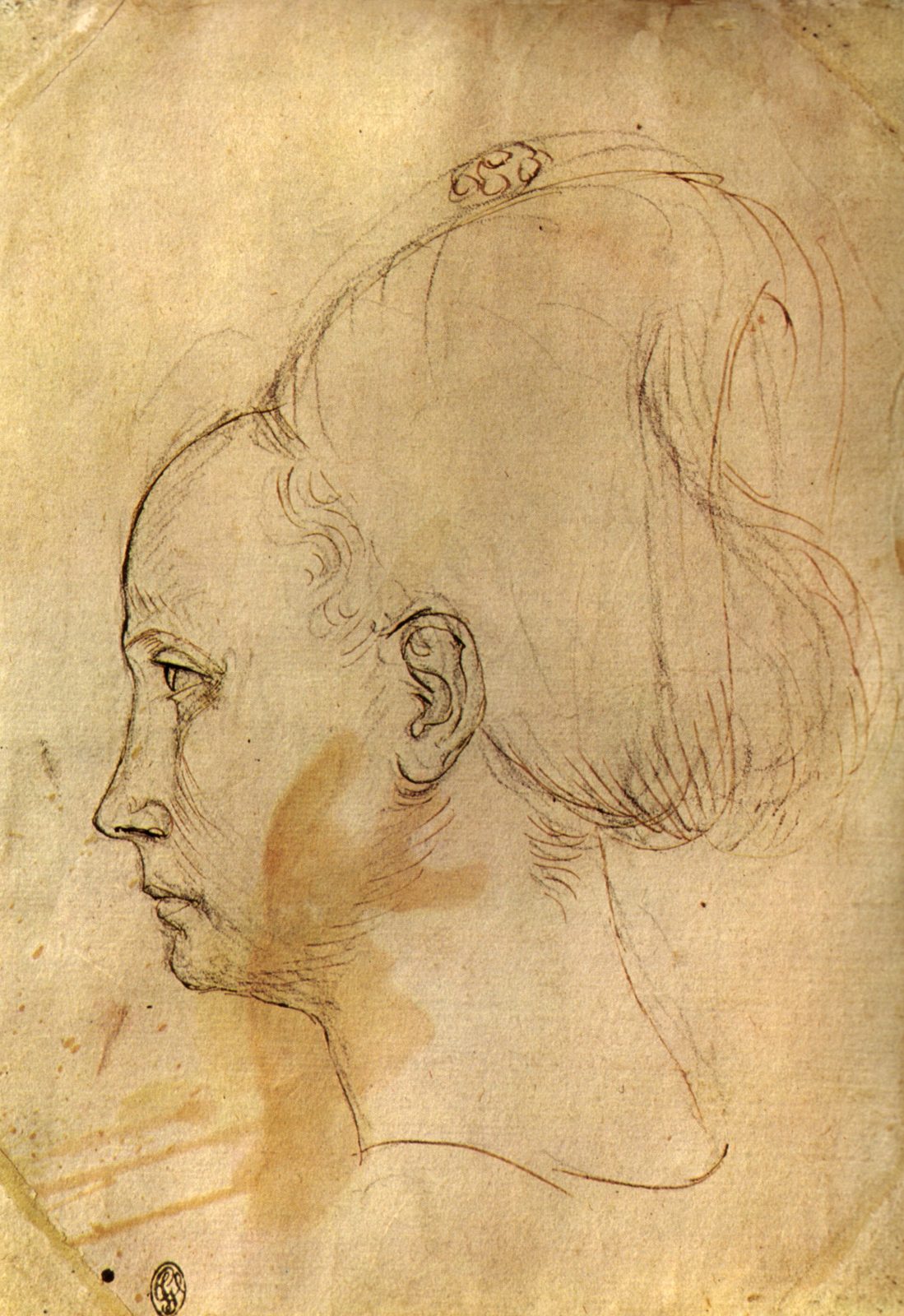
 Image: see filename or category
Codex Vallardi
🎧 This work has audio narration — listen in the appAs you stand before the Codex Vallardi, let your eyes wander over the intricate details of Pisanello's drawings. Notice how the delicate lines capture the elegance of the figures, their garments flowing with an almost lifelike quality. Each stroke feels like a whisper from the past, inviting you into a world where art and life intertwine.
These drawings are not mere sketches; they are autonomous works of art that showcase Pisanello's mastery of form and texture. The way he depicts the ornate hats and flowing fabrics of his time reveals a keen understanding of both fashion and the human experience. This attention to detail matters because it transports us to the 15th century, allowing us to glimpse the lives and aspirations of those who wore such finery.
Pisanello, active during the early Italian Renaissance, was celebrated for his ability to blend realism with a touch of fantasy. His work was so revered that it was often misattributed to other greats like Leonardo da Vinci. The Codex Vallardi, acquired by the Louvre in 1856, is a testament to his enduring legacy, containing 378 folios that reflect his artistic journey.
As you take in this collection, think about the stories these drawings could tell. What do you imagine the people depicted here were feeling or dreaming about? Let your imagination roam through the pages of history, and consider how Pisanello's vision continues to resonate with us today.
Pisanello, born Antonio di Puccio Pisano around 1380-1395 in Pisa or Verona, was a pivotal figure in early Italian Renaissance art. Renowned for his exquisite frescoes, portraits, and pioneering medallic work, he became a celebrated artist among contemporaries, earning comparisons to greats like Cimabue and Phidias. His career flourished in the courts of Venice, the Vatican, and various Italian city-states, where he was esteemed by the Gonzaga and Este families.
Trained under Gentile da Fabriano, Pisanello developed a refined style characterized by intricate detail and vibrant color. His drawings, often seen as standalone masterpieces rather than preparatory sketches, showcase a keen observation of nature and fashion. Despite the loss of many of his works, his surviving pieces, particularly in medallic art, reveal a deep understanding of form and beauty.
Pisanello's influence waned as the Renaissance evolved, yet he remained a crucial link between Gothic and early Renaissance styles. His legacy endures through the few surviving drawings and medals, which continue to inspire admiration for their elegance and precision.
The Codex Vallardi, a remarkable collection of drawings, was acquired by the Louvre in March 1856 for a hefty sum of 35,000 gold francs. This transaction was orchestrated by Frédéric Reiset, who played a crucial role in restoring the work's rightful attribution to Pisanello, correcting the widespread misattribution to Leonardo da Vinci. Prior to its acquisition, the Codex was owned by Giuseppe Vallardi, a Milanese print dealer and antiquarian, who recognized its significance. The purchase not only enriched the Louvre's collection but also sparked renewed interest in Pisanello's work, which had been overshadowed by his more famous contemporaries. The Codex Vallardi stands as a testament to Pisanello's enduring legacy, inviting viewers to explore the elegance of the 15th century through his eyes.
The drawings reflect not only his artistic prowess but also his keen interest in the natural world, featuring studies of animals and plants that reveal his meticulous attention to detail. This aspect of his work showcases how he blended art with the scientific observation of his surroundings, a practice that was quite innovative for his time.
Unlike many artists who used sketches as preparatory studies for larger works, Pisanello's drawings in the Codex Vallardi are considered autonomous pieces of art, showcasing his refined style and attention to detail as complete works in their own right.