 Image: Seudo
Niobid krater
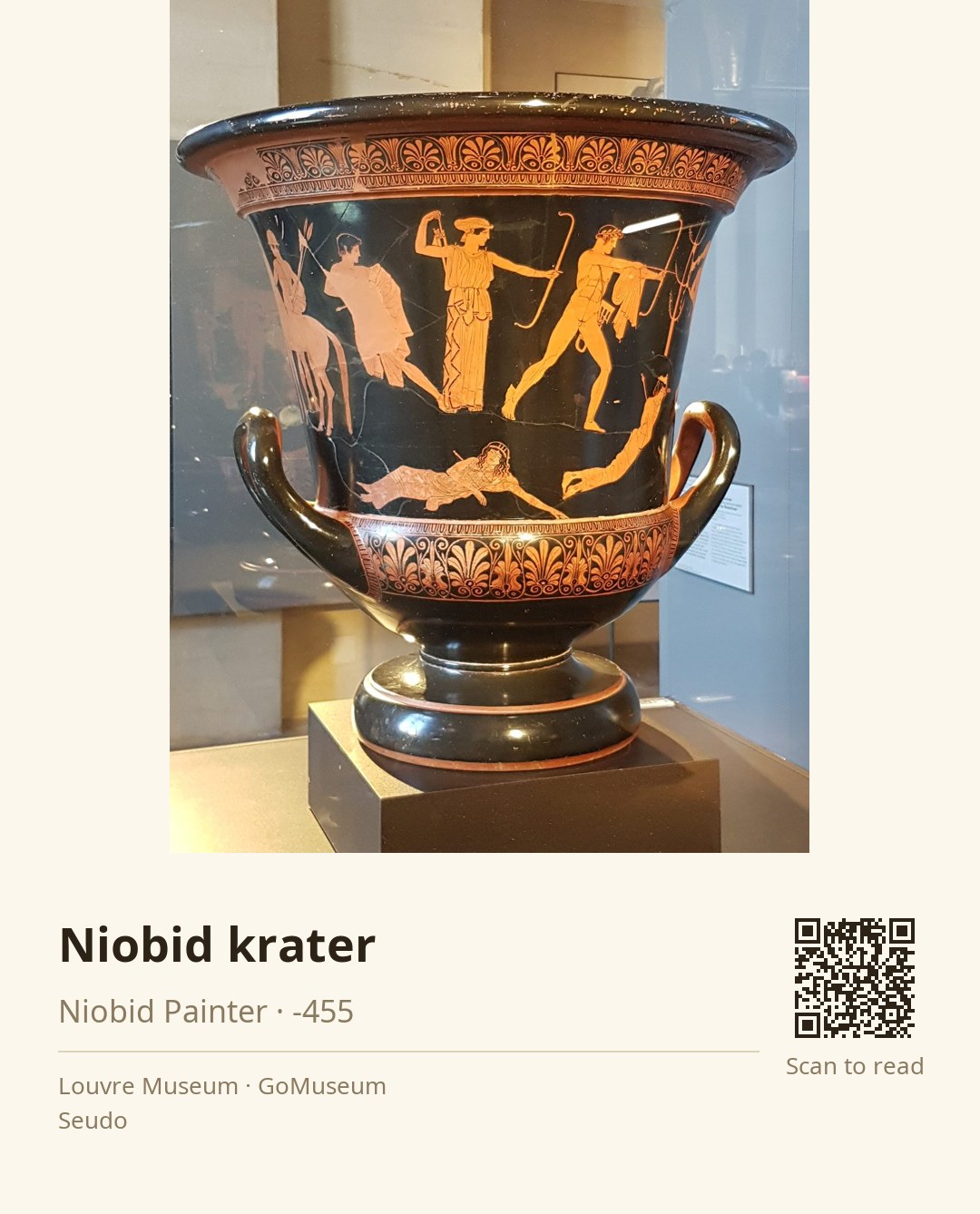
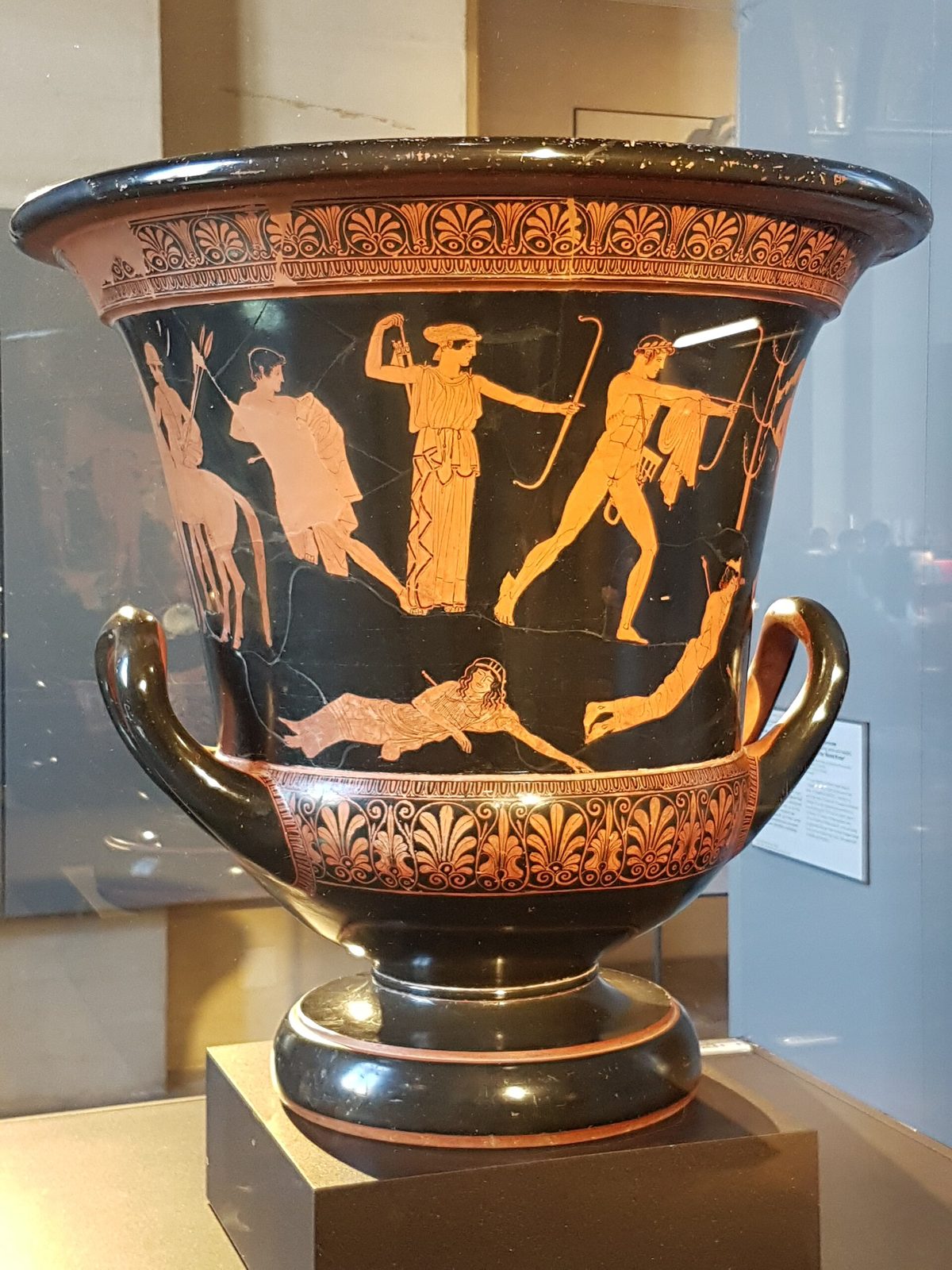
🎧 This work has audio narration — listen in the appThe centaur on the Niobid Krater captures a moment of tension, its human torso merging seamlessly with the powerful horse body, embodying the duality of nature and civilization. Next to it, a draped figure holds a staff, while a nude male figure appears to be in motion, suggesting a narrative unfolding before us. The glossy black background enhances the vivid red of the figures, creating a striking contrast that draws the eye and emphasizes their dynamic poses.
This krater, created around 455 BC by the Niobid Painter, illustrates the rarely depicted massacre of the Niobids, where Apollo and Artemis exact vengeance on Niobe’s children for her hubris. The implied presence of a body, suggested by a single arrow in the corner, marks a significant innovation in vase painting, hinting at the violence without showing it directly. The artist also experimented with depth, layering the figures in a way inspired by contemporary wall paintings, a technique that did not become widespread in vase art.
The Niobid Painter was active in Athens during a period when vase painting was evolving, and his work reflects both the technical advancements and the dramatic narratives that captivated audiences of the time.
The Niobid Painter was an influential ancient Athenian vase painter active around 470 to 450 BC, renowned for his mastery of the red-figure technique. His work is epitomized by the Niobid Krater, which depicts the tragic story of Niobe's children being slain by Apollo and Artemis, a rare theme in Greek art. This krater, housed in the Louvre, showcases his innovative approach to depicting depth and space, inspired by contemporary wall paintings. The artist often favored scenes of Amazonomachy and was known for his distinctive three-quarter-view faces. His legacy continued through his student Polygnotos, who adopted and further developed his style. The Niobid Painter's contributions mark a significant moment in the evolution of vase painting, blending narrative complexity with technical skill, and his works remain celebrated for their artistic and historical significance.
The Niobid Krater, created around 455 BC by the Niobid Painter, is a fascinating artifact from ancient Athens. Commissioned during a time when vase painting was undergoing significant evolution, this krater showcases a dramatic narrative rarely depicted in Greek art: the massacre of Niobe’s children by Apollo and Artemis. The krater was likely displayed in a symposium setting, where wine was mixed and stories shared, enhancing its role as both a functional object and a storytelling medium. Its provenance traces back to the Louvre in Paris, where it remains a centerpiece of their collection, captivating audiences with its intricate details and the weight of its narrative.
One intriguing aspect of the Niobid Krater is the uncertainty surrounding the figures depicted on side A. While Heracles and Athena are recognizable, the identities of the other figures remain a mystery, leading to various hypotheses. Some scholars suggest they might represent the Argonauts awaiting favorable winds, while others propose they could be Athenian soldiers seeking divine protection before the Battle of Marathon. This ambiguity adds a layer of intrigue, inviting viewers to ponder the stories behind the imagery and the choices made by the artist.
The figures on side A are intriguing because their identities are uncertain, leading to various hypotheses about who they might represent, which adds an element of mystery to the artwork.
The Niobid Krater innovatively implies the presence of a body without actually depicting it, which was a significant departure from traditional vase painting techniques.