Drapery Study for the Virgin
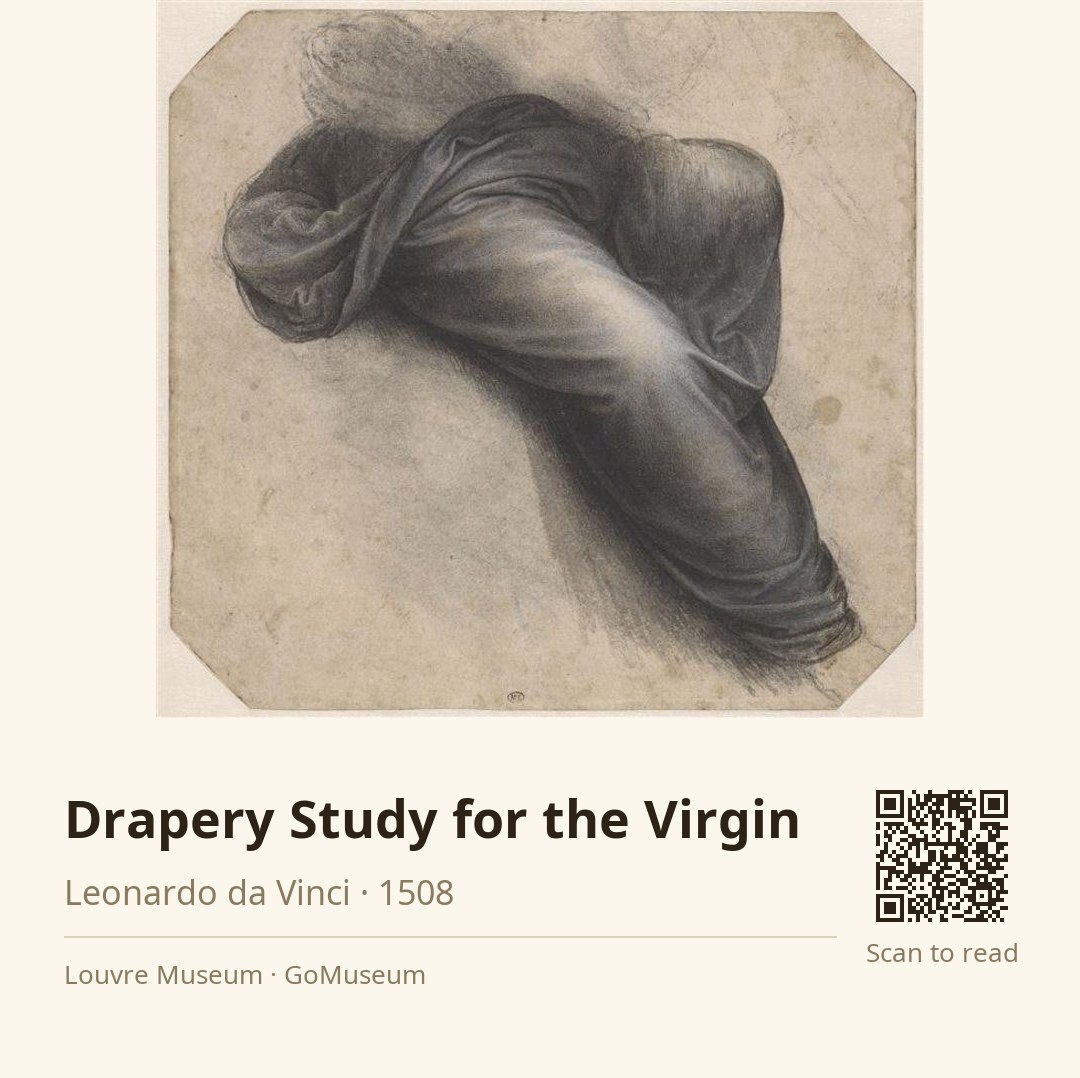
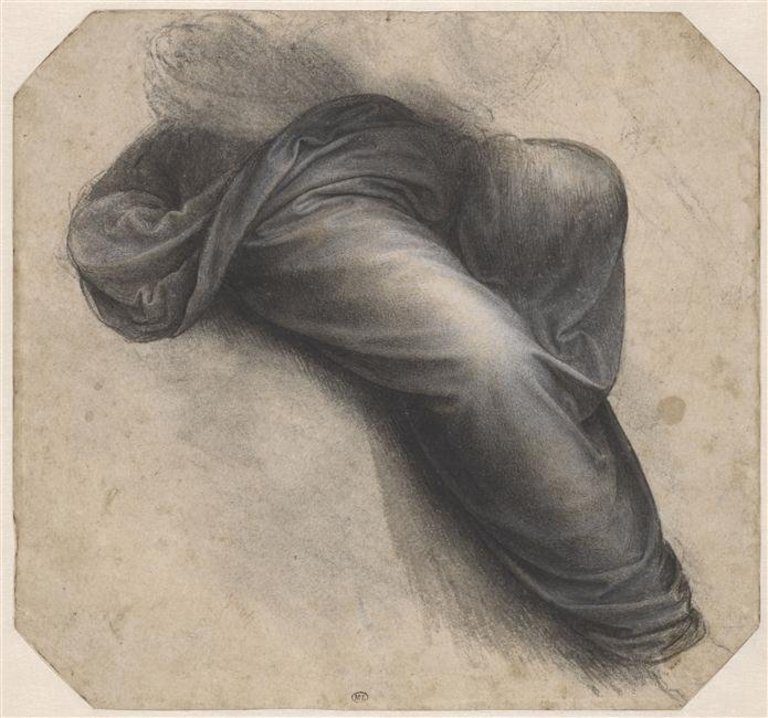
🎧 This work has audio narration — listen in the appTake a moment to really look at this drawing, "Drapery Study for the Virgin" by Leonardo da Vinci. Notice the way the fabric flows, almost as if it’s alive, wrapping around the figure’s legs. The delicate interplay of light and shadow, created with charcoal and ink, gives it a three-dimensional quality that draws you in.
This study isn’t just a sketch; it’s a glimpse into his meticulous process as he prepared for a larger work, "The Virgin and Child with Saint Anne." Each fold and crease in the fabric is a testament to his evolving mastery, showcasing how he captured the essence of cloth in a way that feels both natural and divine.
Leonardo was in his late fifties when he created this, during a prolific period in Milan, where he was juggling multiple commissions and ideas. Despite his famed reluctance towards painting, he was deeply engaged in refining his techniques, and this study is a prime example of that dedication.
As you stand here, think about the countless hours Leonardo spent perfecting this drapery. What do you think he was trying to convey through the fabric? How does it make you feel about the Virgin Mary, the figure it represents?
Leonardo da Vinci, born on April 15, 1452, in Vinci, Italy, was a quintessential figure of the High Renaissance, renowned for his multifaceted genius as a painter, scientist, and inventor. Raised by his grandparents after being born out of wedlock, he received artistic training under Andrea del Verrocchio in Florence. His career flourished in Milan under Ludovico Sforza, where he produced iconic works like "The Last Supper" and began his extensive studies in anatomy and engineering.
Leonardo's notebooks reveal a relentless curiosity, encompassing subjects from botany to mechanics, showcasing his innovative spirit. Despite creating fewer than 25 major works, his influence on Western art is profound, with the "Mona Lisa" standing as a cultural icon. His visionary designs for flying machines and other inventions, though largely unfeasible in his time, reflect a forward-thinking approach that laid groundwork for future scientific exploration.
In his later years, he moved to France, where he continued to work until his death in 1519. Leonardo's legacy endures as a symbol of the Renaissance ideal, blending art and science, and inspiring generations with his empirical observations and artistic mastery. His life and work remain a testament to the boundless potential of human creativity.
Leonardo da Vinci created the 'Drapery Study for the Virgin' between 1507 and 1517, during a vibrant period of his life in Milan. This drawing was part of his preparation for the larger painting 'The Virgin and Child with Saint Anne,' which he had begun around 1502-1503. The study showcases Leonardo's meticulous approach to capturing the essence of drapery, a skill he honed over decades. The drawing has been housed in the Louvre, where it has been admired for its intricate detail and technical finesse. Over the years, it has been the subject of scholarly debate regarding its dating and purpose, with some suggesting it served as a life-sized prototype for the final painting. The drawing's journey through history reflects Leonardo's enduring legacy and the high regard in which he was held by his contemporaries and future generations alike.
In this drawing, Leonardo employs a mix of charcoal, Indian ink, and gray wash, with highlights of ceruse white to create a striking contrast against the yellowed, black-tinted paper. Notice how the brushwork feels both delicate and dynamic, capturing the way fabric flows and wraps around the figure's legs. The shading techniques he uses give the drapery a three-dimensional quality, almost as if you could reach out and touch it. The composition is carefully structured; the outstretched right leg and the bent left leg create a sense of movement and tension.
This drawing, executed with a blend of charcoal and ink, showcases Leonardo's innovative techniques that would influence generations of artists. The way he captures the flow and texture of fabric set a new standard for depicting drapery in painting. Artists who followed him, from the Baroque masters to the Impressionists, would draw inspiration from his meticulous studies, pushing the boundaries of realism. This piece exemplifies how a simple study can ripple through art history, shaping the way we understand movement and form in the visual arts. Remember, this isn't just a study; it's a pivotal moment in the evolution of artistic technique.
One intriguing aspect of the 'Drapery Study for the Virgin' is its uncertain dating. While many scholars agree on a range between 1507 and 1517, some suggest it could have been created as late as 1516-1517, close to Leonardo's death. This ambiguity highlights the complexity of his working process and the evolution of his style, as he continually refined his techniques even in his later years.
Leonardo's use of charcoal, Indian ink, and gray wash, along with highlights of ceruse white, demonstrates his experimentation with different media to achieve depth and texture. This combination allowed him to create a striking contrast and a sense of realism in the drapery, showcasing his evolving mastery of technique even in his later years.